Text to imageArt stylesStyle guide
One Pink Blossom · Silk Ribbon Embroidery
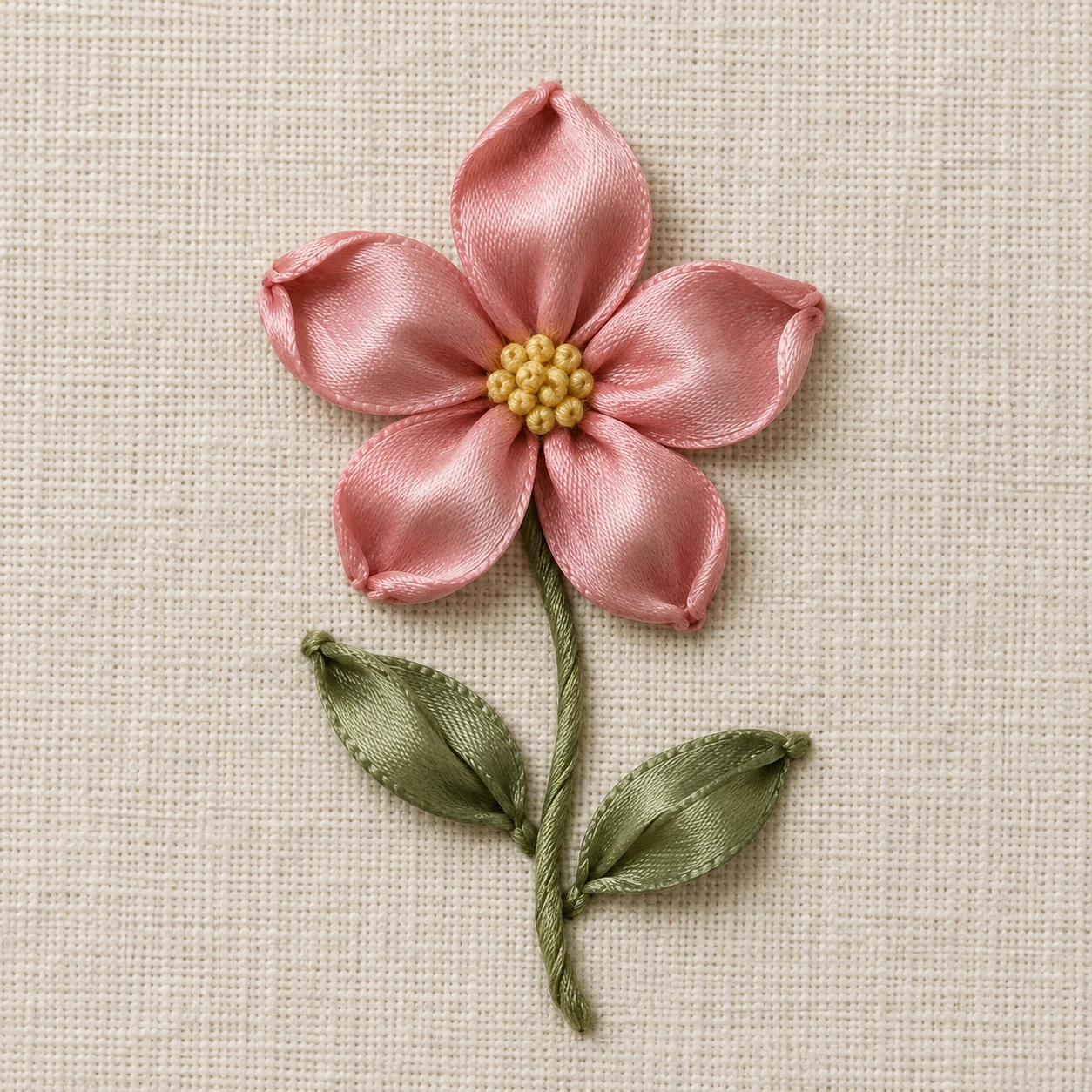
Silk ribbon embroidery that builds five dimensional petals through broad ribbon folds and soft satin highlights.
One Pink Blossom · Silk Ribbon Embroidery
- Shape & line
- Construct each of the five petals from a broad pink ribbon loop that emerges beside the yellow center, arches outward, and returns to the cloth at its tip; show folded edges and slight differences in petal curvature instead of drawn outlines.
- Color & light
- Use dusty pink petals, a warm yellow center, and muted green foliage on cream linen; illuminate from the upper-left image side so the raised ribbon ridges carry soft pale highlights and their lower-right sides cast small shadows onto the cloth.
- Texture & material
- Give the silk ribbon a smooth satin sheen that follows its bends, retaining visible creases where petals fold; make the linen visibly woven and matte, and build the flower center from a compact cluster of rounded yellow thread knots.
- Composition
- Keep all five petal tips readable around the center, allowing only small overlaps near their roots; curve the stem gently downward and angle the two leaves away from it, preserving open linen gaps between the leaves and flower.
Priority
Prioritize the raised, folded ribbon construction that makes each petal visibly dimensional.
What to avoid & what to check
Avoid painted petal gradients, flat fabric cutouts, and glossy plastic surfaces.
Check that ribbon folds, satin highlights, and shadows on the linen together explain the raised petals.
Exact prompt for this example
SUBJECT
One pink five-petaled blossom embroidered in silk ribbon, with a small yellow knotted center, one green stem, and two ribbon leaves, all attached to a cream linen ground.

COMPOSITION
Use a close, nearly overhead view of the entire blossom and stem. Place the flower above the image center, with the stem extending toward the lower edge and one leaf on each side. Leave a generous linen margin around the embroidery.

STYLE GUIDE
1. Shape & line
Construct each of the five petals from a broad pink ribbon loop that emerges beside the yellow center, arches outward, and returns to the cloth at its tip; show folded edges and slight differences in petal curvature instead of drawn outlines.

2. Color & light
Use dusty pink petals, a warm yellow center, and muted green foliage on cream linen; illuminate from the upper-left image side so the raised ribbon ridges carry soft pale highlights and their lower-right sides cast small shadows onto the cloth.

3. Texture & material
Give the silk ribbon a smooth satin sheen that follows its bends, retaining visible creases where petals fold; make the linen visibly woven and matte, and build the flower center from a compact cluster of rounded yellow thread knots.

4. Composition
Keep all five petal tips readable around the center, allowing only small overlaps near their roots; curve the stem gently downward and angle the two leaves away from it, preserving open linen gaps between the leaves and flower.

PRIORITY
Preserve the requested identity, count, action, composition and output settings. Apply the style rules within those constraints; a style reference must not replace the subject or layout. Within the style: Prioritize the raised, folded ribbon construction that makes each petal visibly dimensional.

AVOID
Avoid painted petal gradients, flat fabric cutouts, and glossy plastic surfaces.

OUTPUT
Create one square image showing a finished textile artwork, with no lettering, labels, or watermark.

SELF-CHECK
Check that ribbon folds, satin highlights, and shadows on the linen together explain the raised petals.
Model information comes from image provenance. The same prompt may produce a different result.