Text to imageSpace & architectureStyle guide
Narrow Hall · Ceiling-Bounced Indirect Light
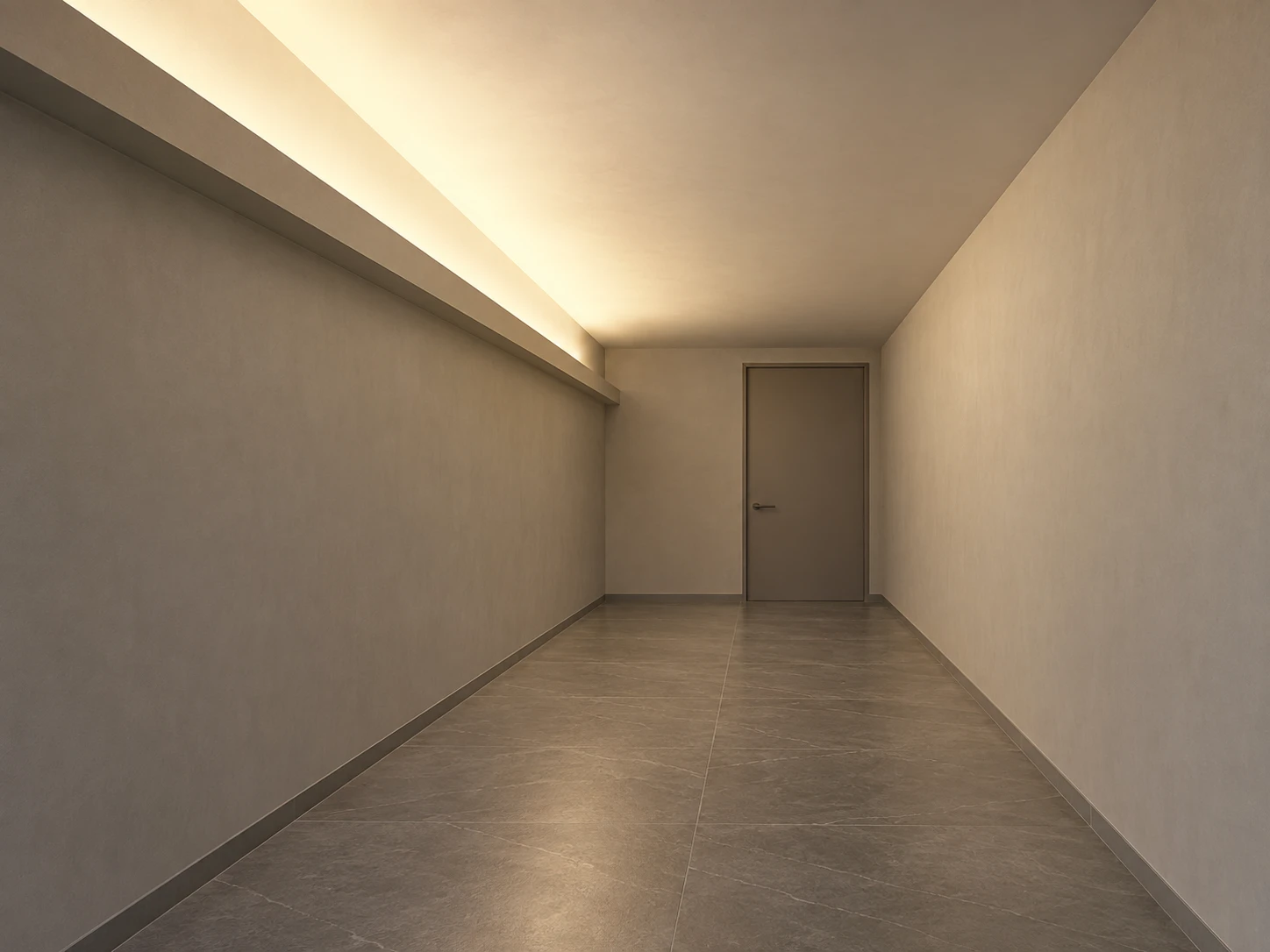
Reveal a narrow hall’s height and depth through the brightness gradient created by a concealed ceiling-edge light.
Narrow Hall · Ceiling-Bounced Indirect Light
- Shape & line
- Keep wall corners and door jambs vertical, and make the ceiling and floor edges converge consistently toward the far door. Draw the image-left lighting ledge as a shallow, continuous horizontal projection whose upper lip conceals the source from the entrance viewpoint.
- Color & light
- Place the brightest warm ivory wash on the ceiling immediately above the image-left ledge, then soften and dim it toward image-right. Let reflected light gently illuminate the opposite wall and floor; keep the ledge underside darker so the upward lighting path remains visible.
- Texture & material
- Use matte pale plaster on the ceiling and walls so the light forms a broad, smooth gradient. Give the gray stone floor a restrained, diffuse sheen and broad slab joints; keep surface texture subtle enough that it does not break the ceiling wash into speckles.
- Composition
- Let the illuminated ceiling occupy roughly the upper third of the frame, with the left ledge leading the eye toward the far door. Preserve a clear strip of the darker left wall beneath it and a generous foreground floor area, making the ceiling glow the dominant spatial cue.
Priority
Prioritize the visible ceiling gradient and the concealed upward light path.
What to avoid & what to check
Avoid an exposed glowing strip, hard downward spotlight pools or uniformly bright surfaces.
Check that the ceiling is brightest above the left ledge and fades toward the right while the source stays concealed.
Exact prompt for this example
SUBJECT
One short, empty rectangular hallway with a closed door at the far end and one continuous recessed lighting ledge along the image-left wall, just below the ceiling. The ledge hides an upward-facing light source that illuminates the ceiling above it.

COMPOSITION
One eye-level architectural view from the hallway entrance, looking toward the far door. Include the image-left ledge, the full ceiling width, both wall-to-floor junctions and enough foreground floor to read the enclosure. Keep the far door slightly right of center.

STYLE GUIDE
1. Shape & line
Keep wall corners and door jambs vertical, and make the ceiling and floor edges converge consistently toward the far door. Draw the image-left lighting ledge as a shallow, continuous horizontal projection whose upper lip conceals the source from the entrance viewpoint.

2. Color & light
Place the brightest warm ivory wash on the ceiling immediately above the image-left ledge, then soften and dim it toward image-right. Let reflected light gently illuminate the opposite wall and floor; keep the ledge underside darker so the upward lighting path remains visible.

3. Texture & material
Use matte pale plaster on the ceiling and walls so the light forms a broad, smooth gradient. Give the gray stone floor a restrained, diffuse sheen and broad slab joints; keep surface texture subtle enough that it does not break the ceiling wash into speckles.

4. Composition
Let the illuminated ceiling occupy roughly the upper third of the frame, with the left ledge leading the eye toward the far door. Preserve a clear strip of the darker left wall beneath it and a generous foreground floor area, making the ceiling glow the dominant spatial cue.

PRIORITY
Preserve the requested identity, count, action, composition and output settings. Apply the style rules within those constraints; a style reference must not replace the subject or layout. Within the style: Prioritize the visible ceiling gradient and the concealed upward light path.

AVOID
Avoid an exposed glowing strip, hard downward spotlight pools or uniformly bright surfaces.

OUTPUT
One landscape image in a 4:3 aspect ratio, rendered as a realistic architectural visualization with no text, labels, logos or watermark.

SELF-CHECK
Check that the ceiling is brightest above the left ledge and fades toward the right while the source stays concealed.
Model information comes from image provenance. The same prompt may produce a different result.