Text to imageProductStyle guide
Crank Desk Fan
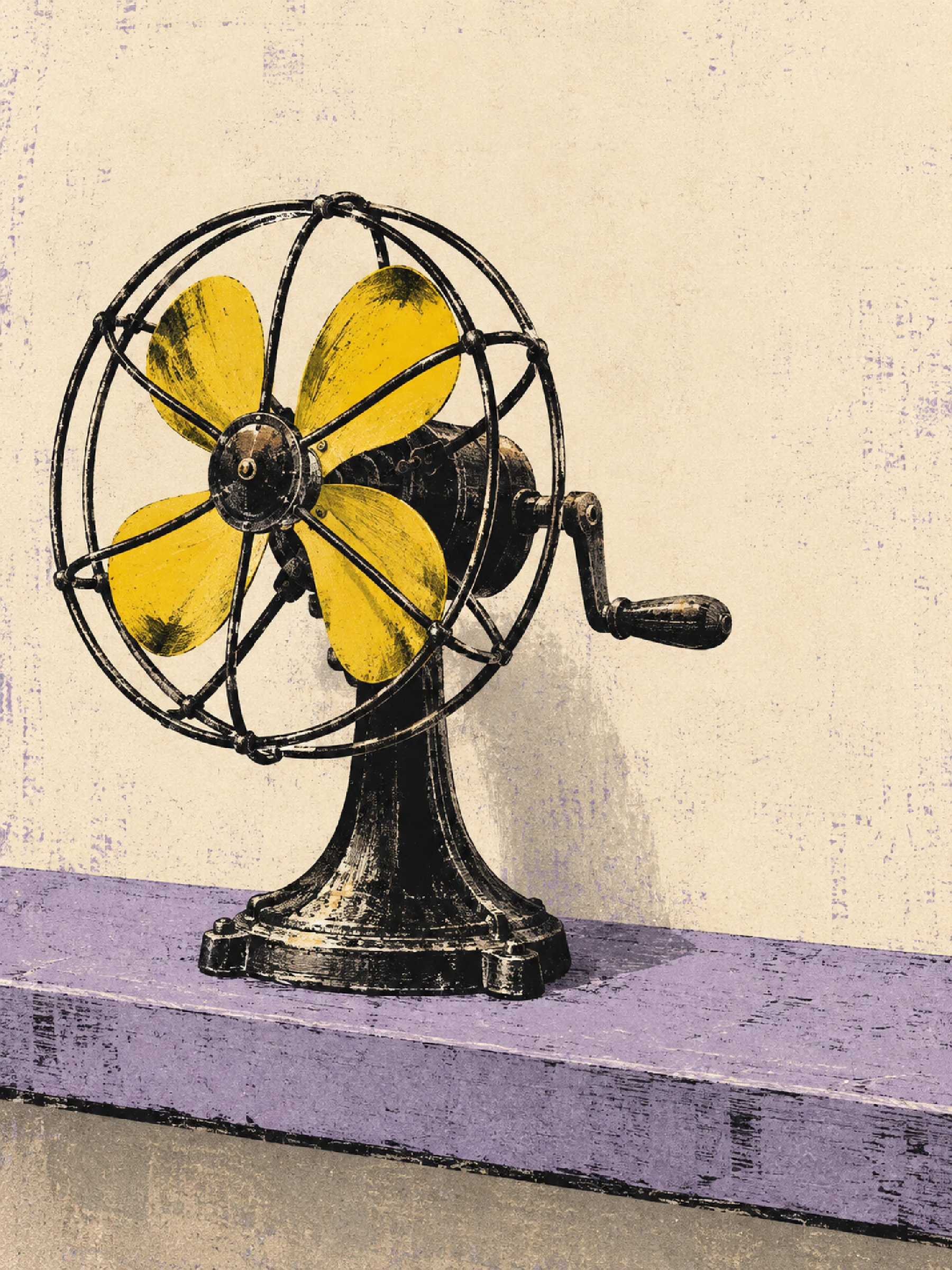
An original hand-cranked desk fan with a curved iron frame and broad blades, staged off-center in an experimental poster illustration of dragged ink and imperfect overprinting.
Remix this referenceCrank Desk Fan
- Form language
- Reduce volumes into asymmetric curved slabs and blunt wedges, retaining useful apertures as expressive negative shapes.
- Contour
- Use heavy, slightly ragged outer ink edges and sparse broken interior lines; let thickness fluctuate with pressure.
- Mark-making
- Combine broad scraper-dragged ink strokes with coarse stamped patches, allowing natural skips and modest overprint misregistration.
- Surface rendering
- Build tone through overlapping translucent ink passes and wiped pale passages, mixing abrupt print boundaries with occasional soft bleeds.
Priority
Make the image feel physically inked and printed.
What to avoid & what to check
Avoid uniform vector edges with a texture overlay.
Dragged ink and overprinting visibly shape the image.
Exact prompt for this example
MODULE OWNERSHIP
subject: Subject count, type, stable proportions and landmarks, resting face geometry, hair shape, physical materials, garment construction and permanent marks. No emotion, movement, color assignment or rendering recipe.
expression: Facial soft-tissue displacement and pupil direction, muscle coordination, regional intensity, asymmetry and onset/peak/release. No head/body pose, stable appearance, skin color or rendering.
gesture: Head/neck/body/limb orientation, joint movement, support, contact and pose-caused occlusion using existing anatomy. No eye/pupil movement, emotion, identity, props inventory or camera.
props: Prop count, type, construction, physical material and scale relative to the subject. Holding/contact belongs to gesture, position to composition, color to palette.
scene: Environment elements, terrain, backdrop/floor presence and structural detail. No canvas positions, camera, lighting, assigned colors or render texture.
camera: Projection, focal-length impression, camera elevation/yaw/roll, viewing distance and crop. No actor pose, world placement, lighting or canvas aspect ratio.
composition: Normalized 0-100% canvas positions, scale in frame, depth/overlap, focal hierarchy and margins. No joint pose, camera projection, rendering, subject/prop inventory or emotion.
palette: Color anchors, hue/saturation/value ranges, colors assigned to parts and approximate color coverage. No illumination direction, shading algorithm, physical material or layout.
lighting: Light-source direction/softness/intensity, ambient illumination, physical shadow direction/length and highlight position. Absence of directional illumination is allowed. No shading technique, palette or material changes.
style: Reusable form abstraction, contour weight/taper/edge quality, medium and mark scale/density/direction, surface rendering and tonal transition technique. No fixed subject proportions, anatomy, identity, expression, pose, palette, light-source direction, camera or layout.
output: Image count, aspect ratio, size, file/alpha requirements and global lettering/logo/watermark restrictions. No background scenery, crop, style, identity or pose.

SUBJECT
inventory: One original hand-cranked desk fan, unbranded and entirely mechanical.
geometry: A broad circular guard sits on a narrow arched pedestal, with leaf-shaped blades and a short side crank.
resting-face: No facial geometry applies.
appearance: Bent iron guard spars, pressed aluminum blades and a cast-metal base; minor fabrication irregularities may vary.

PRIORITY
Keep the mechanical silhouette distinctive and believable.

AVOID
Avoid anthropomorphic facial features.

CHECK
The crank clearly identifies manual operation.

PROPS
inventory: No separate props.
construction: No prop construction applies.

PRIORITY
Keep the separate prop inventory empty.

AVOID
Avoid lifestyle accessories.

CHECK
No separate accessories appear.

SCENE
inventory: A shallow display shelf against a plain wall; no surrounding room furnishings.
structure: The shelf has a substantial front lip and meets the wall without additional architectural decoration.

PRIORITY
Give the product a simple architectural setting.

AVOID
Avoid a busy workshop interior.

CHECK
The shelf and wall remain the only environmental elements.

CAMERA
projection: Restrained perspective with a normal-lens impression.
viewpoint: View from slightly above the product, at a front three-quarter angle revealing the crank side.
crop: Include the whole fan and base, while allowing the shelf to continue beyond the frame.

PRIORITY
Show the guard depth and side mechanism together.

AVOID
Avoid exaggerated wide-angle distortion.

CHECK
The crank is visible beside the circular guard.

COMPOSITION
placement: Place the fan around 34% width and 57% height; the shelf occupies the lower portion of the canvas.
depth: The guard overlaps the blades, the pedestal overlaps the wall, and the shelf front supplies a secondary depth cue.
spacing: Keep generous open space above and to the right, with the complete product occupying roughly half the image height.

PRIORITY
Balance the dense product with spacious poster rhythm.

AVOID
Avoid centering the fan like a catalog cutout or enclosing the artwork in a mockup border.

CHECK
The open area feels intentional beside the focal product.

PALETTE
colors: Use warm ivory, dense ink black, sharp citron yellow and subdued lavender.
assignment: Assign ivory to the wall, black to the frame and base, citron to the blades, and lavender to the shelf.
balance: Ivory supplies the largest color field; black concentrates visual weight, with yellow as the primary accent.

PRIORITY
Let the yellow blades punctuate the dark structure.

AVOID
Avoid adding decorative accent hues.

CHECK


LIGHTING
sources: A broad soft source illuminates from the upper left, supported by modest ambient light.
shadows: The base casts a short shadow toward the rear right; guard shadows remain soft and subordinate.
highlights: Small highlights follow the upper-left guard rim and the exposed blade shoulders.

PRIORITY


AVOID
Avoid glossy showroom light streaks.

CHECK
The base feels grounded by its visible shadow.

STYLE GUIDE
form-language: Reduce volumes into asymmetric curved slabs and blunt wedges, retaining useful apertures as expressive negative shapes.
contour: Use heavy, slightly ragged outer ink edges and sparse broken interior lines; let thickness fluctuate with pressure.
mark-making: Combine broad scraper-dragged ink strokes with coarse stamped patches, allowing natural skips and modest overprint misregistration.
surface-rendering: Build tone through overlapping translucent ink passes and wiped pale passages, mixing abrupt print boundaries with occasional soft bleeds.

PRIORITY
Make the image feel physically inked and printed.

AVOID
Avoid uniform vector edges with a texture overlay.

CHECK
Dragged ink and overprinting visibly shape the image.

OUTPUT
format: One portrait image, 3:4 aspect ratio, 1800 × 2400 pixels, opaque PNG.
restrictions: No lettering, logos, signatures or watermarks.

PRIORITY
Deliver one complete image at the specified export size.

AVOID
Avoid process annotations.

CHECK
The export presents one complete artwork.

FINAL INTEGRATION
subject + camera + composition + style: Preserve product recognition as the image simplifies and dramatizes its forms.
scene + palette + lighting + style: Keep environmental depth compatible with the print treatment; preserve color-anchor clarity through ink overlaps and reveal volume without overpowering the print.
Model information comes from image provenance. The same prompt may produce a different result.