Text to imageComicsStyle guide
Kite Tail in a Stone Lion’s Mouth
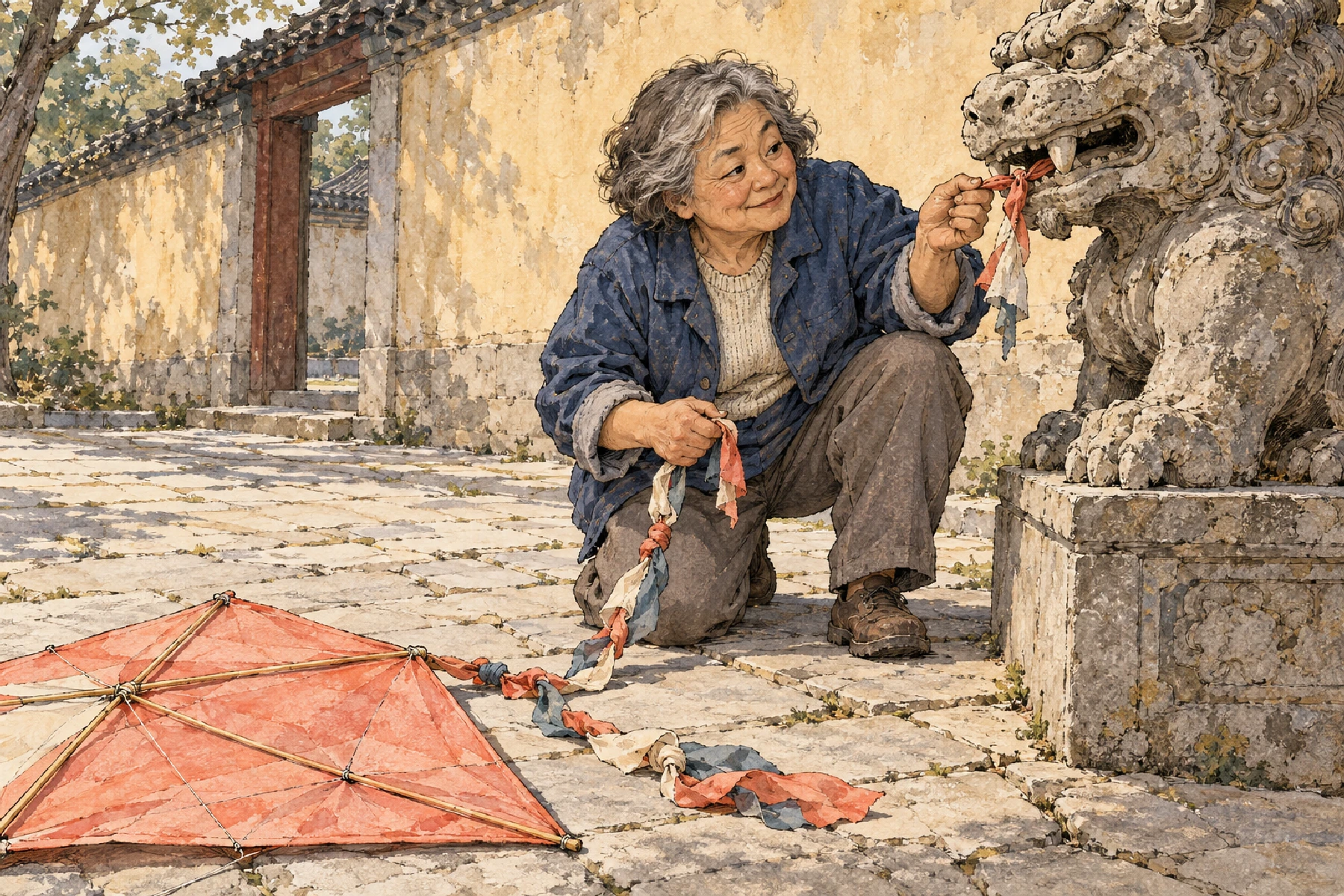
A crouching woman frees a kite tail caught on a stone lion’s tooth. Rough pen strokes and bleeding watercolor washes bring a small struggle into a spacious courtyard.
Remix this referenceKite Tail in a Stone Lion’s Mouth
- Form language
- Build forms from blunt, irregular masses and selective angular shortcuts; keep small descriptive shapes loose within a coherent vocabulary.
- Contour
- Use scratchy dip-pen contours with pressure swells, abrupt breaks and occasional searching double lines; edges should retain the hesitation of a hand.
- Mark-making
- Gather short oblique hatches into uneven bursts, then leave passages quiet; stray nib flicks and variable spacing preserve an independent-comic immediacy.
- Surface rendering
- Float transparent watercolor over and beyond the ink; let puddled rims, blooms and dry skips interrupt broad tonal washes instead of smoothing every transition.
Priority
Rendering medium: Rough independent-comic dip-pen and watercolor-wash illustration on paper.
What to avoid & what to check
Exact prompt for this example
MODULE OWNERSHIP
subject: Subject count, type, stable proportions and landmarks, resting face geometry, hair shape, physical materials, garment construction and permanent marks. No emotion, movement, color assignment or rendering recipe.
expression: Facial soft-tissue displacement and pupil direction, muscle coordination, regional intensity, asymmetry and onset/peak/release. No head/body pose, stable appearance, skin color or rendering.
gesture: Head/neck/body/limb orientation, joint movement, support, contact and pose-caused occlusion using existing anatomy. No eye/pupil movement, emotion, identity, props inventory or camera.
props: Prop count, type, construction, physical material and scale relative to the subject. Holding/contact belongs to gesture, position to composition, color to palette.
scene: Environment elements, terrain, backdrop/floor presence and structural detail. No canvas positions, camera, lighting, assigned colors or render texture.
camera: Projection, focal-length impression, camera elevation/yaw/roll, viewing distance and crop. No actor pose, world placement, lighting or canvas aspect ratio.
composition: Normalized 0-100% canvas positions, scale in frame, depth/overlap, focal hierarchy and margins. No joint pose, camera projection, rendering, subject/prop inventory or emotion.
palette: Color anchors, hue/saturation/value ranges, colors assigned to parts and approximate color coverage. No illumination direction, shading algorithm, physical material or layout.
lighting: Light-source direction/softness/intensity, ambient illumination, physical shadow direction/length and highlight position. Absence of directional illumination is allowed. No shading technique, palette or material changes.
style: Reusable form abstraction, contour weight/taper/edge quality, medium and mark scale/density/direction, surface rendering and tonal transition technique. No fixed subject proportions, anatomy, identity, expression, pose, palette, light-source direction, camera or layout.
output: Image count, aspect ratio, size, file/alpha requirements and global lettering/logo/watermark restrictions. No background scenery, crop, style, identity or pose.

SUBJECT
inventory: One original human character, A: an older woman.
geometry: A has a compact, sturdy build, broad hands, a square face and a short, softly waved bob.
resting-face: Wide-set eyes, low straight brows, a gently hooked nose and a broad mouth define her resting features.
appearance: She wears a loose canvas work jacket over a knitted shirt, roomy trousers and soft leather shoes.

PRIORITY


AVOID


CHECK


EXPRESSION — ACTOR A
brows: One brow lifts slightly while the other stays low.
lids: Lower lids rise gently; the eyes remain visibly open.
cheeks: A small cheek lift is stronger beside the raised mouth corner.
nose: The nostrils remain relaxed without a nose wrinkle.
mouth: Closed lips curl upward at one corner in a restrained, crooked smile.
jaw: The jaw stays relaxed with the teeth together.
gaze: Pupils turn toward the cloth caught on the stone tooth.
coordination: The uneven brow and mouth lifts combine into quiet amusement.
timing: Hold the apex of the small smile while her attention stays on the snag.

PRIORITY


AVOID


CHECK


GESTURE
head: A extends her neck slightly and tips her chin down toward her working hand.
torso: She crouches low, leaning forward with a slight turn through the shoulders.
limbs: One knee rests on the paving and the opposite foot plants firmly; both elbows stay loosely bent.
contact: Her left fingertips lift the tail off the tooth while her right hand gathers a slack loop beside her hip.

PRIORITY


AVOID


CHECK


PROPS
inventory: One diamond-shaped kite, roughly as long as A’s torso, with an attached long cloth tail.
construction: Thin bamboo spars support a paper sail; loose cloth knots interrupt the supple tail.

PRIORITY


AVOID


CHECK


SCENE
inventory: A quiet paved courtyard with one stone guardian lion, its low plinth and a tall plaster boundary wall.
structure: The worn lion has open carved jaws and a projecting tooth; a shallow gateway recess interrupts the wall.

PRIORITY


AVOID


CHECK


CAMERA
projection: Natural perspective with a restrained normal-lens impression.
viewpoint: View from crouched eye height at a gentle three-quarter yaw, with no camera roll.
crop: A medium-wide view includes A’s whole figure, the complete kite and the lion with its plinth.

PRIORITY


AVOID


CHECK


COMPOSITION
placement: Group A and the lion around 70% across the canvas; let the kite spread low near 40% across.
depth: The kite occupies the foreground, A overlaps the plinth, and the wall recedes behind their shared plane.
spacing: Make face, fingers and snag the focal cluster; the tail bridges to the kite across generous open paving.

PRIORITY
Use one continuous scene without panel divisions or speech balloons.

AVOID


CHECK


PALETTE
colors: Use soot black, warm ivory, dusty indigo, muted coral and pale ochre, mostly at low saturation.
assignment: Assign indigo to the jacket, coral to the kite, ochre to the wall, warm gray to stone and warm brown to skin.
balance: Ivory and pale neutrals dominate; the smaller coral accent answers the deeper indigo mass.

PRIORITY


AVOID


CHECK


LIGHTING
sources: Broad, soft daylight arrives from upper left, supported by gentle courtyard ambient light.
shadows: Soft-edged shadows extend moderately toward lower right, with deeper contact shade beneath the plinth.
highlights: Quiet highlights touch upper-left-facing forehead, knuckles and the lion’s muzzle.

PRIORITY


AVOID


CHECK


STYLE GUIDE
form-language: Build forms from blunt, irregular masses and selective angular shortcuts; keep small descriptive shapes loose within a coherent vocabulary.
contour: Use scratchy dip-pen contours with pressure swells, abrupt breaks and occasional searching double lines; edges should retain the hesitation of a hand.
mark-making: Gather short oblique hatches into uneven bursts, then leave passages quiet; stray nib flicks and variable spacing preserve an independent-comic immediacy.
surface-rendering: Float transparent watercolor over and beyond the ink; let puddled rims, blooms and dry skips interrupt broad tonal washes instead of smoothing every transition.

PRIORITY
Rendering medium: Rough independent-comic dip-pen and watercolor-wash illustration on paper.

AVOID


CHECK


OUTPUT
format: One finished image, landscape 3:2, 1800 × 1200 pixels, opaque PNG.
restrictions: No lettering, logos or watermarks.

PRIORITY


AVOID


CHECK


FINAL INTEGRATION
expression + gesture + composition: Let the facial acting and hand contact remain legible together within the focal grouping.
style + palette + lighting: Let wash variation carry the color and light decisions while preserving spontaneous pen marks.
Model information comes from image provenance. The same prompt may produce a different result.