Text to imageArt stylesStyle guide
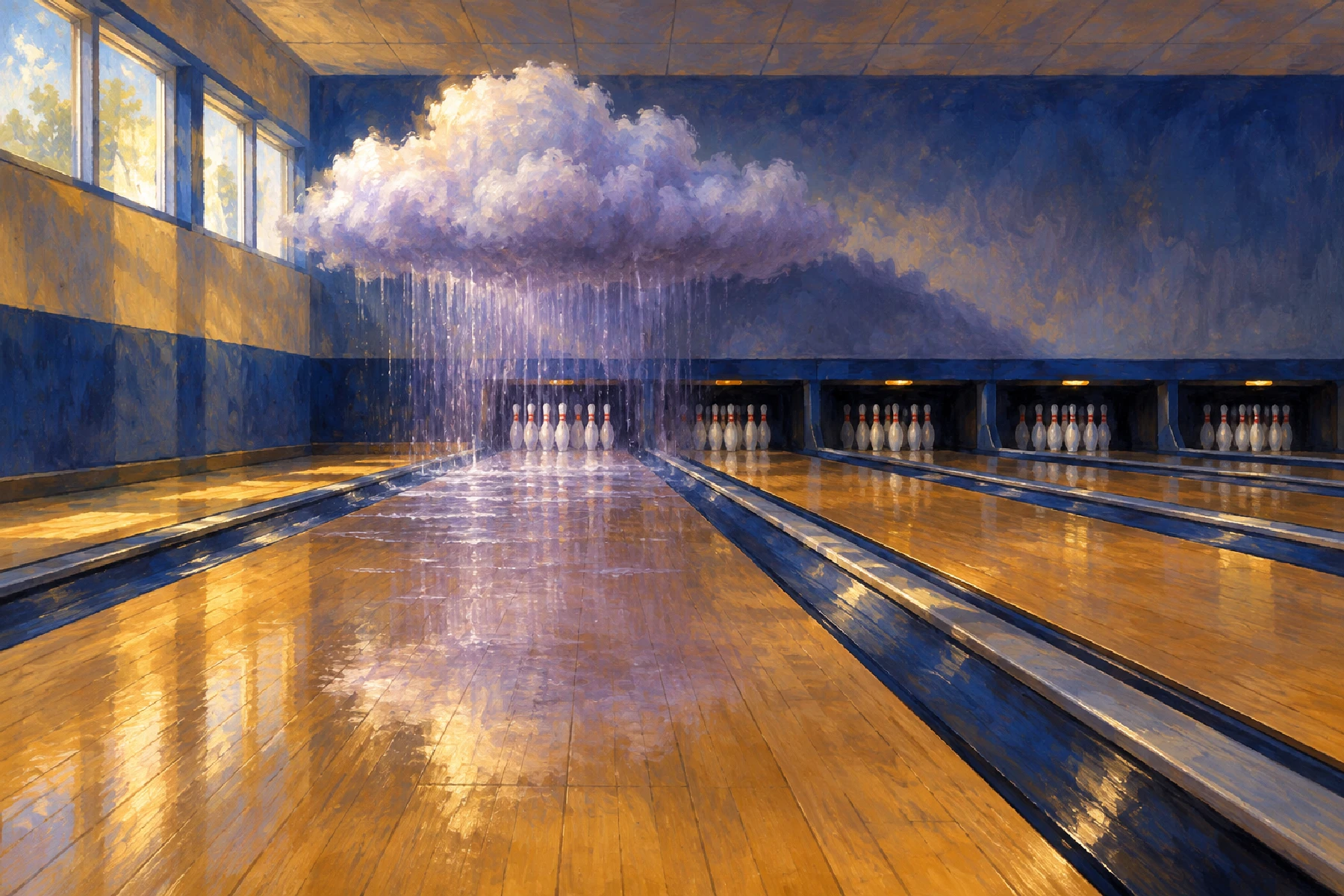
Small Storm Above a Bowling Lane
A small raincloud floats inside an empty bowling alley, its localized shower joining long reflections along one lane. Thin oil glazes and softly dissolving brushwork give the unexpected scale a luminous presence.
Remix this referenceSmall Storm Above a Bowling Lane
- Form language
- Simplify forms into interlocking rounded and elongated masses, retaining enough irregularity to feel observed rather than diagrammatic.
- Contour
- Build contours from adjoining paint passages rather than outlines; alternate soft lost edges with a few crisp, broken edge accents.
- Mark-making
- Use broad, lightly dragged oil strokes with occasional slender wet strokes; let pressure and paint load vary naturally within each passage.
- Surface rendering
- Layer translucent glazes over softly blended opaque paint for luminous continuous tones; leave occasional scumbled interruptions instead of polishing every transition.
Priority
Make luminosity emerge through layered continuous tones while keeping the painter's touch visible.
What to avoid & what to check
Exact prompt for this example
MODULE OWNERSHIP
subject: Subject count, type, stable proportions and landmarks, resting face geometry, hair shape, physical materials, garment construction and permanent marks. No emotion, movement, color assignment or rendering recipe.
expression: Facial soft-tissue displacement and pupil direction, muscle coordination, regional intensity, asymmetry and onset/peak/release. No head/body pose, stable appearance, skin color or rendering.
gesture: Head/neck/body/limb orientation, joint movement, support, contact and pose-caused occlusion using existing anatomy. No eye/pupil movement, emotion, identity, props inventory or camera.
props: Prop count, type, construction, physical material and scale relative to the subject. Holding/contact belongs to gesture, position to composition, color to palette.
scene: Environment elements, terrain, backdrop/floor presence and structural detail. No canvas positions, camera, lighting, assigned colors or render texture.
camera: Projection, focal-length impression, camera elevation/yaw/roll, viewing distance and crop. No actor pose, world placement, lighting or canvas aspect ratio.
composition: Normalized 0-100% canvas positions, scale in frame, depth/overlap, focal hierarchy and margins. No joint pose, camera projection, rendering, subject/prop inventory or emotion.
palette: Color anchors, hue/saturation/value ranges, colors assigned to parts and approximate color coverage. No illumination direction, shading algorithm, physical material or layout.
lighting: Light-source direction/softness/intensity, ambient illumination, physical shadow direction/length and highlight position. Absence of directional illumination is allowed. No shading technique, palette or material changes.
style: Reusable form abstraction, contour weight/taper/edge quality, medium and mark scale/density/direction, surface rendering and tonal transition technique. No fixed subject proportions, anatomy, identity, expression, pose, palette, light-source direction, camera or layout.
output: Image count, aspect ratio, size, file/alpha requirements and global lettering/logo/watermark restrictions. No background scenery, crop, style, identity or pose.

SUBJECT
inventory: One miniature rainstorm consisting of a single vapor cloud and its connected shower; no people or animals.
geometry: A low, broad cloud with an uneven domed crown and a trailing rain curtain, narrow enough to fit above one bowling lane.
resting-face: No face or facial landmarks.
appearance: The cloud consists of suspended water droplets; its shower remains liquid water, without solid casing or ornament.

PRIORITY


AVOID


CHECK


PROPS
inventory: One standard rack of ten bowling pins, at ordinary bowling-alley scale.
construction: The pins have rounded shoulders, narrow necks and glossy polymer shells over solid cores.

PRIORITY


AVOID


CHECK


SCENE
inventory: An empty neighborhood bowling alley with parallel lanes, recessed gutters, an approach floor and a plain end wall.
structure: Long floorboard joints and repeated lane dividers establish the familiar interior; a shallow puddle interrupts one lane.

PRIORITY


AVOID


CHECK


CAMERA
projection: Natural perspective with a moderately wide lens impression and gently converging architectural lines.
viewpoint: View from standing eye height, slightly downward and obliquely along the lanes, with a level horizon.
crop: A room-wide view includes the near approach and distant pin deck; the side walls continue beyond the frame.

PRIORITY


AVOID


CHECK


COMPOSITION
placement: The cloud sits left of center in the middle distance; the shower and its reflection form the main focal connection.
depth: Distant pins remain visible beneath the cloud; long foreground reflections lead toward the small storm.
spacing: Leave a broad expanse of empty lane in front and an open neighboring lane beside the storm; keep the cloud clear of the upper edge.

PRIORITY


AVOID


CHECK


PALETTE
colors: Use honey amber, deep ultramarine and pearl lavender, with a restrained vermilion accent.
assignment: Assign amber to the lanes, ultramarine to the gutters and walls, pearl lavender to cloud and rain, and vermilion to pin neck bands.
balance: Let subdued amber and blue dominate; reserve the palest values for the cloud, rain and their reflected traces.

PRIORITY


AVOID


CHECK


LIGHTING
sources: Broad, soft daylight enters from high windows on the left; weak room ambience keeps the far end visible.
shadows: A diffuse cloud shadow falls to the right across the lane; pin shadows remain short and soft.
highlights: Light catches the cloud's upper-left rim, the window-facing rain and the wet floor; the cloud does not emit light.

PRIORITY


AVOID


CHECK


STYLE GUIDE
form-language: Simplify forms into interlocking rounded and elongated masses, retaining enough irregularity to feel observed rather than diagrammatic.
contour: Build contours from adjoining paint passages rather than outlines; alternate soft lost edges with a few crisp, broken edge accents.
mark-making: Use broad, lightly dragged oil strokes with occasional slender wet strokes; let pressure and paint load vary naturally within each passage.
surface-rendering: Layer translucent glazes over softly blended opaque paint for luminous continuous tones; leave occasional scumbled interruptions instead of polishing every transition.

PRIORITY
Make luminosity emerge through layered continuous tones while keeping the painter's touch visible.

AVOID


CHECK


OUTPUT
format: One landscape image, 3:2 aspect ratio, 1800 × 1200 pixels, opaque PNG.
restrictions: No lettering, logos, watermarks or decorative border.

PRIORITY


AVOID


CHECK


FINAL INTEGRATION
subject + scene + composition: The familiar lane structure supplies the scale comparison, while the open spacing lets the atmospheric anomaly remain legible.
lighting + style: Paint transitions interpret the established illumination; natural variations in brushwork and minor detail are welcome.
Model information comes from image provenance. The same prompt may produce a different result.