Text to imageCharacterStyle guide
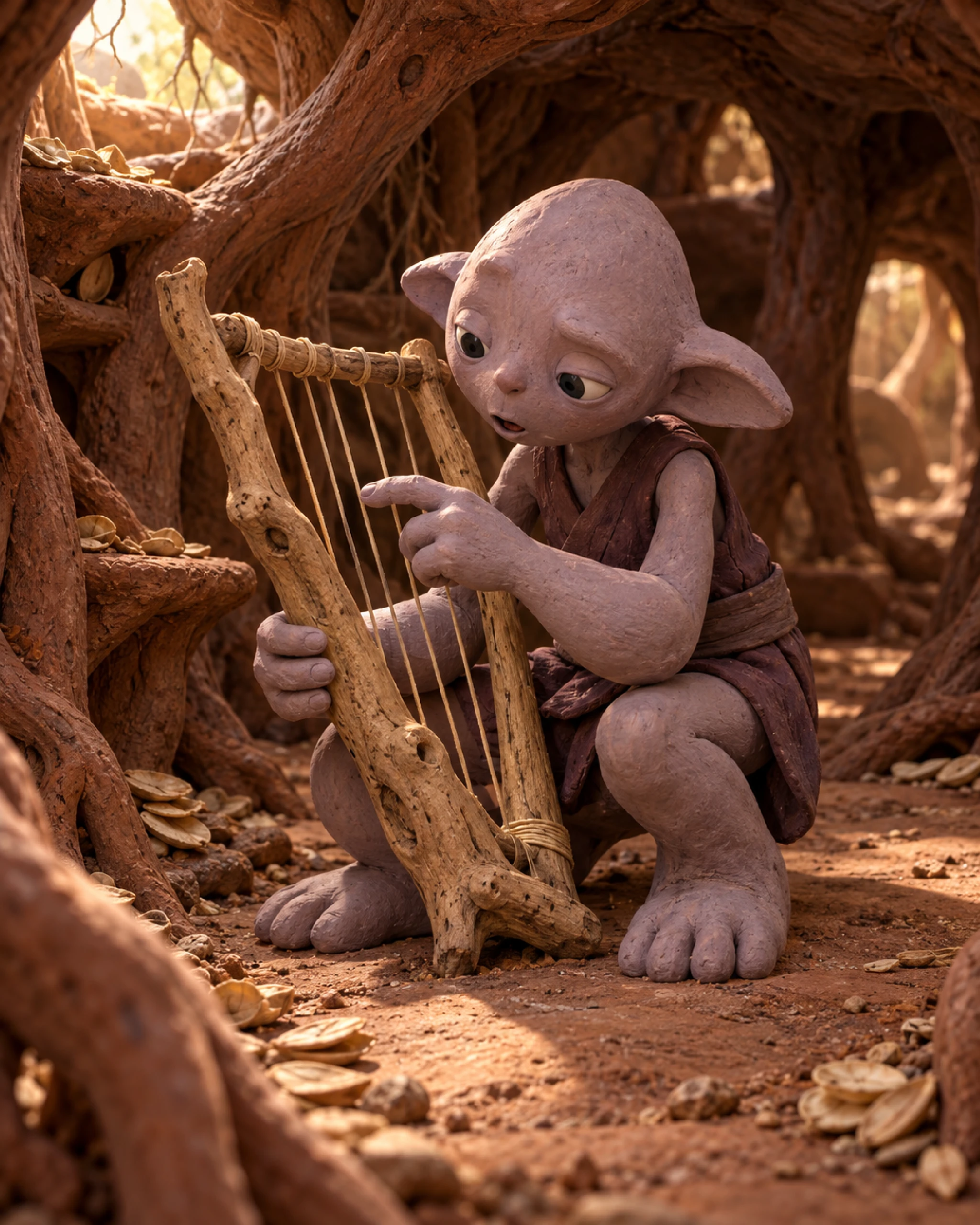
Long-Armed Creature Plucking a Root Harp
Inside a hollow root chamber, a small creature plucks a harp string and listens. Layered spaces and softly pressed clay surfaces make a tactile sculptural miniature.
Remix this referenceLong-Armed Creature Plucking a Root Harp
- Form language
- Build forms as joined, softly compressed masses; simplify small features into pressed hollows and attached clay pieces.
- Contour
- Keep rounded, slightly wavering silhouettes and softly pinched edges; avoid mechanically perfect curves.
- Mark-making
- Let broad thumb presses and occasional dragged tool marks follow each mass, with natural differences in pressure.
- Surface rendering
- Render matte handbuilt clay with softly rubbed transitions; retain small dents and shallow joins as part of the finished surface.
Priority
The image must visibly read as a sculptural clay miniature with handmade surfaces.
What to avoid & what to check
Exact prompt for this example
MODULE OWNERSHIP
subject: Subject count, type, stable proportions and landmarks, resting face geometry, hair shape, physical materials, garment construction and permanent marks. No emotion, movement, color assignment or rendering recipe.
expression: Facial soft-tissue displacement and pupil direction, muscle coordination, regional intensity, asymmetry and onset/peak/release. No head/body pose, stable appearance, skin color or rendering.
gesture: Head/neck/body/limb orientation, joint movement, support, contact and pose-caused occlusion using existing anatomy. No eye/pupil movement, emotion, identity, props inventory or camera.
props: Prop count, type, construction, physical material and scale relative to the subject. Holding/contact belongs to gesture, position to composition, color to palette.
scene: Environment elements, terrain, backdrop/floor presence and structural detail. No canvas positions, camera, lighting, assigned colors or render texture.
camera: Projection, focal-length impression, camera elevation/yaw/roll, viewing distance and crop. No actor pose, world placement, lighting or canvas aspect ratio.
composition: Normalized 0-100% canvas positions, scale in frame, depth/overlap, focal hierarchy and margins. No joint pose, camera projection, rendering, subject/prop inventory or emotion.
palette: Color anchors, hue/saturation/value ranges, colors assigned to parts and approximate color coverage. No illumination direction, shading algorithm, physical material or layout.
lighting: Light-source direction/softness/intensity, ambient illumination, physical shadow direction/length and highlight position. Absence of directional illumination is allowed. No shading technique, palette or material changes.
style: Reusable form abstraction, contour weight/taper/edge quality, medium and mark scale/density/direction, surface rendering and tonal transition technique. No fixed subject proportions, anatomy, identity, expression, pose, palette, light-source direction, camera or layout.
output: Image count, aspect ratio, size, file/alpha requirements and global lettering/logo/watermark restrictions. No background scenery, crop, style, identity or pose.

SUBJECT
inventory: One original small humanoid creature, physically modeled in clay.
geometry: A tall egg-shaped head, shelf-like ears, narrow trunk, long heavy forearms and broad feet give it a distinctive silhouette.
resting-face: Shallow oval eye sockets, low brow ridges, a small button nose and a short mouth slit form the resting face.
appearance: Hairless clay skin and an overlapping clay tabard with a broad sash; minor shaping differences may remain.

PRIORITY


AVOID


CHECK


EXPRESSION — ACTOR A
brows: The left brow rises while the right stays low.
lids: The left eye opens wider; the right lid narrows slightly.
cheeks: Cheeks stay soft, without a smiling lift.
nose: The nose remains unwrinkled with relaxed nostrils.
mouth: The lips part into a small, uneven gap.
jaw: The jaw drops just enough to support the parted lips.
gaze: Both pupils angle down toward the fingertips.
coordination: Unequal eye opening carries the curiosity; the lower face remains quiet.
timing: Hold the apex of concentrated curiosity.

PRIORITY


AVOID


CHECK


GESTURE
head: A inclines its head toward the harp, presenting one ear more openly.
torso: The torso curls forward in a low crouch, balanced over its planted feet.
limbs: One elbow reaches outward as a fingertip releases a string; the opposite arm bends around the frame.
contact: One hand steadies the harp’s frame against the knee; the released fingertip remains close to its string.

PRIORITY


AVOID


CHECK


PROPS
inventory: One root harp, roughly the height of the creature’s torso.
construction: A forked wooden root forms an open frame with a crossbar and sparse taut gut strings.

PRIORITY


AVOID


CHECK


SCENE
inventory: A hollow root chamber with buttress roots, small connecting openings, an earthen floor and scattered seed husks.
structure: Roots merge into low shelves and interlocking arches; uneven openings reveal further chambers beyond.

PRIORITY


AVOID


CHECK


CAMERA
projection: Perspective projection with a moderately wide lens impression and restrained perspective expansion.
viewpoint: View from just above the creature’s eye height, at a gentle three-quarter yaw with no roll.
crop: Show the complete creature and instrument at close range, retaining enough chamber to feel enclosed.

PRIORITY


AVOID


CHECK


COMPOSITION
placement: Set A’s face near 61% across and 36% down; the harp occupies the adjacent central opening.
depth: Foreground roots overlap the chamber edges; the hand leads to the face, then to nested rear openings.
spacing: Leave a clear pocket around the fingertips and strings, with unequal gaps between surrounding arches.

PRIORITY


AVOID


CHECK


PALETTE
colors: Chalk lilac, deep plum, red earth and pale straw form a muted, earthy palette.
assignment: Lilac skin, plum tabard, red-earth roots and floor, straw-colored harp and seed husks; eyes are near-black.
balance: Earth colors dominate the setting, with the paler figure and harp providing compact color relief.

PRIORITY


AVOID


CHECK


LIGHTING
sources: A broad soft source enters through an upper-left opening, with subdued ambient illumination inside the chamber.
shadows: Soft shadows extend toward the lower right, deepening beneath roots and at the feet.
highlights: Gentle highlights gather on the brow, upper forearms and the harp’s upper rim.

PRIORITY


AVOID


CHECK


STYLE GUIDE
form-language: Build forms as joined, softly compressed masses; simplify small features into pressed hollows and attached clay pieces.
contour: Keep rounded, slightly wavering silhouettes and softly pinched edges; avoid mechanically perfect curves.
mark-making: Let broad thumb presses and occasional dragged tool marks follow each mass, with natural differences in pressure.
surface-rendering: Render matte handbuilt clay with softly rubbed transitions; retain small dents and shallow joins as part of the finished surface.

PRIORITY
The image must visibly read as a sculptural clay miniature with handmade surfaces.

AVOID


CHECK


OUTPUT
format: One finished image, 4:5 aspect ratio, 2048 × 2560 pixels, opaque PNG.
restrictions: No lettering, logos or watermarks.

PRIORITY


AVOID


CHECK


FINAL INTEGRATION
gesture + props + composition: Make the playing contact readable through the instrument’s open construction and the space reserved around the fingers.
expression + gesture + props: Synchronize the facial apex with the moment just after the note sounds.
Model information comes from image provenance. The same prompt may produce a different result.