Text to imageAnimationStyle guide
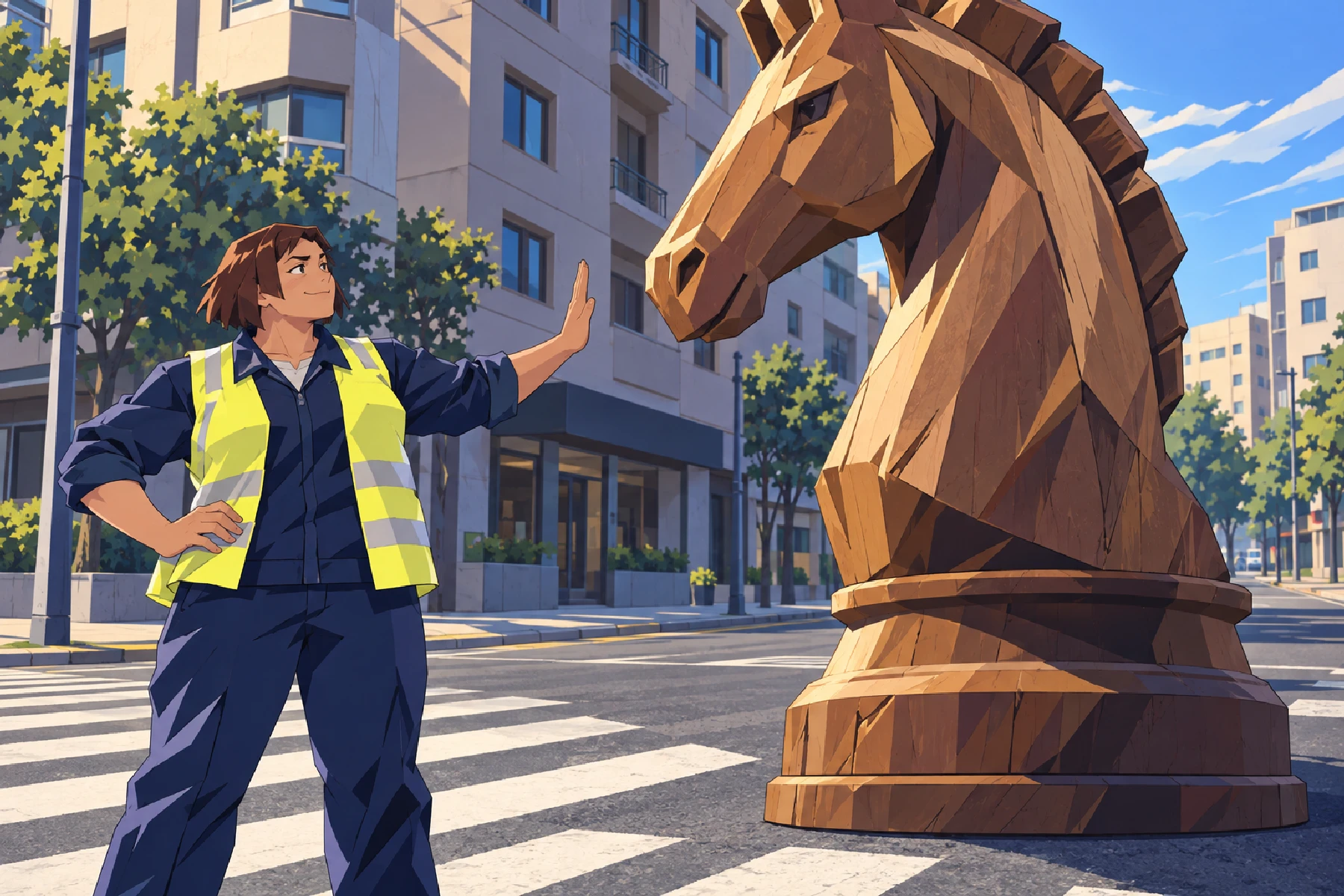
A Giant Chess Knight at the Crossing
A crossing guard raises her palm before an enormous wooden chess knight. Her dutiful stance and emerging smile turn an ordinary intersection into an absurd morning encounter.
Remix this referenceA Giant Chess Knight at the Crossing
- Form language
- Translate curved surfaces into interlocking wedges and triangular facets, alternating broad simple planes with abrupt angular breaks.
- Contour
- Use strongly varied exterior line weight, tapered corners and short sharp interior cuts; leave selected plane boundaries unoutlined.
- Mark-making
- Place a few sharp, irregular facet marks on worked surfaces and broad directional strokes on rough areas; leave clean planes unmarked.
- Surface rendering
- Build volume from a small set of sharply separated tonal planes rather than gradients; allow slight hand-drawn variation in their edges.
Priority
Rendering medium: 2D angular Japanese anime graphic illustration; formal rendering reference: TRIGGER · 2010s · Promare (2019)
What to avoid & what to check
Exact prompt for this example
MODULE OWNERSHIP
subject: Subject count, type, stable proportions and landmarks, resting face geometry, hair shape, physical materials, garment construction and permanent marks. No emotion, movement, color assignment or rendering recipe.
expression: Facial soft-tissue displacement and pupil direction, muscle coordination, regional intensity, asymmetry and onset/peak/release. No head/body pose, stable appearance, skin color or rendering.
gesture: Head/neck/body/limb orientation, joint movement, support, contact and pose-caused occlusion using existing anatomy. No eye/pupil movement, emotion, identity, props inventory or camera.
props: Prop count, type, construction, physical material and scale relative to the subject. Holding/contact belongs to gesture, position to composition, color to palette.
scene: Environment elements, terrain, backdrop/floor presence and structural detail. No canvas positions, camera, lighting, assigned colors or render texture.
camera: Projection, focal-length impression, camera elevation/yaw/roll, viewing distance and crop. No actor pose, world placement, lighting or canvas aspect ratio.
composition: Normalized 0-100% canvas positions, scale in frame, depth/overlap, focal hierarchy and margins. No joint pose, camera projection, rendering, subject/prop inventory or emotion.
palette: Color anchors, hue/saturation/value ranges, colors assigned to parts and approximate color coverage. No illumination direction, shading algorithm, physical material or layout.
lighting: Light-source direction/softness/intensity, ambient illumination, physical shadow direction/length and highlight position. Absence of directional illumination is allowed. No shading technique, palette or material changes.
style: Reusable form abstraction, contour weight/taper/edge quality, medium and mark scale/density/direction, surface rendering and tonal transition technique. No fixed subject proportions, anatomy, identity, expression, pose, palette, light-source direction, camera or layout.
output: Image count, aspect ratio, size, file/alpha requirements and global lettering/logo/watermark restrictions. No background scenery, crop, style, identity or pose.

SUBJECT
inventory: One original adult woman, actor A, working as a crossing guard; no other people or animals.
geometry: A has a sturdy build, broad shoulders, large hands and a rounded square face with a long straight nose.
resting-face: Straight brows, shallow upper-lid folds and a broad mouth establish her resting facial structure.
appearance: Short blunt hair with one uneven temple notch; canvas work jacket, open safety vest with reflective bands, plain trousers.

PRIORITY


AVOID


CHECK


EXPRESSION — ACTOR A
brows: One brow lifts slightly while the other remains nearly level.
lids: The lower lids tighten faintly; the upper lids stay comfortably open.
cheeks: A small cheek lift begins on the same side as the rising mouth corner.
nose: The nose remains relaxed, without wrinkling or nostril flare.
mouth: Closed lips develop a small crooked smile at one corner.
jaw: The jaw stays loose with no visible drop.
gaze: Both pupils track the wooden knight's muzzle.
coordination: Keep the upper face restrained while the cheek and mouth first reveal amusement.
timing: Catch the onset of a smile before it becomes a laugh.

PRIORITY


AVOID


CHECK


GESTURE
head: A lifts her chin toward the knight, keeping her neck comfortably extended.
torso: Her torso turns partly toward the knight while her shoulders remain squared in a firm standing stance.
limbs: One arm extends with a softly bent elbow and an upright open palm; the opposite elbow bends outward.
contact: The bent arm's hand rests on her hip; the raised palm makes no contact with the knight.

PRIORITY


AVOID


CHECK


PROPS
inventory: One monumental wooden chess knight, about three times A's height; no handheld equipment.
construction: A solid carved horse head and curved neck rise from a broad circular chess base; shallow cuts describe the mane.

PRIORITY


AVOID


CHECK


SCENE
inventory: An ordinary neighborhood intersection with a zebra crossing, asphalt roadway, curb and modest apartment façades.
structure: Repeated windows and a recessed shop entrance establish everyday building scale; the roadway remains unobstructed otherwise.

PRIORITY


AVOID


CHECK


CAMERA
projection: Moderately wide perspective with clear depth and restrained edge distortion.
viewpoint: View from slightly below A's chest height, obliquely across the crossing, with a level horizon.
crop: A medium-wide view crops A around the knees while retaining the knight's head and most of its base.

PRIORITY


AVOID


CHECK


COMPOSITION
placement: A occupies the left third; the knight dominates the right half. Her face and raised palm form the first focal pair.
depth: A overlaps the near crossing stripes; the knight stands one depth layer behind her, with buildings receding beyond.
spacing: Preserve a generous clear gap between palm and muzzle; crossing stripes lead through this gap toward the distant street.

PRIORITY


AVOID


CHECK


PALETTE
colors: Use ink indigo, citron yellow, pale clay, warm umber and chalk white as the main anchors.
assignment: Indigo jacket and trousers, citron vest, umber hair, warm clay skin and knight; chalk crossing stripes and reflective bands.
balance: Muted indigo and clay dominate; concentrate strong yellow in the vest and keep distant architecture low in saturation.

PRIORITY


AVOID


CHECK


LIGHTING
sources: Broad morning light enters from the upper left, with gentle sky fill keeping the visible face legible.
shadows: The knight casts a broad, softly edged shadow toward the lower right; facial shadows remain shallow.
highlights: Restrained highlights touch the upper-left muzzle ridge, raised knuckles and vest shoulder.

PRIORITY


AVOID


CHECK


STYLE GUIDE
form-language: Translate curved surfaces into interlocking wedges and triangular facets, alternating broad simple planes with abrupt angular breaks.
contour: Use strongly varied exterior line weight, tapered corners and short sharp interior cuts; leave selected plane boundaries unoutlined.
mark-making: Place a few sharp, irregular facet marks on worked surfaces and broad directional strokes on rough areas; leave clean planes unmarked.
surface-rendering: Build volume from a small set of sharply separated tonal planes rather than gradients; allow slight hand-drawn variation in their edges.

PRIORITY
Rendering medium: 2D angular Japanese anime graphic illustration; formal rendering reference: TRIGGER · 2010s · Promare (2019)

AVOID


CHECK


OUTPUT
format: One finished image, landscape 3:2, 1800 × 1200 pixels, opaque PNG.
restrictions: No lettering, logos, signatures or watermarks.

PRIORITY


AVOID


CHECK


FINAL INTEGRATION
expression + gesture + composition: Keep the emerging smile readable within the authoritative gesture, with enough separation to understand the encounter immediately.
Art direction
트리거 / TRIGGER · 2010s · 프로메어(2019) / Promare (2019) ↗- Abstract form surfaces into wedges, triangles and angular facets
- Strong exterior weight contrast with short sharp interior cuts
- Small angular facets and sharp marks, with no marks in clean planes
- A small set of sharply separated tonal planes in place of gradients
Model information comes from image provenance. The same prompt may produce a different result.