Text to imageArt stylesStyle guide
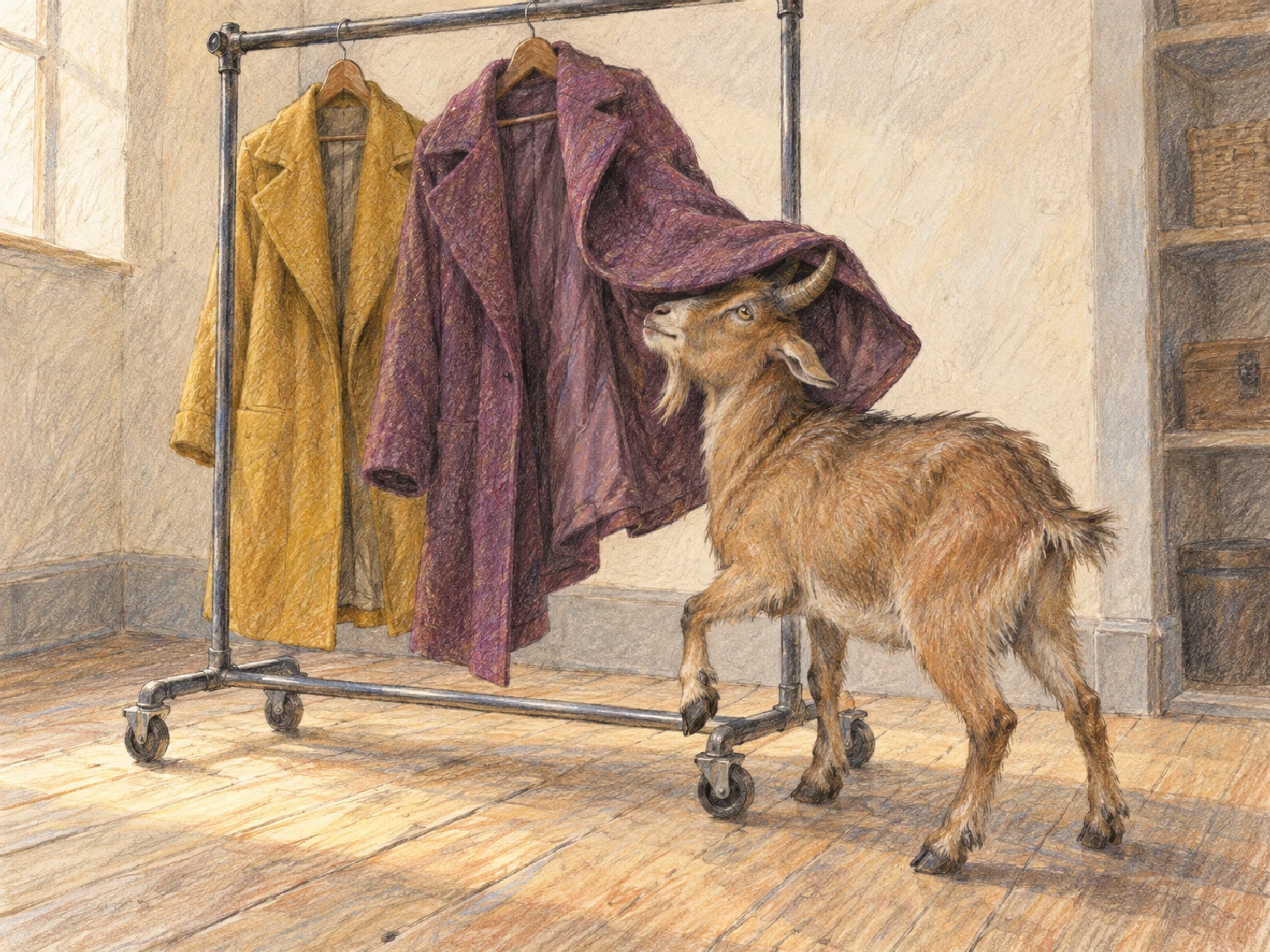
Goat Under the Costume Rack
A stage coat catches on a goat’s horn, stirring up a cramped costume room. Searching pencil lines and loose colored-pencil layers weave overlapping cloth and animal movement into a lively sketchbook illustration.
Remix this referenceGoat Under the Costume Rack
- Form language
- Reduce volumes to irregular wedges and rounded masses; allow small shapes to vary within a coherent observational drawing language.
- Contour
- Use searching graphite contours with occasional doubled lines, broken edges, and pressure-darkened turns; vary line weight naturally.
- Mark-making
- Alternate broad side-of-pencil strokes with quick directional hatching; retain exploratory strokes and spontaneous shifts in mark density.
- Surface rendering
- Build translucent, uneven colored-pencil layers that catch paper tooth; rub and selectively erase tones into soft, frayed transitions.
Priority
Keep rough pencil and colored-pencil sketchbook handling visibly present in the finished drawing.
What to avoid & what to check
Exact prompt for this example
MODULE OWNERSHIP
subject: Subject count, type, stable proportions and landmarks, resting face geometry, hair shape, physical materials, garment construction and permanent marks. No emotion, movement, color assignment or rendering recipe.
expression: Facial soft-tissue displacement and pupil direction, muscle coordination, regional intensity, asymmetry and onset/peak/release. No head/body pose, stable appearance, skin color or rendering.
gesture: Head/neck/body/limb orientation, joint movement, support, contact and pose-caused occlusion using existing anatomy. No eye/pupil movement, emotion, identity, props inventory or camera.
props: Prop count, type, construction, physical material and scale relative to the subject. Holding/contact belongs to gesture, position to composition, color to palette.
scene: Environment elements, terrain, backdrop/floor presence and structural detail. No canvas positions, camera, lighting, assigned colors or render texture.
camera: Projection, focal-length impression, camera elevation/yaw/roll, viewing distance and crop. No actor pose, world placement, lighting or canvas aspect ratio.
composition: Normalized 0-100% canvas positions, scale in frame, depth/overlap, focal hierarchy and margins. No joint pose, camera projection, rendering, subject/prop inventory or emotion.
palette: Color anchors, hue/saturation/value ranges, colors assigned to parts and approximate color coverage. No illumination direction, shading algorithm, physical material or layout.
lighting: Light-source direction/softness/intensity, ambient illumination, physical shadow direction/length and highlight position. Absence of directional illumination is allowed. No shading technique, palette or material changes.
style: Reusable form abstraction, contour weight/taper/edge quality, medium and mark scale/density/direction, surface rendering and tonal transition technique. No fixed subject proportions, anatomy, identity, expression, pose, palette, light-source direction, camera or layout.
output: Image count, aspect ratio, size, file/alpha requirements and global lettering/logo/watermark restrictions. No background scenery, crop, style, identity or pose.

SUBJECT
inventory: One small adult goat, actor A; no other figures.
geometry: A compact barrel-shaped torso, short neck, slender lower legs, and backward-curving horns.
resting-face: A narrow muzzle, modest eye openings, and horizontal pupils; facial landmarks remain understated.
appearance: Coarse fur, a short beard, ridged horns, and cloven hooves; no permanent markings.

PRIORITY


AVOID


CHECK


EXPRESSION — ACTOR A
brows: No brow displacement is prescribed.
lids: Visible eyelids retain their resting aperture without widening or squeezing.
cheeks: The visible lower cheek stays loose, without lifting or bunching.
nose: Visible nostrils stay relaxed, without flaring or wrinkling.
mouth: The lips meet gently, without pulling the corners or exposing teeth.
jaw: The jaw remains softly closed without a clenched muzzle.
gaze: The visible pupil turns slightly upward toward the lifted hem.
coordination: Keep the visible facial regions evenly relaxed.
timing: Sustain this minimal neutral apex.

PRIORITY


AVOID


CHECK


GESTURE
head: A raises its neck beneath the coat, which hides the brow and far side while leaving the near eye and muzzle visible.
torso: The torso twists slightly away from the rack while the hindquarters remain planted.
limbs: One forehoof pauses above the low rack rail; the other legs support an interrupted step.
contact: One horn hooks beneath the open coat hem, lifting it into a loose tent over the head and shoulder.

PRIORITY


AVOID


CHECK


PROPS
inventory: One wheeled garment rack, two hangers, and two long theatrical coats, each larger than the goat; no accessories.
construction: Tubular steel rack, wooden hangers, and wool coats with broad collars, open fronts, and loose fabric linings.

PRIORITY


AVOID


CHECK


SCENE
inventory: A modest costume workroom with a plank floor, plain plaster wall, and shallow storage recess.
structure: A low skirting board and a few floorboard divisions establish the room with sparse decoration.

PRIORITY


AVOID


CHECK


CAMERA
projection: Natural perspective with a normal-lens impression and gentle spatial convergence.
viewpoint: View obliquely from slightly above the goat’s back, with no camera roll.
crop: A medium-wide room fragment includes the whole goat and rack, with nearby architecture cropped.

PRIORITY


AVOID


CHECK


COMPOSITION
placement: The rack spans the middle and the goat fills the lower-right area; the lifted hem leads the focal hierarchy.
depth: The caught coat overlaps the goat; the second coat and rear rail form a subordinate layer behind them.
spacing: Leave open floor around the hooves, breathing room above, and small gaps between the leg silhouettes.

PRIORITY


AVOID


CHECK


PALETTE
colors: Warm ivory, dusty plum, muted mustard, tawny brown, and graphite gray.
assignment: Ivory paper and wall, plum caught coat, mustard second coat, tawny goat and floor, gray rack.
balance: Ivory dominates; restrained plum carries the strongest chromatic weight, with mustard as a smaller counterpoint.

PRIORITY


AVOID


CHECK


LIGHTING
sources: Broad, soft daylight enters from the upper left, supported by gentle room ambience.
shadows: Soft shadows fall toward the lower right; contact shadows anchor hooves and rack wheels.
highlights: Subdued highlights touch upper-left horn edges, raised cloth folds, and the rack’s top tube.

PRIORITY


AVOID


CHECK


STYLE GUIDE
form-language: Reduce volumes to irregular wedges and rounded masses; allow small shapes to vary within a coherent observational drawing language.
contour: Use searching graphite contours with occasional doubled lines, broken edges, and pressure-darkened turns; vary line weight naturally.
mark-making: Alternate broad side-of-pencil strokes with quick directional hatching; retain exploratory strokes and spontaneous shifts in mark density.
surface-rendering: Build translucent, uneven colored-pencil layers that catch paper tooth; rub and selectively erase tones into soft, frayed transitions.

PRIORITY
Keep rough pencil and colored-pencil sketchbook handling visibly present in the finished drawing.

AVOID


CHECK


OUTPUT
format: One finished illustration, 4:3 landscape, 1536 × 1152 pixels, opaque PNG.
restrictions: No lettering, logos, or watermarks.

PRIORITY


AVOID


CHECK


FINAL INTEGRATION
gesture + composition: Coordinate the visible contact and overlapping forms so the snag reads immediately.
Model information comes from image provenance. The same prompt may produce a different result.