Text to imageIllustrationStyle guide
One Clay Ring · Cross-Contour Volume
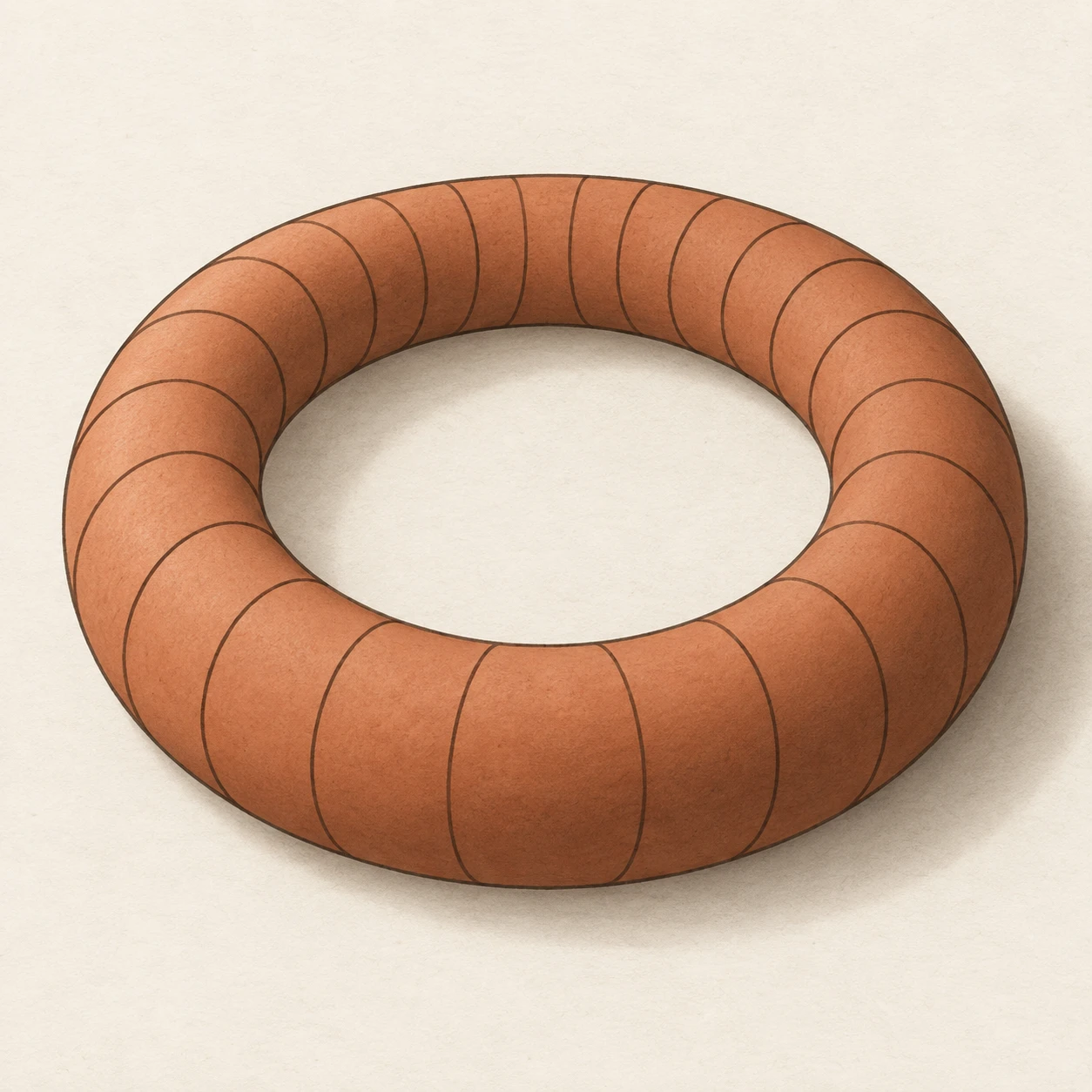
An illustration using cross-contour curves around a clay ring to reveal its rounded surface and the depth of its central opening.
One Clay Ring · Cross-Contour Volume
- Shape & line
- Draw a clean outer silhouette and a lighter inner boundary, then wrap repeated cross-contour arcs around the tubular body like curved bands. Turn each arc with its position around the ring, and stop it where the surface disappears from view; never continue a line through the solid clay.
- Color & light
- Use muted terracotta for the ring and dark brown for the lines. Light it from the upper left of the image, keeping the upper-left surfaces pale and the lower-right surfaces gently darker; place a restrained cast shadow to the image's lower right without letting tonal shading overpower the contour curves.
- Texture & material
- Render the clay as matte with broad, even color fills and only a faint paper grain. Keep the cross-contour strokes crisp and clearly drawn on the surface, without grooves, ridges, or glossy highlights that would make them appear physically carved.
- Composition
- Keep the central opening large enough to read immediately against the warm off-white background. Space the contour arcs openly across the visible front of the ring and let their projected spacing compress along the far rim at the image's top, making depth legible without adding a second view or explanatory graphics.
Priority
Make the cross-contour curves explain the ring's rounded volume before adding surface detail.
What to avoid & what to check
Avoid flat decorative stripes, visible hidden lines, and contours that bridge the central hole.
Check that every arc follows the local surface and that the near rim visibly overlaps the inner wall.
Exact prompt for this example
SUBJECT
Show exactly one thick, smoothly rounded clay ring lying flat on a plain surface. Its continuous tubular body surrounds one open central hole; the near rim partially conceals the lower portion of the inner wall.

COMPOSITION
Use an elevated three-quarter view so the ring and its opening appear as broad ellipses. Center the complete ring with generous margins, placing the near rim toward the bottom of the image and the far rim toward the top.

STYLE GUIDE
1. Shape & line
Draw a clean outer silhouette and a lighter inner boundary, then wrap repeated cross-contour arcs around the tubular body like curved bands. Turn each arc with its position around the ring, and stop it where the surface disappears from view; never continue a line through the solid clay.

2. Color & light
Use muted terracotta for the ring and dark brown for the lines. Light it from the upper left of the image, keeping the upper-left surfaces pale and the lower-right surfaces gently darker; place a restrained cast shadow to the image's lower right without letting tonal shading overpower the contour curves.

3. Texture & material
Render the clay as matte with broad, even color fills and only a faint paper grain. Keep the cross-contour strokes crisp and clearly drawn on the surface, without grooves, ridges, or glossy highlights that would make them appear physically carved.

4. Composition
Keep the central opening large enough to read immediately against the warm off-white background. Space the contour arcs openly across the visible front of the ring and let their projected spacing compress along the far rim at the image's top, making depth legible without adding a second view or explanatory graphics.

PRIORITY
Preserve the requested identity, count, action, composition and output settings. Apply the style rules within those constraints; a style reference must not replace the subject or layout. Within the style: Make the cross-contour curves explain the ring's rounded volume before adding surface detail.

AVOID
Avoid flat decorative stripes, visible hidden lines, and contours that bridge the central hole.

OUTPUT
Produce one square illustration with no lettering, labels, numbers, or watermark.

SELF-CHECK
Check that every arc follows the local surface and that the near rim visibly overlaps the inner wall.
Model information comes from image provenance. The same prompt may produce a different result.