Text to imageIllustrationStyle guide
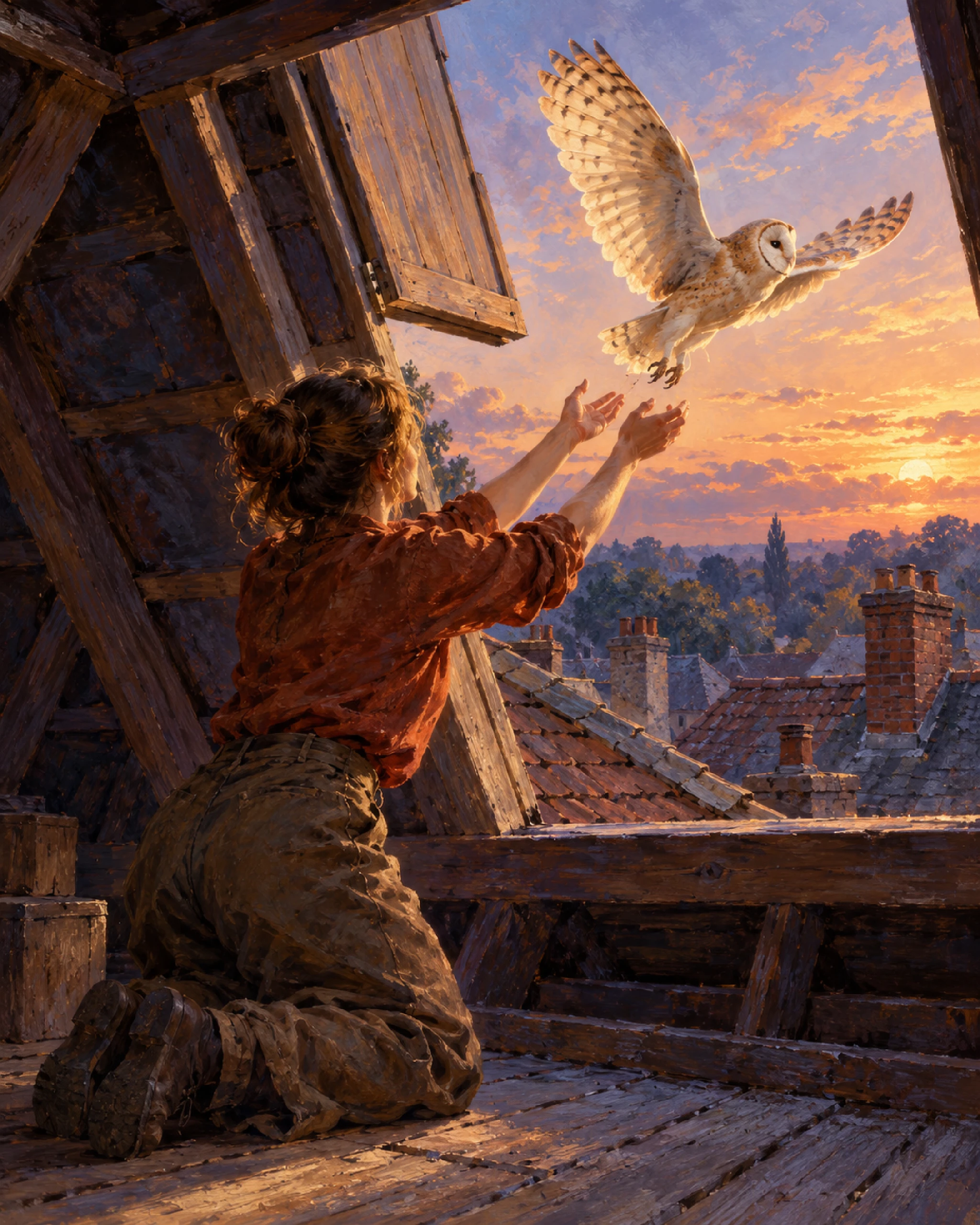
An Owl Leaving the Roof Hatch
A woman kneels in an attic, extending her hands through a roof hatch. An owl lifts clear of her fingers against layered evening rooftops in a luminous painterly illustration.
Remix this referenceAn Owl Leaving the Roof Hatch
- Form language
- Simplify forms into interlocking rounded and wedge-like masses; let minor details vary within a coherent painted shorthand.
- Contour
- Use painted edges without enclosing outlines, alternating soft lost boundaries with crisp, tapering edge accents.
- Mark-making
- Broad bristle strokes follow surface flow, interrupted by dragged dry-brush breaks and smaller flicks of naturally varied length.
- Surface rendering
- Build luminous continuous tones with translucent oil-like layers over softly blended opaque passages; retain scumbled interruptions.
Priority
Preserve luminous continuous-tone painting with visibly varied brushwork.
What to avoid & what to check
Exact prompt for this example
MODULE OWNERSHIP
subject: Subject count, type, stable proportions and landmarks, resting face geometry, hair shape, physical materials, garment construction and permanent marks. No emotion, movement, color assignment or rendering recipe.
expression: Facial soft-tissue displacement and pupil direction, muscle coordination, regional intensity, asymmetry and onset/peak/release. No head/body pose, stable appearance, skin color or rendering.
gesture: Head/neck/body/limb orientation, joint movement, support, contact and pose-caused occlusion using existing anatomy. No eye/pupil movement, emotion, identity, props inventory or camera.
props: Prop count, type, construction, physical material and scale relative to the subject. Holding/contact belongs to gesture, position to composition, color to palette.
scene: Environment elements, terrain, backdrop/floor presence and structural detail. No canvas positions, camera, lighting, assigned colors or render texture.
camera: Projection, focal-length impression, camera elevation/yaw/roll, viewing distance and crop. No actor pose, world placement, lighting or canvas aspect ratio.
composition: Normalized 0-100% canvas positions, scale in frame, depth/overlap, focal hierarchy and margins. No joint pose, camera projection, rendering, subject/prop inventory or emotion.
palette: Color anchors, hue/saturation/value ranges, colors assigned to parts and approximate color coverage. No illumination direction, shading algorithm, physical material or layout.
lighting: Light-source direction/softness/intensity, ambient illumination, physical shadow direction/length and highlight position. Absence of directional illumination is allowed. No shading technique, palette or material changes.
style: Reusable form abstraction, contour weight/taper/edge quality, medium and mark scale/density/direction, surface rendering and tonal transition technique. No fixed subject proportions, anatomy, identity, expression, pose, palette, light-source direction, camera or layout.
output: Image count, aspect ratio, size, file/alpha requirements and global lettering/logo/watermark restrictions. No background scenery, crop, style, identity or pose.

SUBJECT
inventory: A is one adult woman; B is one barn owl. No other people or animals.
geometry: A has an ordinary adult build; B has a compact feathered body, rounded head and long tapering wings.
resting-face: A's resting facial geometry is unspecified; B has a heart-shaped facial disc and short hooked beak.
appearance: A has a loose bun, a woven work shirt with rolled sleeves and loose trousers; no permanent marks.

PRIORITY


AVOID


CHECK


EXPRESSION — ACTOR A
brows: Brow displacement remains unprescribed.
lids: Eyelid opening or narrowing remains unprescribed.
cheeks: Cheek lift or compression remains unprescribed.
nose: Expressive changes of the nose and nostrils remain unprescribed.
mouth: Expressive mouth shape remains unprescribed.
jaw: Jaw opening remains unprescribed.
gaze: Pupil direction remains unprescribed.
coordination: No coordinated facial performance is prescribed.
timing: A neutral hold accompanies this instant; no facial onset or release is depicted.

PRIORITY


AVOID


CHECK


EXPRESSION — ACTOR B
brows: Expressive displacement of the brow region remains unprescribed.
lids: Eyelid aperture remains unprescribed.
cheeks: Expressive compression of the facial disc remains unprescribed.
nose: Expressive changes of the nostril region remain unprescribed.
mouth: Beak opening remains unprescribed.
jaw: Jaw movement remains unprescribed.
gaze: Pupil direction remains unprescribed.
coordination: No coordinated facial performance is prescribed; avoid anthropomorphic facial acting.
timing: A neutral hold accompanies this instant; no facial onset or release is depicted.

PRIORITY


AVOID


CHECK


GESTURE
head: A extends her neck toward the opening with her face turned away; B directs its head outward beyond the roof.
torso: A kneels and leans forward from the hips; B pitches gently upward as its body clears the opening.
limbs: A reaches both arms upward with open palms; B spreads its wings in a rising stroke, feet loosely tucked.
contact: A's knees support her on the floor; B's feet have just left her fingers, leaving a small visible gap.

PRIORITY


AVOID


CHECK


PROPS
inventory: No separate props.
construction: No prop construction applies.

PRIORITY


AVOID


CHECK


SCENE
inventory: An unfinished attic opens onto a steep tiled roof, clustered neighborhood roofs, distant trees and evening sky.
structure: Exposed rafters and floorboards surround an open hinged roof hatch; chimneys interrupt the roof slopes.

PRIORITY


AVOID


CHECK


CAMERA
projection: Use natural perspective with a moderately wide lens impression and restrained edge expansion.
viewpoint: Look from inside the attic at standing chest height, slightly upward, in a rear three-quarter view of A; keep roll level.
crop: Include A's complete figure and B's full silhouette; let nearby architectural edges continue beyond the frame.

PRIORITY


AVOID


CHECK


COMPOSITION
placement: A occupies the lower-left third; the hands sit near the middle, with B in the upper-right.
depth: A foreground rafter overlaps the attic edge; hands and owl bridge the opening to receding roof layers.
spacing: Make the hand-to-foot gap the first focal pause, followed by the wings; retain breathing room beyond the outer feathers.

PRIORITY


AVOID


CHECK


PALETTE
colors: Anchor the image in deep indigo, smoky violet, apricot and ivory, with restrained rust accents.
assignment: Attic: indigo-violet; sky: apricot; owl: ivory and tawny; shirt: rust; trousers and hair: umber; skin: muted peach.
balance: Subdued darks occupy most of the image; reserve the palest values for the owl and a limited portion of sky.

PRIORITY


AVOID


CHECK


LIGHTING
sources: Broad, soft exterior light enters from the upper right through the hatch; faint ambient light reaches the attic floor.
shadows: Rafters cast long, soft shadows toward the lower left; overlapping feathers create shallow local shadows.
highlights: Broad, soft highlights touch the upper wing surfaces, fingertips and hatch rim.

PRIORITY


AVOID


CHECK


STYLE GUIDE
form-language: Simplify forms into interlocking rounded and wedge-like masses; let minor details vary within a coherent painted shorthand.
contour: Use painted edges without enclosing outlines, alternating soft lost boundaries with crisp, tapering edge accents.
mark-making: Broad bristle strokes follow surface flow, interrupted by dragged dry-brush breaks and smaller flicks of naturally varied length.
surface-rendering: Build luminous continuous tones with translucent oil-like layers over softly blended opaque passages; retain scumbled interruptions.

PRIORITY
Preserve luminous continuous-tone painting with visibly varied brushwork.

AVOID


CHECK


OUTPUT
format: Produce one opaque PNG image, portrait 4:5, at 2048 × 2560 pixels.
restrictions: No lettering, logos or watermarks.

PRIORITY


AVOID


CHECK


FINAL INTEGRATION
gesture + composition: Let the release gesture and surrounding negative space cooperate to make the departure legible.
palette + lighting + style: Let value relationships, illumination and painted transitions cooperate while preserving visible brushwork.
Model information comes from image provenance. The same prompt may produce a different result.