Text to imageCharacterStyle guide
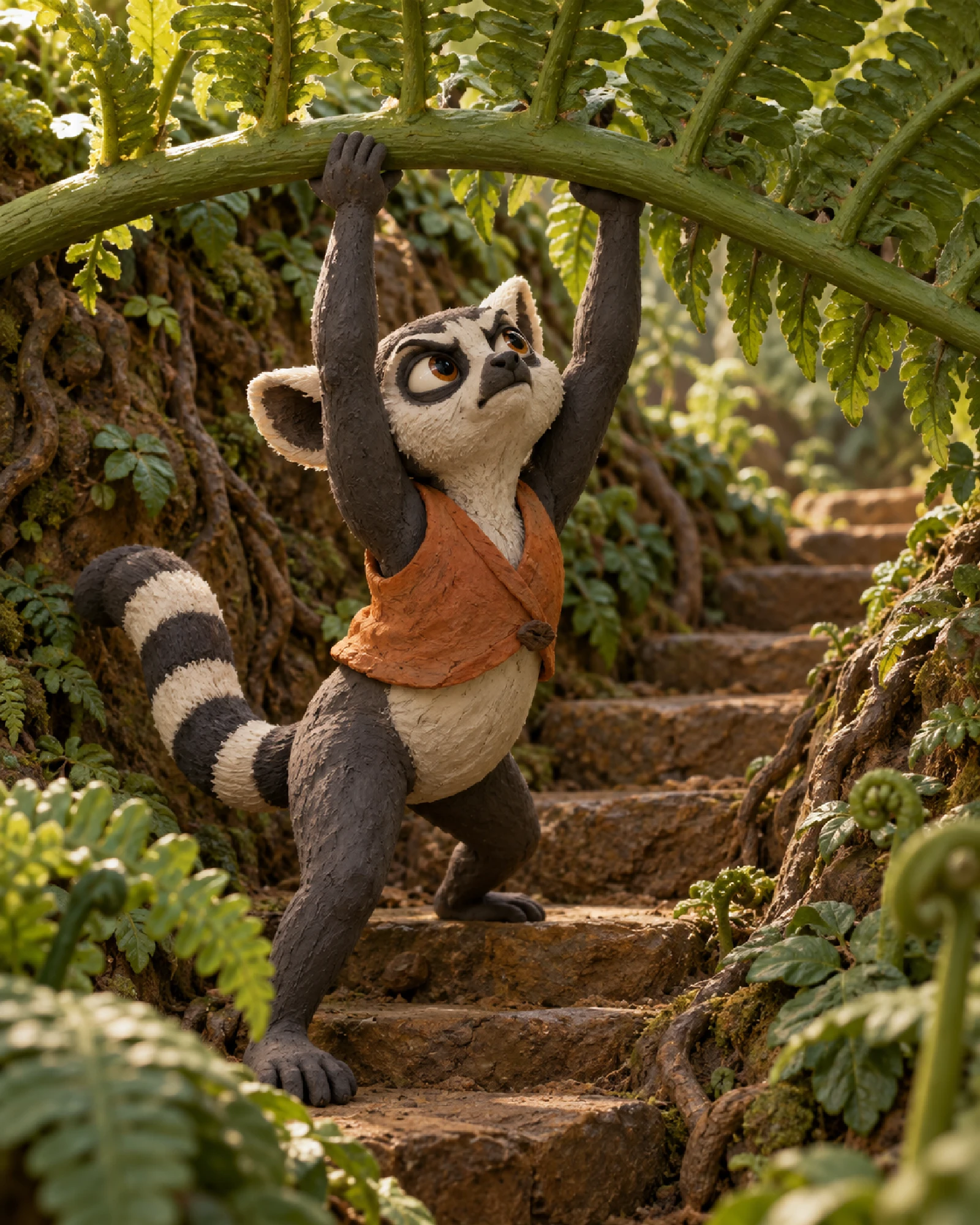
Lemur Opening the Fern Passage
A small lemur lifts a giant fern frond to open a passage through a sunken garden. Hand-shaped clay impressions and joins give the layered foliage and vigorous gesture a tangible presence.
Remix this referenceLemur Opening the Fern Passage
- Form language
- Build forms from rounded masses and gently compressed slabs, preserving the irregular logic of hand assembly.
- Contour
- Use softly pinched edges, subtly uneven rims and occasional visible joins instead of mechanically perfect silhouettes.
- Mark-making
- Retain selective fingertip impressions and short modeling-tool grooves, with natural variation in pressure and spacing.
- Surface rendering
- Render tactile clay through mostly matte surfaces, gently rubbed peaks and continuous tonal modeling across shallow dents.
Priority
The defining medium is a sculptural clay miniature with visibly handmade surfaces.
What to avoid & what to check
Exact prompt for this example
MODULE OWNERSHIP
subject: Subject count, type, stable proportions and landmarks, resting face geometry, hair shape, physical materials, garment construction and permanent marks. No emotion, movement, color assignment or rendering recipe.
expression: Facial soft-tissue displacement and pupil direction, muscle coordination, regional intensity, asymmetry and onset/peak/release. No head/body pose, stable appearance, skin color or rendering.
gesture: Head/neck/body/limb orientation, joint movement, support, contact and pose-caused occlusion using existing anatomy. No eye/pupil movement, emotion, identity, props inventory or camera.
props: Prop count, type, construction, physical material and scale relative to the subject. Holding/contact belongs to gesture, position to composition, color to palette.
scene: Environment elements, terrain, backdrop/floor presence and structural detail. No canvas positions, camera, lighting, assigned colors or render texture.
camera: Projection, focal-length impression, camera elevation/yaw/roll, viewing distance and crop. No actor pose, world placement, lighting or canvas aspect ratio.
composition: Normalized 0-100% canvas positions, scale in frame, depth/overlap, focal hierarchy and margins. No joint pose, camera projection, rendering, subject/prop inventory or emotion.
palette: Color anchors, hue/saturation/value ranges, colors assigned to parts and approximate color coverage. No illumination direction, shading algorithm, physical material or layout.
lighting: Light-source direction/softness/intensity, ambient illumination, physical shadow direction/length and highlight position. Absence of directional illumination is allowed. No shading technique, palette or material changes.
style: Reusable form abstraction, contour weight/taper/edge quality, medium and mark scale/density/direction, surface rendering and tonal transition technique. No fixed subject proportions, anatomy, identity, expression, pose, palette, light-source direction, camera or layout.
output: Image count, aspect ratio, size, file/alpha requirements and global lettering/logo/watermark restrictions. No background scenery, crop, style, identity or pose.

SUBJECT
inventory: One original anthropomorphic lemur, A, constructed as a clay miniature.
geometry: A has a compact pear-shaped torso, slender limbs, a short broad muzzle and a long tail with transverse bands.
resting-face: Large round eye openings, low rounded brow ridges and a small horizontal mouth define the resting face.
appearance: Rounded triangular ears and a sleeveless wrap vest with an overlapping front are sculpted in clay; small details may vary.

PRIORITY


AVOID


CHECK


EXPRESSION — ACTOR A
brows: Brow ridges draw inward and slightly downward.
lids: Upper lids narrow slightly while lower lids firm upward.
cheeks: Cheeks tighten subtly beside the muzzle.
nose: The nose remains unwrinkled, with a slight nostril flare.
mouth: Lips press together, one corner rising a little higher.
jaw: The jaw stays closed with visible firmness around the mouth.
gaze: Pupils look upward toward the fern stem.
coordination: Brow compression and firm lips align; retain the small mouth asymmetry.
timing: Capture the apex of concentration during the sustained effort.

PRIORITY


AVOID


CHECK


GESTURE
head: A tips the head upward beneath the frond, keeping the muzzle clear of the raised arms.
torso: The torso stretches upward with a slight backward lean, counterbalanced by the sweeping tail.
limbs: Both arms reach overhead; one foot plants forward on a step while the other braces behind.
contact: Both palms lift the fern stem; feet meet separate steps and the face remains unobstructed.

PRIORITY


AVOID


CHECK


PROPS
inventory: No separate props.
construction: No prop construction applies.

PRIORITY


AVOID


CHECK


SCENE
inventory: A sunken fern garden with rooted oversized fronds, earthen steps, retaining walls and a narrow clearing.
structure: Steps descend between root-laced walls; a low living frond with a thick stem forms a canopy over the passage.

PRIORITY


AVOID


CHECK


CAMERA
projection: Perspective projection with a normal-lens impression and modest depth expansion.
viewpoint: View from A's chest height at an oblique angle, with a slight upward view and no roll.
crop: Include the entire character and frond, cropping only the outer garden foliage.

PRIORITY


AVOID


CHECK


COMPOSITION
placement: A occupies a position just left of center, filling roughly half the image height; the passage extends toward upper right.
depth: Foreground leaves overlap the steps; A and the frond lead, with the clearing receding behind.
spacing: Preserve a clear opening around the face and hands, while foliage crowds the outer margins.

PRIORITY


AVOID


CHECK


PALETTE
colors: Deep jade, warm earth brown, burnt orange, charcoal and creamy ivory, with selective rich saturation.
assignment: Jade foliage, earth-brown steps and walls, orange vest, charcoal body accents and alternating charcoal–ivory tail bands.
balance: Green and brown occupy most surfaces; orange and ivory provide smaller, distinct accents.

PRIORITY


AVOID


CHECK


LIGHTING
sources: A broad soft source enters from upper left, supplemented by gentle ambient light beneath the canopy.
shadows: Leaf and character shadows fall toward lower right, with soft edges and deeper pockets under overlaps.
highlights: Broad highlights catch upper leaf ribs, the hands and the left cheek.

PRIORITY


AVOID


CHECK


STYLE GUIDE
form-language: Build forms from rounded masses and gently compressed slabs, preserving the irregular logic of hand assembly.
contour: Use softly pinched edges, subtly uneven rims and occasional visible joins instead of mechanically perfect silhouettes.
mark-making: Retain selective fingertip impressions and short modeling-tool grooves, with natural variation in pressure and spacing.
surface-rendering: Render tactile clay through mostly matte surfaces, gently rubbed peaks and continuous tonal modeling across shallow dents.

PRIORITY
The defining medium is a sculptural clay miniature with visibly handmade surfaces.

AVOID


CHECK


OUTPUT
format: Deliver one finished image, 4:5, 1600 × 2000 pixels, opaque PNG.
restrictions: No lettering, logos or watermarks.

PRIORITY


AVOID


CHECK


FINAL INTEGRATION
gesture + composition + scene: The active gesture opens a readable route through the layered setting without losing the character silhouette.
lighting + style: Illumination makes the handmade surface decisions visible while retaining the miniature's sculptural volume.
Model information comes from image provenance. The same prompt may produce a different result.