Text to imageArt stylesStyle guide
Dunes Across the Mirror Field
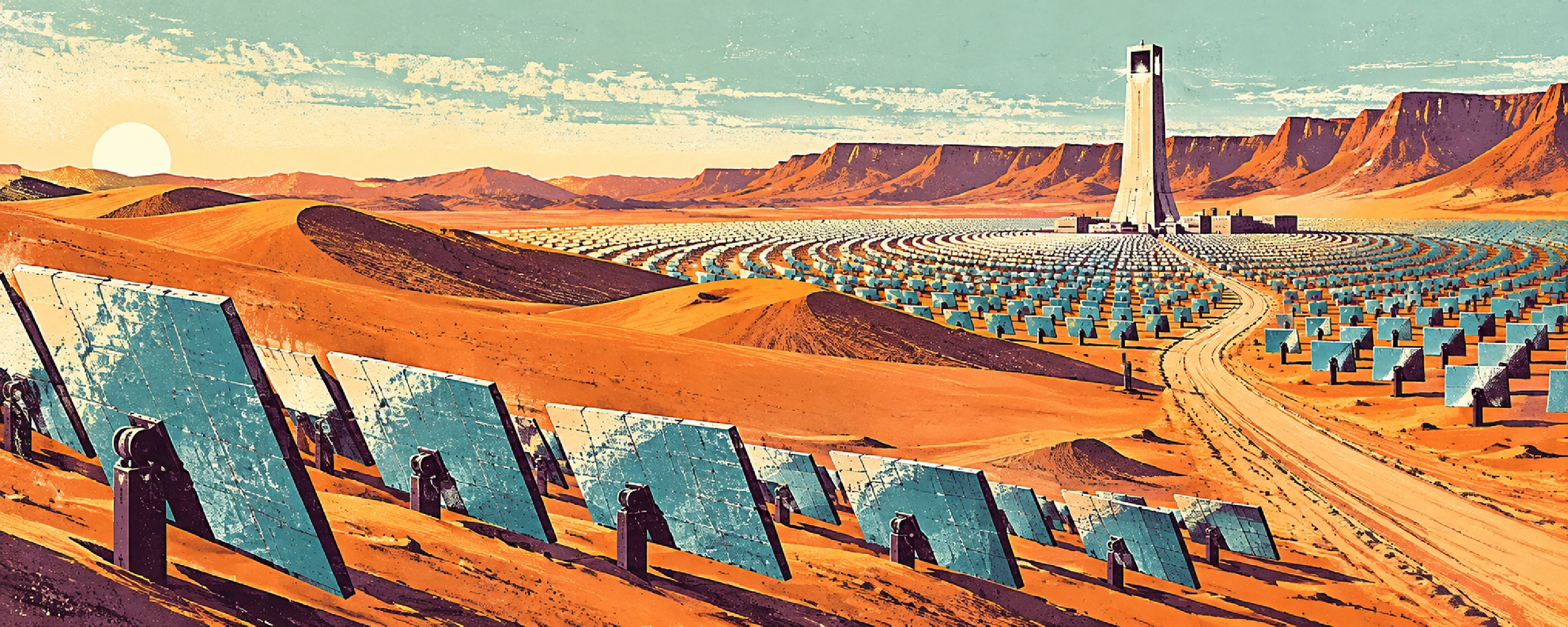
A maintenance road threads through a solar mirror field overtaken by dunes. Angular mirrors and rounded sand banks create a bold screenprinted panorama.
Remix this referenceDunes Across the Mirror Field
- Form language
- Reduce forms to decisive wedges, slabs and broad arcs; alternate repeated angular shapes with generous curved masses.
- Contour
- Let cut silhouettes carry most edges; add occasional blunt tapered lines and slightly uneven stencil boundaries.
- Mark-making
- Use sparse dragged streaks and broken ink scuffs, allowing mark pressure and spacing to vary naturally.
- Surface rendering
- Build screenprinted surfaces from overlapping opaque ink fields, abrupt tonal steps and small expressive registration slips.
Priority
Preserve the decisive shape rhythms and visible ink character of graphic screen printing.
What to avoid & what to check
Exact prompt for this example
MODULE OWNERSHIP
subject: Subject count, type, stable proportions and landmarks, resting face geometry, hair shape, physical materials, garment construction and permanent marks. No emotion, movement, color assignment or rendering recipe.
expression: Facial soft-tissue displacement and pupil direction, muscle coordination, regional intensity, asymmetry and onset/peak/release. No head/body pose, stable appearance, skin color or rendering.
gesture: Head/neck/body/limb orientation, joint movement, support, contact and pose-caused occlusion using existing anatomy. No eye/pupil movement, emotion, identity, props inventory or camera.
props: Prop count, type, construction, physical material and scale relative to the subject. Holding/contact belongs to gesture, position to composition, color to palette.
scene: Environment elements, terrain, backdrop/floor presence and structural detail. No canvas positions, camera, lighting, assigned colors or render texture.
camera: Projection, focal-length impression, camera elevation/yaw/roll, viewing distance and crop. No actor pose, world placement, lighting or canvas aspect ratio.
composition: Normalized 0-100% canvas positions, scale in frame, depth/overlap, focal hierarchy and margins. No joint pose, camera projection, rendering, subject/prop inventory or emotion.
palette: Color anchors, hue/saturation/value ranges, colors assigned to parts and approximate color coverage. No illumination direction, shading algorithm, physical material or layout.
lighting: Light-source direction/softness/intensity, ambient illumination, physical shadow direction/length and highlight position. Absence of directional illumination is allowed. No shading technique, palette or material changes.
style: Reusable form abstraction, contour weight/taper/edge quality, medium and mark scale/density/direction, surface rendering and tonal transition technique. No fixed subject proportions, anatomy, identity, expression, pose, palette, light-source direction, camera or layout.
output: Image count, aspect ratio, size, file/alpha requirements and global lettering/logo/watermark restrictions. No background scenery, crop, style, identity or pose.

SUBJECT
inventory: One solar-furnace tower and one extensive array of heliostat mirrors; no people or animals.
geometry: Rectangular mirror panels have short pivoting supports; the tapering tower ends in a square receiver opening.
resting-face: No facial geometry applies.
appearance: Polished metal mirrors, steel supports and a concrete tower; minor construction details may vary coherently.

PRIORITY


AVOID


CHECK


PROPS
inventory: No separate props.
construction: No prop construction applies.

PRIORITY


AVOID


CHECK


SCENE
inventory: A desert basin contains encroaching dunes, an exposed maintenance road and a distant rocky escarpment.
structure: Sand partly buries the mirror supports; the road reappears between dunes and reaches the tower apron.

PRIORITY


AVOID


CHECK


CAMERA
projection: Rectilinear perspective with a moderately wide lens impression.
viewpoint: Look diagonally down into the basin from a low ridge, with a level horizon.
crop: Use a panoramic environmental view, retaining the whole tower while cropping some nearest mirror panels.

PRIORITY


AVOID


CHECK


COMPOSITION
placement: Large cropped mirrors occupy the lower left; the road leads toward the tower in the upper-right third.
depth: Overlapping mirror rows establish depth; a broad sand bank interrupts them before the distant tower.
spacing: The tower is the destination and the road the connecting thread; spacious sand separates dense mirror groups.

PRIORITY


AVOID


CHECK


PALETTE
colors: Use burnt orange, pale turquoise, deep aubergine and warm ivory; restrain saturation outside the orange.
assignment: Assign orange to sand, turquoise to mirrors, aubergine to supports and recesses, and ivory to sky and tower.
balance: Orange and ivory dominate broad areas; turquoise repeats as accents and aubergine supplies compact dark anchors.

PRIORITY


AVOID


CHECK


LIGHTING
sources: Broad low sunlight enters from the left, with gentle ambient illumination across the basin.
shadows: Supports cast long shadows to the right; dune hollows remain softly shaded.
highlights: Light catches left-facing dune crests and selected mirror edges.

PRIORITY


AVOID


CHECK


STYLE GUIDE
form-language: Reduce forms to decisive wedges, slabs and broad arcs; alternate repeated angular shapes with generous curved masses.
contour: Let cut silhouettes carry most edges; add occasional blunt tapered lines and slightly uneven stencil boundaries.
mark-making: Use sparse dragged streaks and broken ink scuffs, allowing mark pressure and spacing to vary naturally.
surface-rendering: Build screenprinted surfaces from overlapping opaque ink fields, abrupt tonal steps and small expressive registration slips.

PRIORITY
Preserve the decisive shape rhythms and visible ink character of graphic screen printing.

AVOID


CHECK


OUTPUT
format: One finished image, 5:2 aspect ratio, 3000 × 1200 pixels, opaque PNG.
restrictions: No lettering, logos or watermarks.

PRIORITY


AVOID


CHECK


FINAL INTEGRATION
scene + composition: Use environmental interruptions to give the visual journey a sequence of concealment and rediscovery.
palette + lighting + style: Translate illumination through the print vocabulary while preserving the assigned color roles.
Model information comes from image provenance. The same prompt may produce a different result.