Text to imageAnimationStyle guide
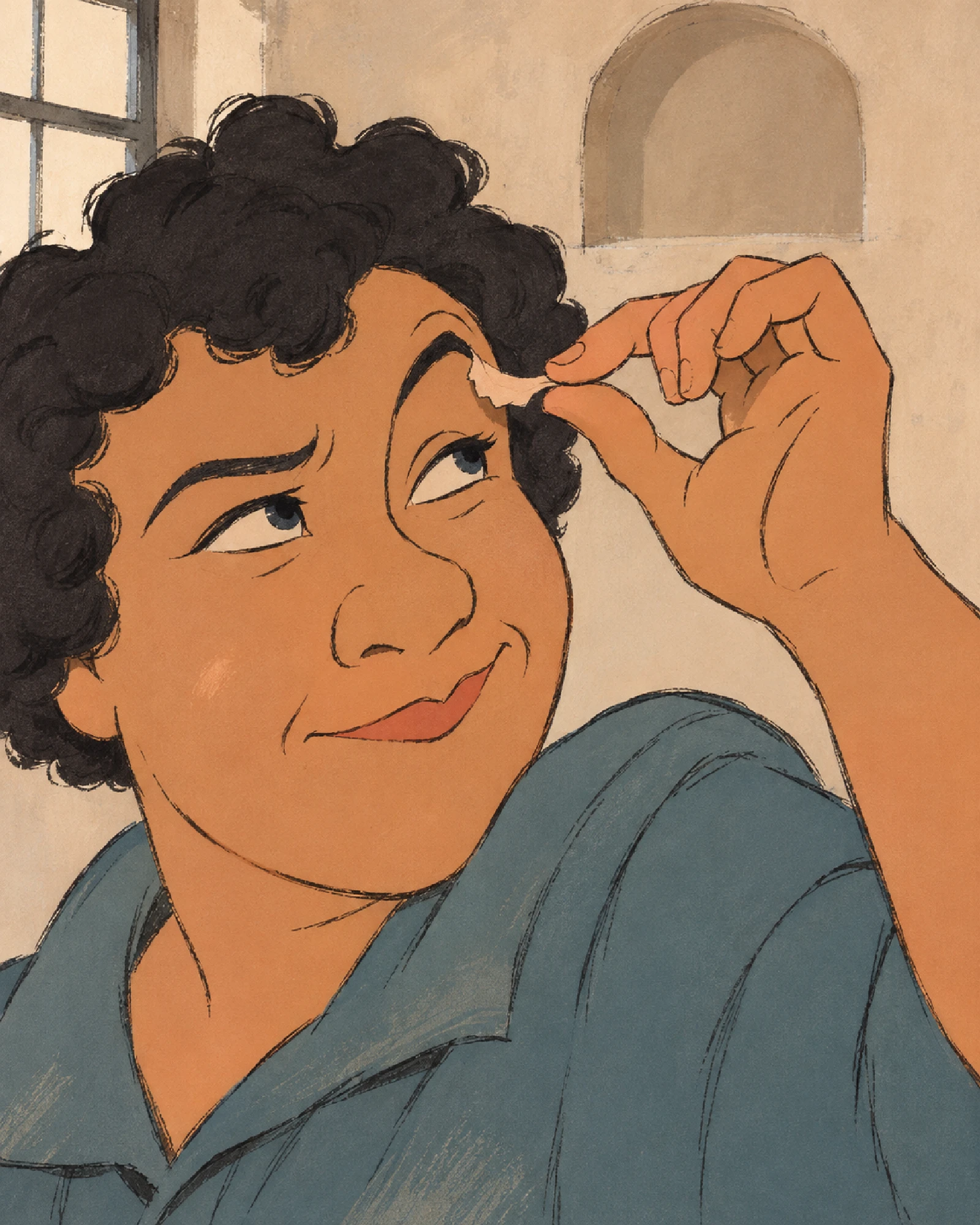
A Potter Peeling Clay from Her Eyebrow
An intimate close-up catches a potter's crooked smile as she squints and peels dried clay from her eyebrow. Irregular pencil contours and slightly misregistered cel fills give the small mishap an unpolished warmth.
Remix this referenceA Potter Peeling Clay from Her Eyebrow
- Form language
- Reduce forms to legible curved masses with selective angular breaks; allow minor shapes to vary within this shorthand.
- Contour
- Use sketch-like contours with slight weight fluctuations, tapered departures and occasional open edges instead of uniform ink closure.
- Mark-making
- Retain selective short doubled traces and broken pencil strokes; vary their rhythm naturally rather than applying an even texture.
- Surface rendering
- Use opaque cel fills with few tonal steps and slight line-to-fill misregistration, alongside sparse dry-brushed painted passages.
Priority
Rendering medium: hand-drawn 2D xerographic cel-animation illustration; formal rendering reference: Walt Disney Studios · 1960s · One Hundred and One Dalmatians (1961)
What to avoid & what to check
Exact prompt for this example
MODULE OWNERSHIP
subject: Subject count, type, stable proportions and landmarks, resting face geometry, hair shape, physical materials, garment construction and permanent marks. No emotion, movement, color assignment or rendering recipe.
expression: Facial soft-tissue displacement and pupil direction, muscle coordination, regional intensity, asymmetry and onset/peak/release. No head/body pose, stable appearance, skin color or rendering.
gesture: Head/neck/body/limb orientation, joint movement, support, contact and pose-caused occlusion using existing anatomy. No eye/pupil movement, emotion, identity, props inventory or camera.
props: Prop count, type, construction, physical material and scale relative to the subject. Holding/contact belongs to gesture, position to composition, color to palette.
scene: Environment elements, terrain, backdrop/floor presence and structural detail. No canvas positions, camera, lighting, assigned colors or render texture.
camera: Projection, focal-length impression, camera elevation/yaw/roll, viewing distance and crop. No actor pose, world placement, lighting or canvas aspect ratio.
composition: Normalized 0-100% canvas positions, scale in frame, depth/overlap, focal hierarchy and margins. No joint pose, camera projection, rendering, subject/prop inventory or emotion.
palette: Color anchors, hue/saturation/value ranges, colors assigned to parts and approximate color coverage. No illumination direction, shading algorithm, physical material or layout.
lighting: Light-source direction/softness/intensity, ambient illumination, physical shadow direction/length and highlight position. Absence of directional illumination is allowed. No shading technique, palette or material changes.
style: Reusable form abstraction, contour weight/taper/edge quality, medium and mark scale/density/direction, surface rendering and tonal transition technique. No fixed subject proportions, anatomy, identity, expression, pose, palette, light-source direction, camera or layout.
output: Image count, aspect ratio, size, file/alpha requirements and global lettering/logo/watermark restrictions. No background scenery, crop, style, identity or pose.

SUBJECT
inventory: One original adult human potter, actor A.
geometry: A broad oval face, substantial nose, compact neck and sturdy shoulders establish her recognizable construction.
resting-face: At rest, thick brows sit low above almond-shaped eyes; a wide mouth has a distinct shallow upper-lip notch.
appearance: Short, tightly curled hair forms an uneven cap; a woven cotton work smock has a broad folded collar.

PRIORITY


AVOID


CHECK


EXPRESSION — ACTOR A
brows: Her left brow arches while the right inner brow draws inward slightly.
lids: The left eye narrows; the right upper lid remains relaxed and open.
cheeks: The right cheek bunches more strongly than the left.
nose: Nostrils remain relaxed, with no bridge wrinkle.
mouth: The closed right mouth corner lifts farther into a crooked smile.
jaw: The jaw stays loosely settled without dropping.
gaze: Both pupils turn upward toward the clay flake.
coordination: The uneven smile and single narrowed eye suggest amusement at her own small mishap.
timing: Catch the first instant of the smile, before it opens into laughter.

PRIORITY


AVOID


CHECK


GESTURE
head: Her chin tucks slightly and her head inclines toward the raised left shoulder.
torso: Her torso turns gently away from the working arm, with the left shoulder lifted.
limbs: Her left elbow bends outward; thumb and forefinger make a delicate pinch beside the brow.
contact: The fingertips grip one lifted edge of the flake while its other edge still touches the eyebrow.

PRIORITY


AVOID


CHECK


PROPS
inventory: One dried clay flake, approximately thumb-length.
construction: A thin, brittle crescent of unglazed clay with a curled edge and an irregular fracture.

PRIORITY


AVOID


CHECK


SCENE
inventory: A pottery workshop interior with a plaster wall, shallow arched niche and deep window reveal; no floor is visible.
structure: The niche is empty, and the window opening has a thick masonry surround with an uneven plaster lip.

PRIORITY


AVOID


CHECK


CAMERA
projection: Perspective with a gentle portrait-lens impression and little facial distortion.
viewpoint: Eye-height, shallow three-quarter view from her left, at intimate conversational distance; no roll.
crop: Close portrait from the clipped hair crown to the upper chest; the working fingertips remain fully visible.

PRIORITY


AVOID


CHECK


COMPOSITION
placement: The face dominates left of center; the hand occupies the upper right, and the flake sits just above her left eyebrow.
depth: The hand overlaps the temple without covering the eyes; the workshop recesses remain subordinate behind her.
spacing: The face reads first, followed by the flake and fingertips; leave open wall space beyond the hand.

PRIORITY


AVOID


CHECK


PALETTE
colors: Warm ochre, dusty petrol blue, chalk cream and charcoal, with a small coral accent.
assignment: Ochre skin, charcoal hair, petrol-blue smock, cream wall and clay flake, and muted coral lips.
balance: Cream and ochre carry most of the image; blue forms a substantial counterweight and coral stays scarce.

PRIORITY


AVOID


CHECK


LIGHTING
sources: Broad, soft window light arrives from upper left with generous ambient fill.
shadows: Short, soft shadows fall down and right beneath the fingers, nose and collar.
highlights: Restrained highlights touch the upper-left cheek plane and the lifted edge of the clay.

PRIORITY


AVOID


CHECK


STYLE GUIDE
form-language: Reduce forms to legible curved masses with selective angular breaks; allow minor shapes to vary within this shorthand.
contour: Use sketch-like contours with slight weight fluctuations, tapered departures and occasional open edges instead of uniform ink closure.
mark-making: Retain selective short doubled traces and broken pencil strokes; vary their rhythm naturally rather than applying an even texture.
surface-rendering: Use opaque cel fills with few tonal steps and slight line-to-fill misregistration, alongside sparse dry-brushed painted passages.

PRIORITY
Rendering medium: hand-drawn 2D xerographic cel-animation illustration; formal rendering reference: Walt Disney Studios · 1960s · One Hundred and One Dalmatians (1961)

AVOID


CHECK


OUTPUT
format: One finished image, portrait 4:5 aspect ratio, 1600 × 2000 pixels, opaque PNG.
restrictions: No lettering, logos, signatures or watermarks.

PRIORITY


AVOID


CHECK


FINAL INTEGRATION
expression + gesture + composition: Coordinate the facial acting and hand action so both remain readable within the close arrangement.
Art direction
디즈니 / Walt Disney Studios · 1960s · 101마리 달마시안(1961) / One Hundred and One Dalmatians (1961) ↗- Use legible form masses with selective angular simplification
- Sketch-like contours with small weight irregularities instead of polished ink uniformity
- Retain selective short doubled contour traces and broken pencil-like marks
- Flat fills with few tonal levels and slight line-to-fill edge misregistration
Model information comes from image provenance. The same prompt may produce a different result.