Text to imageAnimationStyle guide
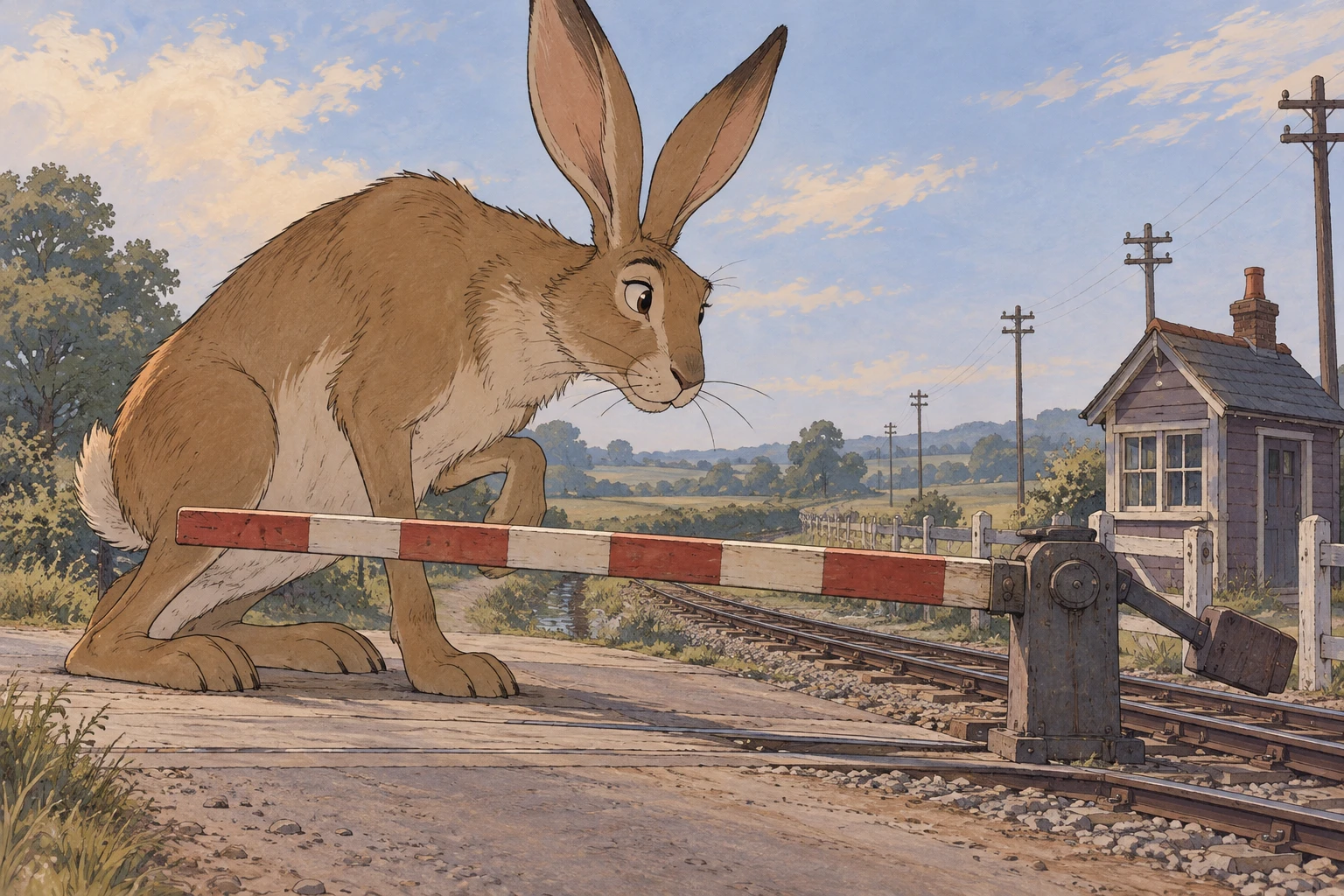
A Giant Hare at the Level Crossing
A house-sized hare pauses before a lowered country crossing gate, one forepaw suspended as it peers along the rails. Its enormous size and careful patience create quiet humor.
Remix this referenceA Giant Hare at the Level Crossing
- Form language
- Build legible masses with selective angular simplification; let secondary shapes vary naturally within the same economical drawing language.
- Contour
- Use sketch-like xerographic contours with small weight irregularities, tapered exits and occasional open joins instead of polished ink uniformity.
- Mark-making
- Retain selective short doubled traces and broken pencil marks; vary accent strokes with loose, longer sweeps and economical detail.
- Surface rendering
- Combine flat cel fills and a few decisive tonal steps with slight line-to-fill misregistration; vary painted edges with uneven, brush-led boundaries.
Priority
Rendering medium: hand-drawn 2D xerographic cel-animation illustration; formal rendering reference: Walt Disney Studios · 1960s · One Hundred and One Dalmatians (1961)
What to avoid & what to check
Exact prompt for this example
MODULE OWNERSHIP
subject: Subject count, type, stable proportions and landmarks, resting face geometry, hair shape, physical materials, garment construction and permanent marks. No emotion, movement, color assignment or rendering recipe.
expression: Facial soft-tissue displacement and pupil direction, muscle coordination, regional intensity, asymmetry and onset/peak/release. No head/body pose, stable appearance, skin color or rendering.
gesture: Head/neck/body/limb orientation, joint movement, support, contact and pose-caused occlusion using existing anatomy. No eye/pupil movement, emotion, identity, props inventory or camera.
props: Prop count, type, construction, physical material and scale relative to the subject. Holding/contact belongs to gesture, position to composition, color to palette.
scene: Environment elements, terrain, backdrop/floor presence and structural detail. No canvas positions, camera, lighting, assigned colors or render texture.
camera: Projection, focal-length impression, camera elevation/yaw/roll, viewing distance and crop. No actor pose, world placement, lighting or canvas aspect ratio.
composition: Normalized 0-100% canvas positions, scale in frame, depth/overlap, focal hierarchy and margins. No joint pose, camera projection, rendering, subject/prop inventory or emotion.
palette: Color anchors, hue/saturation/value ranges, colors assigned to parts and approximate color coverage. No illumination direction, shading algorithm, physical material or layout.
lighting: Light-source direction/softness/intensity, ambient illumination, physical shadow direction/length and highlight position. Absence of directional illumination is allowed. No shading technique, palette or material changes.
style: Reusable form abstraction, contour weight/taper/edge quality, medium and mark scale/density/direction, surface rendering and tonal transition technique. No fixed subject proportions, anatomy, identity, expression, pose, palette, light-source direction, camera or layout.
output: Image count, aspect ratio, size, file/alpha requirements and global lettering/logo/watermark restrictions. No background scenery, crop, style, identity or pose.

SUBJECT
inventory: One original adult hare; no other characters.
geometry: House-sized, with tall blade-shaped ears, a narrow chest, deep haunches and long hind feet.
resting-face: A tapered muzzle, broad-set eyes and a small split upper lip establish the resting face; no human eyebrows.
appearance: Short fur with a modest cheek ruff and a compact tail; no clothing or permanent markings.

PRIORITY


AVOID


CHECK


EXPRESSION — ACTOR A
brows: The inner brow planes lift slightly.
lids: Upper lids rise a little; lower lids remain loose.
cheeks: Cheek pads remain unbunched, with a faint forward tension.
nose: The nose tip lifts subtly while the nostrils stay relaxed.
mouth: The split lips meet lightly, without a smile or tooth display.
jaw: The jaw stays nearly closed and free of clenching.
gaze: Visible pupils shift to the right.
coordination: The upper face leads the inquiry while the muzzle stays quiet.
timing: Catch the first attentive instant, before any stronger reaction.

PRIORITY


AVOID


CHECK


GESTURE
head: A lowers its head toward the crossing, extending its neck; both ears incline forward.
torso: The torso pauses in a shallow forward lean, with the haunches settled back.
limbs: One forepaw lifts with a loosely folded wrist; the other foreleg and both hind feet support the body.
contact: The supporting paws meet the road; the raised paw and muzzle remain clear of the boom.

PRIORITY


AVOID


CHECK


PROPS
inventory: One ordinary railway crossing gate, small beside the hare's chest.
construction: A long timber boom attached to a metal pivot housing, with a simple counterweight.

PRIORITY


AVOID


CHECK


SCENE
inventory: A rural level crossing with a narrow road, railway tracks, a keeper's hut, telegraph poles and fields.
structure: Rails cut across the road on a gravel bed; a shallow drainage ditch borders the fields. No train is visible.

PRIORITY


AVOID


CHECK


CAMERA
projection: Use perspective with a natural wide-lens impression and restrained depth expansion.
viewpoint: View from low roadside height, obliquely across the crossing toward the hare's three-quarter face; keep the camera level.
crop: A medium-wide environmental view includes the complete hare and enough railway approach to explain the setting.

PRIORITY


AVOID


CHECK


COMPOSITION
placement: The hare occupies roughly the left 60% of the canvas; the lowered gate crosses the lower middle and the hut sits farther right.
depth: The gate overlaps the hare's lower silhouette; the hut and diminishing poles establish its startling scale. Fields lie in the distance.
spacing: Lead with the face and forepaw, then follow the rails receding right into open space; leave breathing room above the ears.

PRIORITY


AVOID


CHECK


PALETTE
colors: Use warm oatmeal, smoky violet, faded vermilion, pale mint and charcoal as the principal anchors.
assignment: Oatmeal fur with violet accents; vermilion and cream on the boom; mint fields, a violet hut and charcoal rails.
balance: Quiet pale colors dominate; the gate supplies the strongest small accent, with darks used sparingly.

PRIORITY


AVOID


CHECK


LIGHTING
sources: Broad, soft morning light arrives from the upper left, supported by gentle open-sky ambient light.
shadows: Soft ground shadows extend a short distance to the right; contact shadows anchor the supporting paws.
highlights: Keep highlights broad and subdued along the left ear edges, upper muzzle and gate housing.

PRIORITY


AVOID


CHECK


STYLE GUIDE
form-language: Build legible masses with selective angular simplification; let secondary shapes vary naturally within the same economical drawing language.
contour: Use sketch-like xerographic contours with small weight irregularities, tapered exits and occasional open joins instead of polished ink uniformity.
mark-making: Retain selective short doubled traces and broken pencil marks; vary accent strokes with loose, longer sweeps and economical detail.
surface-rendering: Combine flat cel fills and a few decisive tonal steps with slight line-to-fill misregistration; vary painted edges with uneven, brush-led boundaries.

PRIORITY
Rendering medium: hand-drawn 2D xerographic cel-animation illustration; formal rendering reference: Walt Disney Studios · 1960s · One Hundred and One Dalmatians (1961)

AVOID


CHECK


OUTPUT
format: One finished image, landscape 3:2, 1536 × 1024 pixels, opaque PNG.
restrictions: No lettering, logos, signatures or watermarks.

PRIORITY


AVOID


CHECK
Art direction
디즈니 / Walt Disney Studios · 1960s · 101마리 달마시안(1961) / One Hundred and One Dalmatians (1961) ↗- Use legible form masses with selective angular simplification
- Sketch-like contours with small weight irregularities instead of polished ink uniformity
- Retain selective short doubled contour traces and broken pencil-like marks
- Flat fills with few tonal levels and slight line-to-fill edge misregistration
Model information comes from image provenance. The same prompt may produce a different result.