Text to imageCalligraphyStyle guide
Lettering and a Tiny Bakery on a Flour Sack
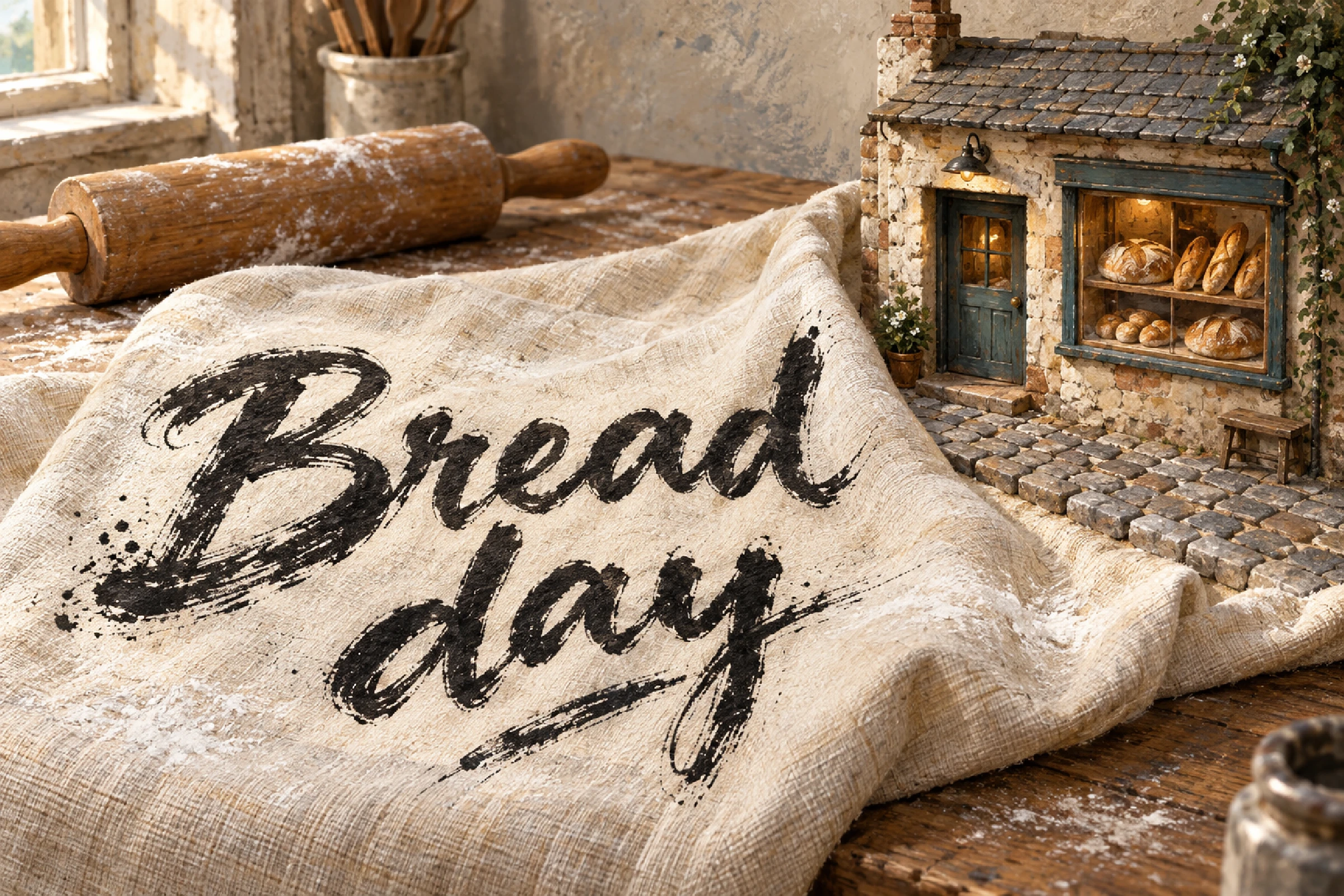
On a full-size bakery workbench, a flour sack's fold becomes a tiny bakery street. Expansive dry-brush lettering and a miniature doorway create a playful change of scale.
Remix this referenceLettering and a Tiny Bakery on a Flour Sack
- Form language
- Reduce supporting architecture and objects to sturdy, slightly irregular shapes; let letterforms carry the most articulate shapes.
- Contour
- Brush contours swell under pressure and fray at their edges; supporting outlines remain sparse and lightly interrupted.
- Mark-making
- Drag a partly dry broad brush into split bristle trails, alternating loaded starts with skipping tails; vary marks naturally.
- Surface rendering
- Use thin ink washes and rubbed dry-brush passages for supporting surfaces; leave the underlying surface visible through broken strokes and soften tonal transitions.
Priority
Keep expressive, broken-edge dry-brush calligraphy visibly dominant as the rendering treatment.
What to avoid & what to check
Exact prompt for this example
MODULE OWNERSHIP
subject: Subject count, type, stable proportions and landmarks, resting face geometry, hair shape, physical materials, garment construction and permanent marks. No emotion, movement, color assignment or rendering recipe.
expression: Facial soft-tissue displacement and pupil direction, muscle coordination, regional intensity, asymmetry and onset/peak/release. No head/body pose, stable appearance, skin color or rendering.
gesture: Head/neck/body/limb orientation, joint movement, support, contact and pose-caused occlusion using existing anatomy. No eye/pupil movement, emotion, identity, props inventory or camera.
props: Prop count, type, construction, physical material and scale relative to the subject. Holding/contact belongs to gesture, position to composition, color to palette.
scene: Environment elements, terrain, backdrop/floor presence and structural detail. No canvas positions, camera, lighting, assigned colors or render texture.
camera: Projection, focal-length impression, camera elevation/yaw/roll, viewing distance and crop. No actor pose, world placement, lighting or canvas aspect ratio.
composition: Normalized 0-100% canvas positions, scale in frame, depth/overlap, focal hierarchy and margins. No joint pose, camera projection, rendering, subject/prop inventory or emotion.
palette: Color anchors, hue/saturation/value ranges, colors assigned to parts and approximate color coverage. No illumination direction, shading algorithm, physical material or layout.
lighting: Light-source direction/softness/intensity, ambient illumination, physical shadow direction/length and highlight position. Absence of directional illumination is allowed. No shading technique, palette or material changes.
style: Reusable form abstraction, contour weight/taper/edge quality, medium and mark scale/density/direction, surface rendering and tonal transition technique. No fixed subject proportions, anatomy, identity, expression, pose, palette, light-source direction, camera or layout.
output: Image count, aspect ratio, size, file/alpha requirements and global lettering/logo/watermark restrictions. No background scenery, crop, style, identity or pose.

SUBJECT
inventory: One English calligraphic inscription; no human or animal subjects.
geometry: The inscription reads "Bread day"; recognizable letter skeletons retain open counters and distinct word separation.
resting-face: No faces are present.
appearance: The inscription consists of ink deposited directly on woven fabric.

PRIORITY


AVOID


CHECK


PROPS
inventory: One full-size flour sack and one ordinary rolling pin establish the scale around the miniature architecture.
construction: The sack is soft woven cloth with a folded mouth; the rolling pin is a plain wooden cylinder with integral handles.

PRIORITY


AVOID


CHECK


SCENE
inventory: A bakery workroom contains a workbench; a miniature bakery frontage and short cobbled street form a second environment.
structure: The tiny frontage has a recessed doorway, shallow bread-display window and low curb; the workroom has a plain rear wall.

PRIORITY


AVOID


CHECK


CAMERA
projection: Use natural perspective with a moderately wide lens impression.
viewpoint: Look obliquely down across the workbench from a slightly elevated three-quarter viewpoint, without roll.
crop: Frame the complete inscription and tiny frontage while cropping the surrounding workbench and rear wall.

PRIORITY


AVOID


CHECK


COMPOSITION
placement: The sack spreads across the lower left and middle; the tiny frontage occupies its far-right fold, with the pin near the upper left.
depth: The street follows the sack fold into the frontage; lettering remains foremost, architecture second, workroom last.
spacing: Give the inscription a broad uninterrupted field; leave breathing room around its terminals and a quiet upper margin.

PRIORITY


AVOID


CHECK


PALETTE
colors: Use warm chalk, charcoal black, muted wheat ochre and a small amount of dusty teal.
assignment: Assign chalk to the sack and wall, black to lettering, ochre to wood and bread, and teal to the tiny doorway.
balance: Pale neutrals dominate; dark lettering provides the strongest contrast, with restrained warm areas and one cool accent.

PRIORITY


AVOID


CHECK


LIGHTING
sources: Soft daylight enters from the upper left, supported by gentle ambient illumination.
shadows: Short, soft shadows fall toward the lower right beneath the fabric folds and miniature building.
highlights: Broad highlights touch the raised folds and the rolling pin's upper surface.

PRIORITY


AVOID


CHECK


STYLE GUIDE
form-language: Reduce supporting architecture and objects to sturdy, slightly irregular shapes; let letterforms carry the most articulate shapes.
contour: Brush contours swell under pressure and fray at their edges; supporting outlines remain sparse and lightly interrupted.
mark-making: Drag a partly dry broad brush into split bristle trails, alternating loaded starts with skipping tails; vary marks naturally.
surface-rendering: Use thin ink washes and rubbed dry-brush passages for supporting surfaces; leave the underlying surface visible through broken strokes and soften tonal transitions.

PRIORITY
Keep expressive, broken-edge dry-brush calligraphy visibly dominant as the rendering treatment.

AVOID


CHECK


OUTPUT
format: One finished image, landscape 3:2, 2400 × 1600 pixels, PNG with an opaque background.
restrictions: Allow readable primary lettering; forbid additional text, logos and watermarks.

PRIORITY


AVOID


CHECK


FINAL INTEGRATION
props + scene + composition: The fabric fold connects the ordinary workbench to the miniature street, making both scales belong to one continuous scene.
subject + style: Natural brush breaks enrich the lettering while its underlying letter skeletons preserve immediate readability.
subject + output: Render "Bread day" as the permitted primary lettering, preserving its exact spelling and readable word separation.
Model information comes from image provenance. The same prompt may produce a different result.