Text to imageAnimationStyle guide
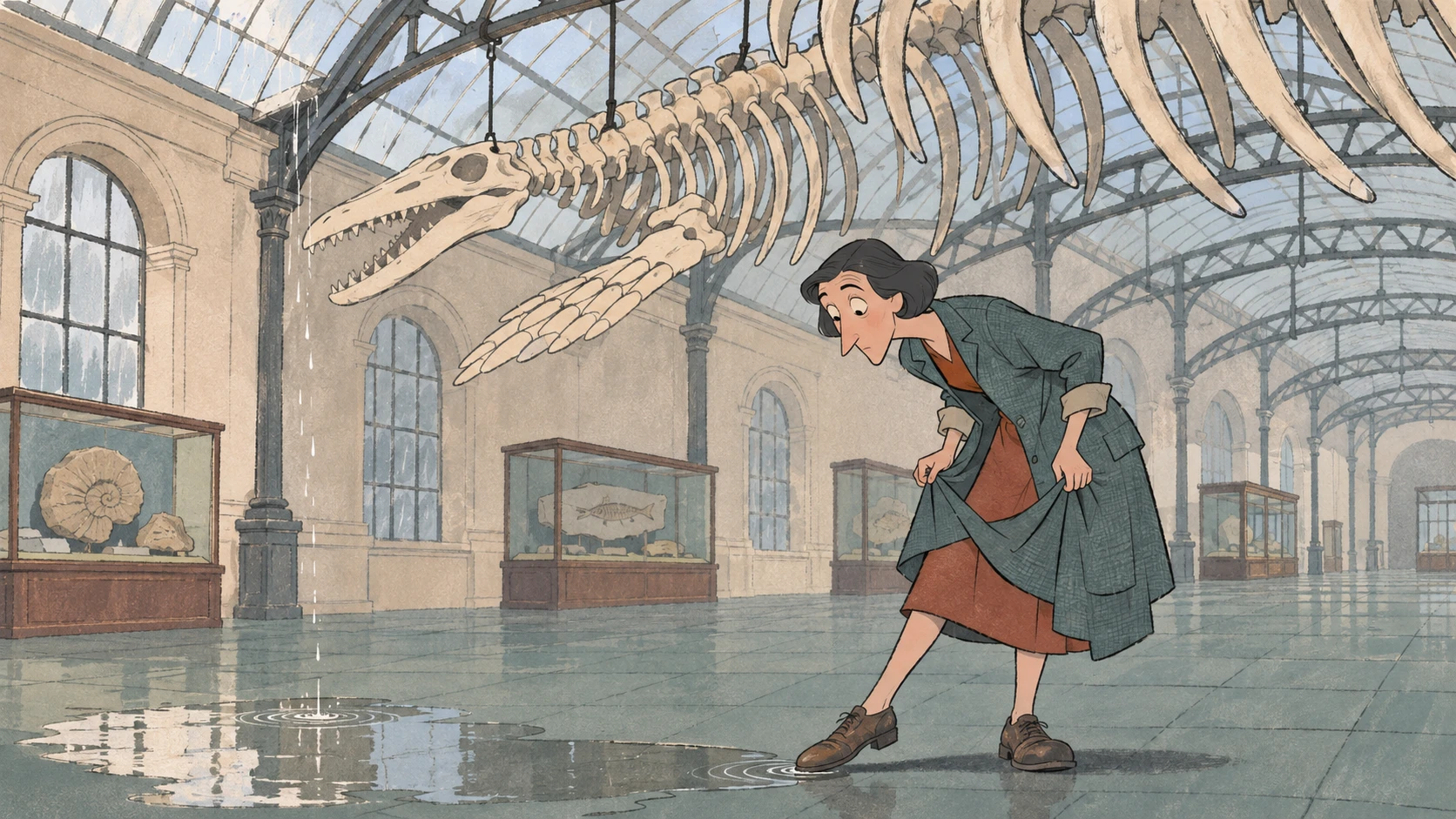
A Museum Attendant Testing a Puddle
Beneath an enormous marine reptile skeleton, a museum attendant tests a small puddle with her shoe. The lofty gallery and her modest curiosity meet in restless pencil contours and restrained cel color.
Remix this referenceA Museum Attendant Testing a Puddle
- Form language
- Build readable masses from economical curves interrupted by selective angular cuts; simplify secondary detail and allow coherent local variation.
- Contour
- Use lively graphite-like contours with small weight fluctuations, tapered ends and occasional open edges rather than uniform polished outlines.
- Mark-making
- Retain selective short doubled traces and broken pencil strokes; let sparse dry-brush scumbles interrupt broad painted passages.
- Surface rendering
- Use flat cel fills with few stepped tonal changes and slight line-to-fill misregistration; wash passages retain uneven pigment edges.
Priority
Rendering medium: hand-drawn 2D xerographic cel-animation illustration; formal rendering reference: Walt Disney Studios · 1960s · One Hundred and One Dalmatians (1961)
What to avoid & what to check
Exact prompt for this example
MODULE OWNERSHIP
subject: Subject count, type, stable proportions and landmarks, resting face geometry, hair shape, physical materials, garment construction and permanent marks. No emotion, movement, color assignment or rendering recipe.
expression: Facial soft-tissue displacement and pupil direction, muscle coordination, regional intensity, asymmetry and onset/peak/release. No head/body pose, stable appearance, skin color or rendering.
gesture: Head/neck/body/limb orientation, joint movement, support, contact and pose-caused occlusion using existing anatomy. No eye/pupil movement, emotion, identity, props inventory or camera.
props: Prop count, type, construction, physical material and scale relative to the subject. Holding/contact belongs to gesture, position to composition, color to palette.
scene: Environment elements, terrain, backdrop/floor presence and structural detail. No canvas positions, camera, lighting, assigned colors or render texture.
camera: Projection, focal-length impression, camera elevation/yaw/roll, viewing distance and crop. No actor pose, world placement, lighting or canvas aspect ratio.
composition: Normalized 0-100% canvas positions, scale in frame, depth/overlap, focal hierarchy and margins. No joint pose, camera projection, rendering, subject/prop inventory or emotion.
palette: Color anchors, hue/saturation/value ranges, colors assigned to parts and approximate color coverage. No illumination direction, shading algorithm, physical material or layout.
lighting: Light-source direction/softness/intensity, ambient illumination, physical shadow direction/length and highlight position. Absence of directional illumination is allowed. No shading technique, palette or material changes.
style: Reusable form abstraction, contour weight/taper/edge quality, medium and mark scale/density/direction, surface rendering and tonal transition technique. No fixed subject proportions, anatomy, identity, expression, pose, palette, light-source direction, camera or layout.
output: Image count, aspect ratio, size, file/alpha requirements and global lettering/logo/watermark restrictions. No background scenery, crop, style, identity or pose.

SUBJECT
inventory: One original adult woman, a museum attendant; no other living figures.
geometry: A lanky build with a compact oval head, long wedge-shaped nose, narrow shoulders and broad practical shoes.
resting-face: Wide-set small eyes, straight brows, a long upper lip and a narrow mouth establish her resting features.
appearance: A blunt bob tucked behind the ears; a woven work coat over a plain dress, turned cuffs and worn leather shoes.

PRIORITY


AVOID


CHECK


EXPRESSION — ACTOR A
brows: One inner brow rises slightly while the other stays nearly level.
lids: Upper lids lift modestly; lower lids remain loose.
cheeks: Cheeks remain relaxed without a smile-driven lift.
nose: Nostrils stay relaxed and the bridge remains unwrinkled.
mouth: Lips meet lightly, with one corner drawn inward a little.
jaw: Jaw stays closed without clenching.
gaze: Pupils point down toward the shoe.
coordination: The questioning brow leads; the mouth barely responds.
timing: Capture curiosity just beginning, before any larger reaction.

PRIORITY


AVOID


CHECK


GESTURE
head: Her neck extends and her head tips down toward the extended foot.
torso: She hinges forward gently at the hips, keeping her weight over the supporting leg.
limbs: One leg supports her; the other reaches forward with its heel raised. Both elbows bend close to her sides.
contact: Her shoe tip just dimples the puddle; her fingertips gather the coat hem clear of the water.

PRIORITY


AVOID


CHECK


PROPS
inventory: No separate props.
construction: No prop construction applies.

PRIORITY


AVOID


CHECK


SCENE
inventory: A lofty natural-history gallery with a suspended marine reptile fossil, glazed roof bays, tiled floor and a shallow rain puddle.
structure: Iron roof trusses span successive gallery bays. The articulated fossil hangs from slender rods; a leaking roof joint feeds the puddle.

PRIORITY


AVOID


CHECK


CAMERA
projection: Natural perspective with a moderately wide lens impression and restrained edge distortion.
viewpoint: View from just below standing eye level, obliquely along the gallery, with a level horizon.
crop: A spacious full-figure view includes generous overhead architecture; the nearest fossil ribs continue beyond the upper edge.

PRIORITY


AVOID


CHECK


COMPOSITION
placement: Place the attendant around 65% across and 62% down, about half the image height; the puddle opens toward the lower left.
depth: Large fossil ribs overlap the upper foreground, the attendant occupies the middle distance, and repeating bays recede behind her.
spacing: The shoe and nearby water lead, her face follows, and the fossil supplies the broad secondary rhythm; preserve open floor around the foot.

PRIORITY


AVOID


CHECK


PALETTE
colors: Use parchment ivory, smoky teal, muted russet and charcoal, with a small pale skin-tone range.
assignment: Ivory belongs to the fossil and walls, teal to the coat and floor, russet to the dress, charcoal to hair and structural accents.
balance: Let pale neutrals dominate, teal carry the larger color masses and russet provide a restrained warm accent.

PRIORITY


AVOID


CHECK


LIGHTING
sources: Broad soft daylight enters from the upper left through the roof glazing, supported by gentle ambient light.
shadows: Diffuse shadows fall toward the lower right; the shoe and supporting foot have the clearest contact shadows.
highlights: A broad reflection gathers along the puddle's left edge; the upper-left planes of face and fossil receive soft highlights.

PRIORITY


AVOID


CHECK


STYLE GUIDE
form-language: Build readable masses from economical curves interrupted by selective angular cuts; simplify secondary detail and allow coherent local variation.
contour: Use lively graphite-like contours with small weight fluctuations, tapered ends and occasional open edges rather than uniform polished outlines.
mark-making: Retain selective short doubled traces and broken pencil strokes; let sparse dry-brush scumbles interrupt broad painted passages.
surface-rendering: Use flat cel fills with few stepped tonal changes and slight line-to-fill misregistration; wash passages retain uneven pigment edges.

PRIORITY
Rendering medium: hand-drawn 2D xerographic cel-animation illustration; formal rendering reference: Walt Disney Studios · 1960s · One Hundred and One Dalmatians (1961)

AVOID


CHECK


OUTPUT
format: One image.
restrictions: Deliver one opaque PNG, 1920 × 1080 pixels, 16:9. No lettering, logos or watermarks.

PRIORITY


AVOID


CHECK


FINAL INTEGRATION
expression + gesture: Let the facial response and physical action feel like the same brief, unhurried observation.
scene + composition + style: Keep the setting legible through its layers while allowing the drawing to remain loose and selective.
Art direction
디즈니 / Walt Disney Studios · 1960s · 101마리 달마시안(1961) / One Hundred and One Dalmatians (1961) ↗- Use legible form masses with selective angular simplification
- Sketch-like contours with small weight irregularities instead of polished ink uniformity
- Retain selective short doubled contour traces and broken pencil-like marks
- Flat fills with few tonal levels and slight line-to-fill edge misregistration
Model information comes from image provenance. The same prompt may produce a different result.