Text to imageCharacterStyle guide
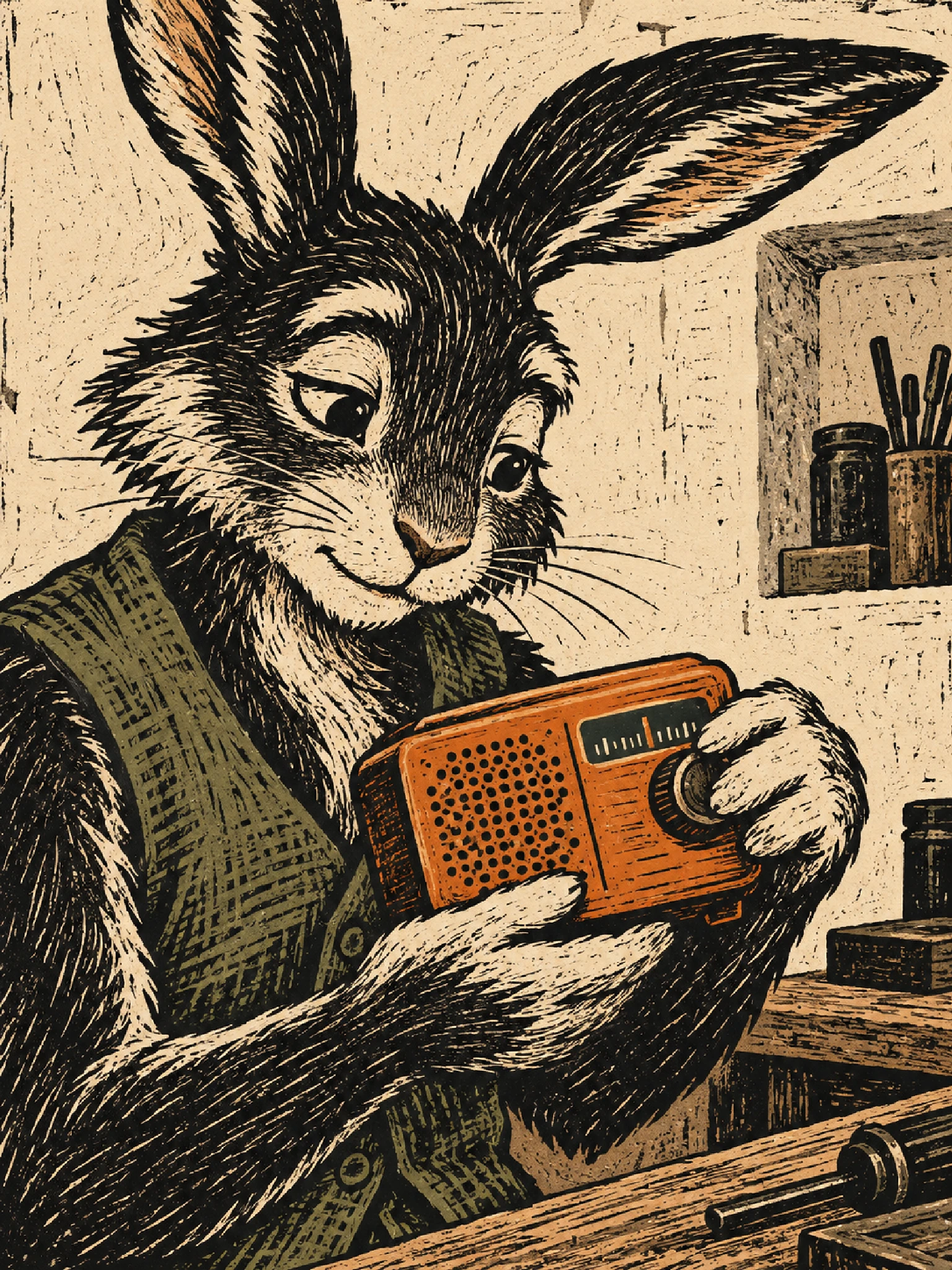
Hare Listening to a Radio
An elderly hare repairer listens as a small radio comes back to life. Cropped ears and close forepaws create an intimate character image, energized by rhythmic carved marks in bold linocut.
Remix this referenceHare Listening to a Radio
- Form language
- Reduce forms into assertive joined masses with wedge-like internal breaks; preserve recognizable silhouettes through economical detail.
- Contour
- Use heavy printed edges with slight bite and uneven swelling; reserve thin incisions for internal divisions rather than uniform outlines.
- Mark-making
- Carve rhythmic hooked strokes and short gouge bundles that curve with local surfaces; vary their spacing and endings by hand.
- Surface rendering
- Let dense ink fields meet exposed paper through carved reserves; retain patchy ink bite and slight overprint at selected color boundaries.
Priority
The defining treatment is bold linocut with visibly carved rhythmic marks and forceful printed edges
What to avoid & what to check
Exact prompt for this example
MODULE OWNERSHIP
subject: Subject count, type, stable proportions and landmarks, resting face geometry, hair shape, physical materials, garment construction and permanent marks. No emotion, movement, color assignment or rendering recipe.
expression: Facial soft-tissue displacement and pupil direction, muscle coordination, regional intensity, asymmetry and onset/peak/release. No head/body pose, stable appearance, skin color or rendering.
gesture: Head/neck/body/limb orientation, joint movement, support, contact and pose-caused occlusion using existing anatomy. No eye/pupil movement, emotion, identity, props inventory or camera.
props: Prop count, type, construction, physical material and scale relative to the subject. Holding/contact belongs to gesture, position to composition, color to palette.
scene: Environment elements, terrain, backdrop/floor presence and structural detail. No canvas positions, camera, lighting, assigned colors or render texture.
camera: Projection, focal-length impression, camera elevation/yaw/roll, viewing distance and crop. No actor pose, world placement, lighting or canvas aspect ratio.
composition: Normalized 0-100% canvas positions, scale in frame, depth/overlap, focal hierarchy and margins. No joint pose, camera projection, rendering, subject/prop inventory or emotion.
palette: Color anchors, hue/saturation/value ranges, colors assigned to parts and approximate color coverage. No illumination direction, shading algorithm, physical material or layout.
lighting: Light-source direction/softness/intensity, ambient illumination, physical shadow direction/length and highlight position. Absence of directional illumination is allowed. No shading technique, palette or material changes.
style: Reusable form abstraction, contour weight/taper/edge quality, medium and mark scale/density/direction, surface rendering and tonal transition technique. No fixed subject proportions, anatomy, identity, expression, pose, palette, light-source direction, camera or layout.
output: Image count, aspect ratio, size, file/alpha requirements and global lettering/logo/watermark restrictions. No background scenery, crop, style, identity or pose.

SUBJECT
inventory: One original anthropomorphic elderly hare repairer, actor A.
geometry: Long narrow ears, a tapered muzzle, a compact trunk, and broad forepaws establish a wiry upright hare.
resting-face: Widely spaced eyes sit beneath distinct brow ridges; a split upper lip meets a small lower mouth.
appearance: Short fur with ragged cheek tufts and a sleeveless woven vest with a simple overlapping front.

PRIORITY


AVOID


CHECK


EXPRESSION — ACTOR A
brows: Brow ridges settle from tension, with one remaining faintly raised.
lids: Upper lids soften downward; lower lids lift slightly with the cheeks.
cheeks: Cheek pads rise gently, more strongly on the radio-facing side.
nose: The nose and nostril margins remain relaxed without wrinkling.
mouth: A small closed-mouth smile lifts the corners beneath the split upper lip.
jaw: The jaw releases without opening the mouth.
gaze: Pupils rest downward toward the radio dial.
coordination: Released brows and a restrained cheek-led smile convey relief without a broad grin.
timing: Show the release immediately after listening tension eases.

PRIORITY


AVOID


CHECK


GESTURE
head: The head inclines toward the radio; the nearer ear turns toward its speaker while the other stays upright.
torso: The torso bends slightly toward the raised radio, with shoulders gathered around the listening action.
limbs: Both elbows fold inward; one forepaw cups the case and the other rests against the tuning knob.
contact: The supporting paw carries the radio from below; the tuning paw touches the knob without hiding it.

PRIORITY


AVOID


CHECK


PROPS
inventory: One portable radio, roughly as wide as A's muzzle and small enough for both forepaws to cradle.
construction: A rounded rigid-plastic case contains a perforated speaker grille, a recessed dial window, and one large knob.

PRIORITY


AVOID


CHECK


SCENE
inventory: A small repair room with a workbench edge and a plain plaster wall; the floor is outside the view.
structure: A shallow wall recess and the bench's worn rounded edge provide modest architectural context.

PRIORITY


AVOID


CHECK


CAMERA
projection: Natural perspective with a short-telephoto impression and gently compressed depth.
viewpoint: View from muzzle height in a shallow three-quarter angle, with the camera level.
crop: Close upper-body crop includes both forepaws and the radio, cuts above the waist, and clips the upright ear tip.

PRIORITY


AVOID


CHECK


COMPOSITION
placement: Set the muzzle near 38% across and 38% down, with the radio occupying the lower-right third.
depth: Forepaws overlap the radio edges; the nearer ear crosses the wall recess, while the bench stays behind the arms.
spacing: The face leads, followed by the paw-and-dial cluster; spacious wall fragments offset the tightly cropped silhouette.

PRIORITY


AVOID


CHECK


PALETTE
colors: Use soot black, warm ivory, burnt orange, and muted olive in a narrow, earthy color range.
assignment: Black and ivory define the fur, olive belongs to the vest, burnt orange to the radio, and ivory to the wall.
balance: Black and ivory dominate; olive forms a secondary field and orange remains a compact saturated accent.

PRIORITY


AVOID


CHECK


LIGHTING
sources: A broad soft source from upper left illuminates the character, with modest ambient fill in the room.
shadows: Soft shadows fall down-right beneath the muzzle and forepaws; wall shadows remain faint.
highlights: Light catches the upper muzzle, left ear rim, and upper-left edge of the radio case.

PRIORITY


AVOID


CHECK


STYLE GUIDE
form-language: Reduce forms into assertive joined masses with wedge-like internal breaks; preserve recognizable silhouettes through economical detail.
contour: Use heavy printed edges with slight bite and uneven swelling; reserve thin incisions for internal divisions rather than uniform outlines.
mark-making: Carve rhythmic hooked strokes and short gouge bundles that curve with local surfaces; vary their spacing and endings by hand.
surface-rendering: Let dense ink fields meet exposed paper through carved reserves; retain patchy ink bite and slight overprint at selected color boundaries.

PRIORITY
The defining treatment is bold linocut with visibly carved rhythmic marks and forceful printed edges

AVOID


CHECK


OUTPUT
format: One finished image, 3:4 aspect ratio, 1536 × 2048 pixels, opaque PNG.
restrictions: No readable lettering, logos, signatures, or watermarks; radio markings may be abstract ticks.

PRIORITY


AVOID


CHECK


FINAL INTEGRATION
expression + gesture + style: Keep the small facial release readable within the listening action, allowing carved simplification without losing the acting.
Model information comes from image provenance. The same prompt may produce a different result.