Text to imageCalligraphyStyle guide
Lettering and a Tiny Reading Room
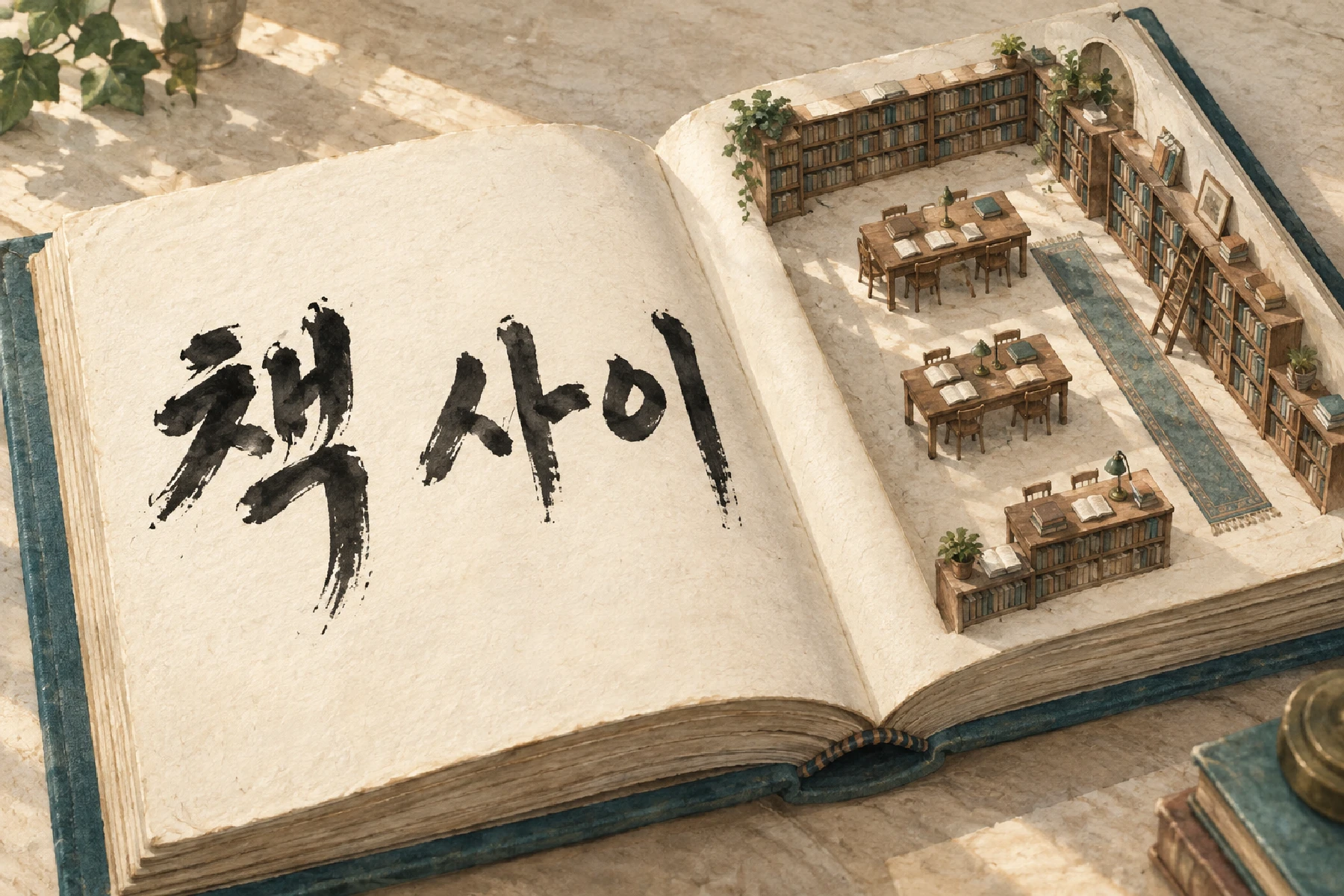
Monumental dry-brush lettering fills one page of an open book, opposite a tiny reading room enclosed by bookshelves. Fractured ink strokes and intimate architecture create a quiet surprise of scale.
Remix this referenceLettering and a Tiny Reading Room
- Form language
- Reduce architecture to small interlocking planes and book rows to grouped rhythms; allow incidental details to vary coherently.
- Contour
- Give brush strokes ragged, broken edges and tapered exits; describe smaller forms with selective, uneven fine lines.
- Mark-making
- Alternate loaded presses with dry, skipping pulls; bristle trails follow each stroke while essential letter connections remain readable.
- Surface rendering
- Use absorbent-paper ink washes with pooled dark joins, translucent thinning and exposed paper; soften room tones in irregular washes.
Priority
Make dry-brush pressure changes and broken ink edges visibly expressive.
What to avoid & what to check
Exact prompt for this example
MODULE OWNERSHIP
subject: Subject count, type, stable proportions and landmarks, resting face geometry, hair shape, physical materials, garment construction and permanent marks. No emotion, movement, color assignment or rendering recipe.
expression: Facial soft-tissue displacement and pupil direction, muscle coordination, regional intensity, asymmetry and onset/peak/release. No head/body pose, stable appearance, skin color or rendering.
gesture: Head/neck/body/limb orientation, joint movement, support, contact and pose-caused occlusion using existing anatomy. No eye/pupil movement, emotion, identity, props inventory or camera.
props: Prop count, type, construction, physical material and scale relative to the subject. Holding/contact belongs to gesture, position to composition, color to palette.
scene: Environment elements, terrain, backdrop/floor presence and structural detail. No canvas positions, camera, lighting, assigned colors or render texture.
camera: Projection, focal-length impression, camera elevation/yaw/roll, viewing distance and crop. No actor pose, world placement, lighting or canvas aspect ratio.
composition: Normalized 0-100% canvas positions, scale in frame, depth/overlap, focal hierarchy and margins. No joint pose, camera projection, rendering, subject/prop inventory or emotion.
palette: Color anchors, hue/saturation/value ranges, colors assigned to parts and approximate color coverage. No illumination direction, shading algorithm, physical material or layout.
lighting: Light-source direction/softness/intensity, ambient illumination, physical shadow direction/length and highlight position. Absence of directional illumination is allowed. No shading technique, palette or material changes.
style: Reusable form abstraction, contour weight/taper/edge quality, medium and mark scale/density/direction, surface rendering and tonal transition technique. No fixed subject proportions, anatomy, identity, expression, pose, palette, light-source direction, camera or layout.
output: Image count, aspect ratio, size, file/alpha requirements and global lettering/logo/watermark restrictions. No background scenery, crop, style, identity or pose.

SUBJECT
inventory: One Hangul calligraphic inscription; no human or animal subjects.
geometry: Write exactly "책 사이" in one readable line, preserving recognizable syllable blocks and a clear word space.
resting-face: No face is present.
appearance: The inscription consists of ink deposited directly on the book's paper.

PRIORITY


AVOID


CHECK


PROPS
inventory: One open book, with each facing page large enough to accommodate the complete inscription.
construction: A clothbound volume with thick paper leaves, gently bowed pages and a deep binding gutter.

PRIORITY


AVOID


CHECK


SCENE
inventory: A miniature public reading room contains perimeter bookshelves, communal reading tables and an open central aisle.
structure: The room has no roof; its floor follows the page surface. A continuous tabletop supports the book. The perimeter shelves are low.

PRIORITY


AVOID


CHECK


CAMERA
projection: Use mild perspective with a natural focal-length impression.
viewpoint: Look down from a high oblique viewpoint, with enough elevation to read both facing pages.
crop: Include the complete inscription and reading room; let a small part of the outer book cover leave the frame.

PRIORITY


AVOID


CHECK


COMPOSITION
placement: Set the open book diagonally across the lower field, with lettering on the left page and the reading room on the right.
depth: Make the lettering dominant and the room a secondary discovery; shelves overlap the page without obscuring the inscription.
spacing: Keep the room small beside the monumental letterforms, with open paper around the words and ample air above the book.

PRIORITY


AVOID


CHECK


PALETTE
colors: Use soot black, warm ivory, muted walnut brown and a restrained oxidized teal.
assignment: Assign black to lettering, ivory to paper and tabletop, walnut to shelving, and teal to the cover and table surfaces.
balance: Let pale values prevail, with the darkest contrast in the inscription and subdued color in the miniature room.

PRIORITY


AVOID


CHECK


LIGHTING
sources: Broad, soft daylight enters from the upper left with gentle ambient fill.
shadows: Short, soft shadows fall toward the lower right beneath shelves, tables and the book.
highlights: Keep highlights broad and quiet along the raised page curves.

PRIORITY


AVOID


CHECK


STYLE GUIDE
form-language: Reduce architecture to small interlocking planes and book rows to grouped rhythms; allow incidental details to vary coherently.
contour: Give brush strokes ragged, broken edges and tapered exits; describe smaller forms with selective, uneven fine lines.
mark-making: Alternate loaded presses with dry, skipping pulls; bristle trails follow each stroke while essential letter connections remain readable.
surface-rendering: Use absorbent-paper ink washes with pooled dark joins, translucent thinning and exposed paper; soften room tones in irregular washes.

PRIORITY
Make dry-brush pressure changes and broken ink edges visibly expressive.

AVOID


CHECK


OUTPUT
format: One finished image; landscape 3:2, 1800 × 1200 pixels, opaque PNG.
restrictions: Allow primary lettering; forbid additional text, logos and watermarks.

PRIORITY


AVOID


CHECK


FINAL INTEGRATION
style + composition: Let the contrast between broad marks and small architectural marks reinforce the difference of scale.
subject + output: The authorized primary lettering is exactly "책 사이".
Model information comes from image provenance. The same prompt may produce a different result.