Text to imageIllustrationStyle guide
Canopy Glider Course · Jump Arcs
Stage a game scene so launch points, airborne paths, and landing zones read immediately.
Remix this referenceCanopy Glider Course · Jump Arcs
- Shape & line
- Use clear takeoff edges and readable platform silhouettes; distinguish playable surfaces by sharper edges than distant foliage.
- Color & light
- Separate playable routes from background foliage by value contrast while retaining lush coherent storybook greens.
- Texture & material
- Use a lush hand-painted storybook surface with restrained brush detail and no interface overlays or photographic gloss.
- Composition
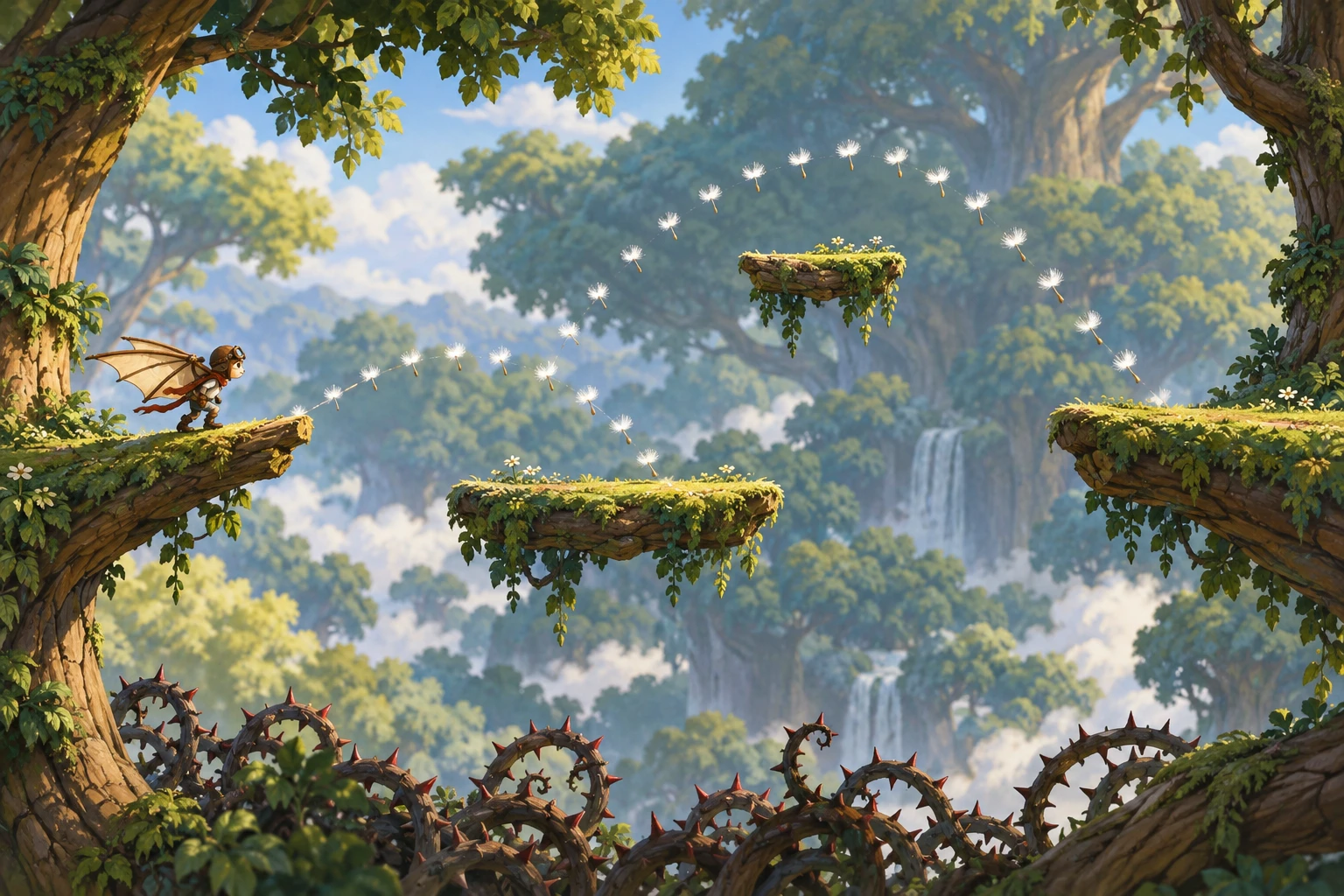
- Make two jump options legible with seed-fluff arcs, broad lower safe platform and narrow higher optional platform; keep hazards below both routes.
Priority
Preserve the distinctive construction and medium first, readable spatial hierarchy second, subtle surface details third.
What to avoid & what to check
Avoid extra subjects, inconsistent repeated geometry, hidden key details, crowded overlaps, unwanted text and watermarks.
Check each style rule against the finished image: visible shape construction, color and light, material treatment, and composition. Preserve the exact subject count and scene requirements.
Exact prompt for this example
SUBJECT
Illustrate an original side-view game level set among giant tree canopies. One small glider pilot stands on a left launch branch, preparing to cross two open gaps toward a right-side landing platform. Shape the branch tips as clear takeoff edges. Use curved strings of loose seed fluff in the air to suggest two possible jump arcs without drawing interface arrows. Place a broad safe platform beneath the first arc and a narrower optional platform higher up beneath the second. Keep hazards, such as thorn clusters, below both readable routes. Separate playable surfaces from distant foliage by value and edge clarity, while retaining a lush hand-painted storybook finish. The viewer should understand where to launch, where to land, and which route is harder. No lettering, logos, interface text, or watermarks.

COMPOSITION
Side-view canopy game level with one pilot on left launch branch, two open gaps and right landing platform. Seed-fluff strings suggest two arcs; broad safe platform below first arc, narrow higher optional platform below second, thorns beneath both routes.

STYLE GUIDE
1. Shape & line
Use clear takeoff edges and readable platform silhouettes; distinguish playable surfaces by sharper edges than distant foliage.

2. Color & light
Separate playable routes from background foliage by value contrast while retaining lush coherent storybook greens.

3. Texture & material
Use a lush hand-painted storybook surface with restrained brush detail and no interface overlays or photographic gloss.

4. Composition
Make two jump options legible with seed-fluff arcs, broad lower safe platform and narrow higher optional platform; keep hazards below both routes.

PRIORITY
Preserve the requested identity, count, action, composition and output settings. Apply the style rules within those constraints; a style reference must not replace the subject or layout. Within the style: Preserve the distinctive construction and medium first, readable spatial hierarchy second, subtle surface details third.

AVOID
Avoid extra subjects, inconsistent repeated geometry, hidden key details, crowded overlaps, unwanted text and watermarks.

OUTPUT
One finished landscape image, aspect ratio 3:2. No lettering, captions, dimensions, unrelated logos, watermark, border or interface.

SELF-CHECK
Check each style rule against the finished image: visible shape construction, color and light, material treatment, and composition. Preserve the exact subject count and scene requirements.
Model information comes from image provenance. The same prompt may produce a different result.