Text to imageArt stylesStyle guide
Rain on an Artichoke Flower
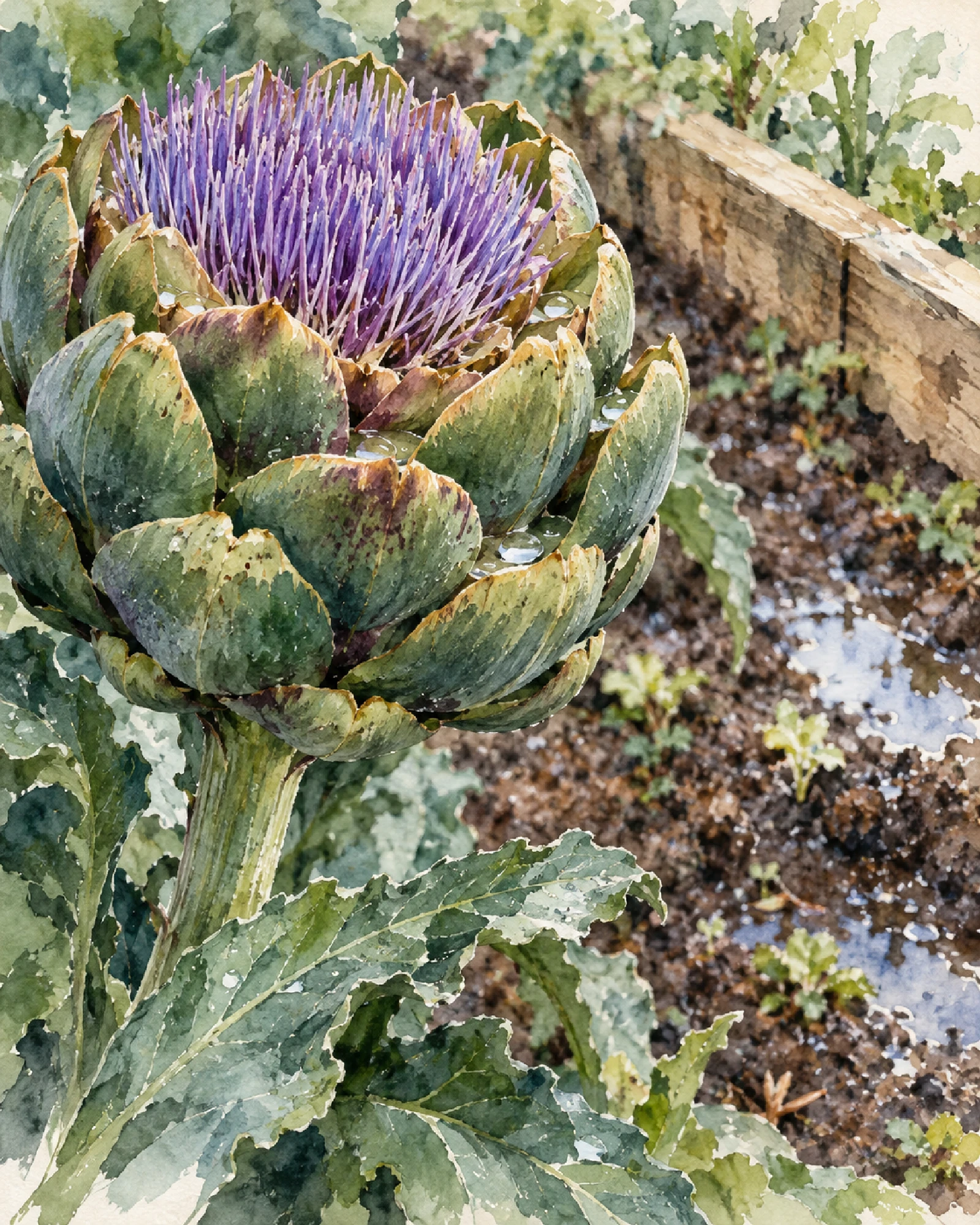
An intimate watercolor of a flowering artichoke with rain caught between its bracts. Violet florets and spreading greens open a small, rain-soaked garden moment.
Remix this referenceRain on an Artichoke Flower
- Form language
- Group complex forms into uneven nested shapes; let secondary details dissolve while larger organic masses remain legible.
- Contour
- Use intermittent fine brush edges, alternating crisp fragments with feathered losses; avoid enclosing every shape with a line.
- Mark-making
- Loose watercolor strokes mingle wet into wet, with spontaneous blooms and occasional dry-brush skips; mark size varies with emphasis.
- Surface rendering
- Build translucent washes with pooling pigment, exposed paper and uneven soft transitions; preserve a few sharp reserves amid the bleeding.
Priority
Make watercolor blooms and broken edges visibly shape the image.
What to avoid & what to check
Exact prompt for this example
MODULE OWNERSHIP
subject: Subject count, type, stable proportions and landmarks, resting face geometry, hair shape, physical materials, garment construction and permanent marks. No emotion, movement, color assignment or rendering recipe.
expression: Facial soft-tissue displacement and pupil direction, muscle coordination, regional intensity, asymmetry and onset/peak/release. No head/body pose, stable appearance, skin color or rendering.
gesture: Head/neck/body/limb orientation, joint movement, support, contact and pose-caused occlusion using existing anatomy. No eye/pupil movement, emotion, identity, props inventory or camera.
props: Prop count, type, construction, physical material and scale relative to the subject. Holding/contact belongs to gesture, position to composition, color to palette.
scene: Environment elements, terrain, backdrop/floor presence and structural detail. No canvas positions, camera, lighting, assigned colors or render texture.
camera: Projection, focal-length impression, camera elevation/yaw/roll, viewing distance and crop. No actor pose, world placement, lighting or canvas aspect ratio.
composition: Normalized 0-100% canvas positions, scale in frame, depth/overlap, focal hierarchy and margins. No joint pose, camera projection, rendering, subject/prop inventory or emotion.
palette: Color anchors, hue/saturation/value ranges, colors assigned to parts and approximate color coverage. No illumination direction, shading algorithm, physical material or layout.
lighting: Light-source direction/softness/intensity, ambient illumination, physical shadow direction/length and highlight position. Absence of directional illumination is allowed. No shading technique, palette or material changes.
style: Reusable form abstraction, contour weight/taper/edge quality, medium and mark scale/density/direction, surface rendering and tonal transition technique. No fixed subject proportions, anatomy, identity, expression, pose, palette, light-source direction, camera or layout.
output: Image count, aspect ratio, size, file/alpha requirements and global lettering/logo/watermark restrictions. No background scenery, crop, style, identity or pose.

SUBJECT
inventory: One flowering artichoke plant, with a single flower head, attached stem and a few visible leaves.
geometry: Broad overlapping bracts form shallow pockets around a brushlike cluster of slender florets; divided leaves branch from a sturdy stem.
resting-face: No face or facial landmarks.
appearance: Thick waxy bracts, delicate tubular florets and fibrous plant tissue; minor natural irregularities may vary.

PRIORITY


AVOID


CHECK


PROPS
inventory: No separate props.
construction: No prop construction applies.

PRIORITY


AVOID


CHECK


SCENE
inventory: A kitchen-garden bed after rain, with damp loam, a low timber border and residual rainwater.
structure: Rainwater gathers between the bracts; the simple garden bed continues beyond the visible detail.

PRIORITY


AVOID


CHECK


CAMERA
projection: Natural perspective with a mild telephoto impression and restrained depth compression.
viewpoint: A close, elevated oblique view reveals the flower's interior without looking straight down.
crop: An intimate detail crop includes the flower head, a short stem segment and incomplete surrounding leaves.

PRIORITY


AVOID


CHECK


COMPOSITION
placement: The enlarged flower sits left of center; the quieter garden opening occupies the right side.
depth: Bracts lead the eye into the florets; a foreground leaf overlaps the stem before the distant bed.
spacing: Keep the upper flower near the margin and give the right side breathing room; leaf intervals may vary naturally.

PRIORITY


AVOID


CHECK


PALETTE
colors: Deep blue-green, muted violet, warm ochre and paper ivory, with a little cool gray-blue.
assignment: Blue-green bracts and leaves, violet florets, ochre earth and timber, gray-blue water, ivory open areas.
balance: Greens dominate; violet provides a concentrated accent, while pale neutrals keep the surrounding area light.

PRIORITY


AVOID


CHECK


LIGHTING
sources: Soft overcast daylight comes broadly from the upper right, with generous ambient illumination.
shadows: Short, diffuse shadows fall lower left; overlapping bracts retain gentle recess shadows.
highlights: Small glints sit on upward-facing water surfaces and the upper-right bract rims.

PRIORITY


AVOID


CHECK


STYLE GUIDE
form-language: Group complex forms into uneven nested shapes; let secondary details dissolve while larger organic masses remain legible.
contour: Use intermittent fine brush edges, alternating crisp fragments with feathered losses; avoid enclosing every shape with a line.
mark-making: Loose watercolor strokes mingle wet into wet, with spontaneous blooms and occasional dry-brush skips; mark size varies with emphasis.
surface-rendering: Build translucent washes with pooling pigment, exposed paper and uneven soft transitions; preserve a few sharp reserves amid the bleeding.

PRIORITY
Make watercolor blooms and broken edges visibly shape the image.

AVOID


CHECK


OUTPUT
format: One finished 4:5 image, 1600 × 2000 pixels, opaque PNG.
restrictions: No lettering, logos or watermarks.

PRIORITY


AVOID


CHECK


FINAL INTEGRATION
composition + style: Let the focal hierarchy guide where edges resolve and where washes remain open.
lighting + style: Translate the soft illumination into translucent tonal changes while retaining the rainwater glints.
Model information comes from image provenance. The same prompt may produce a different result.