Text to imageLandscapeStyle guide
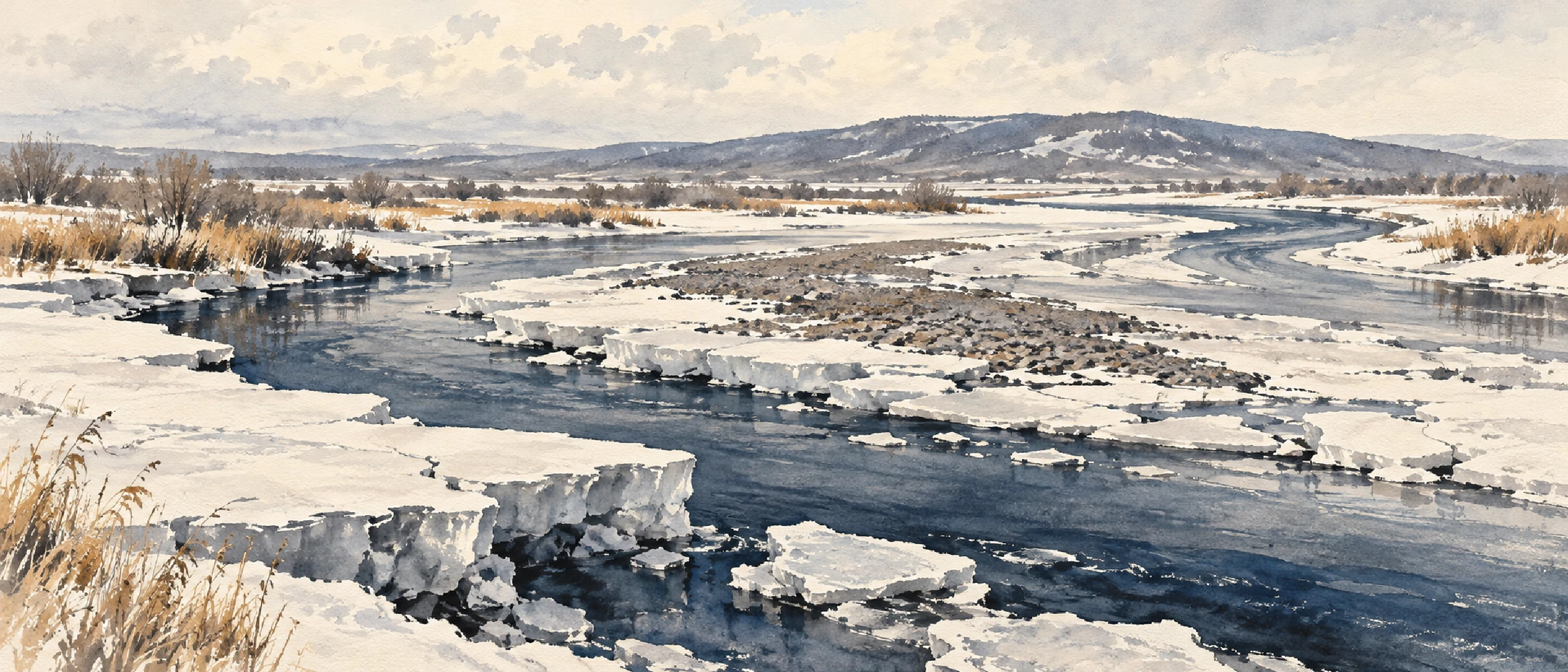
River Between Broken Ice
A river winds between fractured ice and an exposed gravel shoal. Open space and spreading ink connect the quiet passages of a panoramic thawing floodplain.
Remix this referenceRiver Between Broken Ice
- Form language
- Reduce complex forms to broad interlocking masses and a few incisive accents; allow minor details to vary within this economical language.
- Contour
- Use selective brush contours that swell, taper, and occasionally disappear into washes; avoid tracing every boundary.
- Mark-making
- Pair long, fluid brush sweeps with sparse dry-brush scratches; let bristle splits and depleted strokes vary naturally.
- Surface rendering
- Build editorial ink wash through transparent pooling, feathered bleeds, and untouched paper passages; retain occasional tide edges.
Priority
Make expressive ink dilution and visible paper reserves the defining medium qualities.
What to avoid & what to check
Exact prompt for this example
MODULE OWNERSHIP
subject: Subject count, type, stable proportions and landmarks, resting face geometry, hair shape, physical materials, garment construction and permanent marks. No emotion, movement, color assignment or rendering recipe.
expression: Facial soft-tissue displacement and pupil direction, muscle coordination, regional intensity, asymmetry and onset/peak/release. No head/body pose, stable appearance, skin color or rendering.
gesture: Head/neck/body/limb orientation, joint movement, support, contact and pose-caused occlusion using existing anatomy. No eye/pupil movement, emotion, identity, props inventory or camera.
props: Prop count, type, construction, physical material and scale relative to the subject. Holding/contact belongs to gesture, position to composition, color to palette.
scene: Environment elements, terrain, backdrop/floor presence and structural detail. No canvas positions, camera, lighting, assigned colors or render texture.
camera: Projection, focal-length impression, camera elevation/yaw/roll, viewing distance and crop. No actor pose, world placement, lighting or canvas aspect ratio.
composition: Normalized 0-100% canvas positions, scale in frame, depth/overlap, focal hierarchy and margins. No joint pose, camera projection, rendering, subject/prop inventory or emotion.
palette: Color anchors, hue/saturation/value ranges, colors assigned to parts and approximate color coverage. No illumination direction, shading algorithm, physical material or layout.
lighting: Light-source direction/softness/intensity, ambient illumination, physical shadow direction/length and highlight position. Absence of directional illumination is allowed. No shading technique, palette or material changes.
style: Reusable form abstraction, contour weight/taper/edge quality, medium and mark scale/density/direction, surface rendering and tonal transition technique. No fixed subject proportions, anatomy, identity, expression, pose, palette, light-source direction, camera or layout.
output: Image count, aspect ratio, size, file/alpha requirements and global lettering/logo/watermark restrictions. No background scenery, crop, style, identity or pose.

SUBJECT
inventory: No separate figures, animals, or designed objects; landscape elements belong to scene.
geometry: No separate subject geometry applies.
resting-face: No faces are present.
appearance: No separate subject materials, garments, or permanent marks apply.

PRIORITY


AVOID


CHECK


PROPS
inventory: No separate props.
construction: No prop construction applies.

PRIORITY


AVOID


CHECK


SCENE
inventory: A thawing river floodplain contains broken ice sheets, gravel shoals, reed banks, and a distant low ridge.
structure: The river doubles back around a long shoal; fractured ice shelves cling to undercut banks beside sparse reeds.

PRIORITY


AVOID


CHECK


CAMERA
projection: Use gentle perspective with a moderately wide lens impression and little edge distortion.
viewpoint: Look obliquely across the floodplain from a slightly elevated bank, with a level horizon.
crop: Take a distant panoramic view that includes the river's returning bend and the ridge beyond.

PRIORITY


AVOID


CHECK


COMPOSITION
placement: Lead from the lower-left channel through the central shoal toward the upper-right bend; make the bend the focal stop.
depth: Overlap the nearest ice shelf with the channel; progressively smaller banks carry the journey into the distance.
spacing: Keep broad quiet intervals above the river and between shoals; let the nearest shelf extend beyond the bottom edge.

PRIORITY


AVOID


CHECK


PALETTE
colors: Use deep indigo, muted slate, pale amber, and warm ivory, with restrained saturation.
assignment: Give the river indigo, gravel and the ridge slate, reeds pale amber, and ice and sky warm ivory.
balance: Let pale values dominate; concentrate the deepest values along the river and keep amber accents sparse.

PRIORITY


AVOID


CHECK


LIGHTING
sources: Broad overcast daylight comes softly from the upper left, with generous ambient illumination.
shadows: Ice ledges cast short, soft shadows toward the lower right; distant shadows remain faint.
highlights: Subtle highlights touch upper-left ice rims and occasional exposed patches of water.

PRIORITY


AVOID


CHECK


STYLE GUIDE
form-language: Reduce complex forms to broad interlocking masses and a few incisive accents; allow minor details to vary within this economical language.
contour: Use selective brush contours that swell, taper, and occasionally disappear into washes; avoid tracing every boundary.
mark-making: Pair long, fluid brush sweeps with sparse dry-brush scratches; let bristle splits and depleted strokes vary naturally.
surface-rendering: Build editorial ink wash through transparent pooling, feathered bleeds, and untouched paper passages; retain occasional tide edges.

PRIORITY
Make expressive ink dilution and visible paper reserves the defining medium qualities.

AVOID


CHECK


OUTPUT
format: Deliver one image, 21:9, 2520 × 1080 pixels, PNG with an opaque background.
restrictions: Deliver one image, 21:9, 2520 × 1080 pixels, opaque PNG; no lettering, logos, or watermarks.

PRIORITY


AVOID


CHECK


FINAL INTEGRATION
camera + composition + style: Coordinate viewing distance, visual progression, and mark economy so the finished panorama reads clearly at a glance.
Model information comes from image provenance. The same prompt may produce a different result.