Text to imagePortraitStyle guide
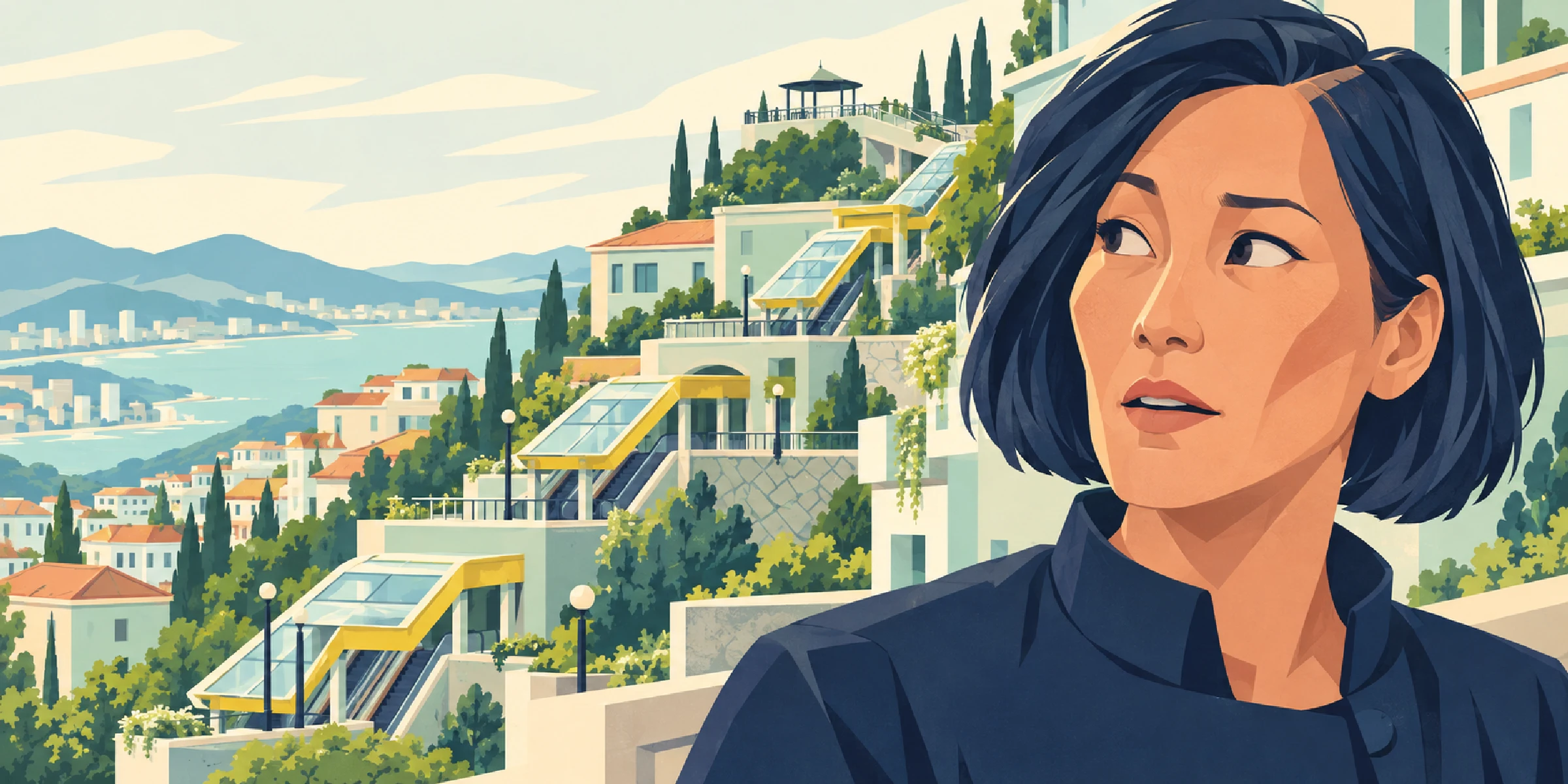
Woman Above the Hillside Escalators
Beside a woman's close face, hillside escalators and small neighborhood plazas unfold across a panorama. Crisp vector shapes and playful asymmetry connect the portrait and the city into one visual journey.
Remix this referenceWoman Above the Hillside Escalators
- Form language
- Reduce forms to interlocking curved wedges and skewed polygons; use unequal paired shapes for playful asymmetry.
- Contour
- Favor crisp silhouette edges; use occasional short interior strokes with rounded ends and consistent light weight.
- Mark-making
- Use sparse vector dashes and offset cutout slivers as rhythmic accents; allow their lengths and spacing to vary.
- Surface rendering
- Build tones from clean adjoining shapes and a few stepped inset planes; preserve sharp joins and lively uneven boundaries.
Priority
Make crisp vector abstraction and playful asymmetry visibly define the image.
What to avoid & what to check
Exact prompt for this example
MODULE OWNERSHIP
subject: Subject count, type, stable proportions and landmarks, resting face geometry, hair shape, physical materials, garment construction and permanent marks. No emotion, movement, color assignment or rendering recipe.
expression: Facial soft-tissue displacement and pupil direction, muscle coordination, regional intensity, asymmetry and onset/peak/release. No head/body pose, stable appearance, skin color or rendering.
gesture: Head/neck/body/limb orientation, joint movement, support, contact and pose-caused occlusion using existing anatomy. No eye/pupil movement, emotion, identity, props inventory or camera.
props: Prop count, type, construction, physical material and scale relative to the subject. Holding/contact belongs to gesture, position to composition, color to palette.
scene: Environment elements, terrain, backdrop/floor presence and structural detail. No canvas positions, camera, lighting, assigned colors or render texture.
camera: Projection, focal-length impression, camera elevation/yaw/roll, viewing distance and crop. No actor pose, world placement, lighting or canvas aspect ratio.
composition: Normalized 0-100% canvas positions, scale in frame, depth/overlap, focal hierarchy and margins. No joint pose, camera projection, rendering, subject/prop inventory or emotion.
palette: Color anchors, hue/saturation/value ranges, colors assigned to parts and approximate color coverage. No illumination direction, shading algorithm, physical material or layout.
lighting: Light-source direction/softness/intensity, ambient illumination, physical shadow direction/length and highlight position. Absence of directional illumination is allowed. No shading technique, palette or material changes.
style: Reusable form abstraction, contour weight/taper/edge quality, medium and mark scale/density/direction, surface rendering and tonal transition technique. No fixed subject proportions, anatomy, identity, expression, pose, palette, light-source direction, camera or layout.
output: Image count, aspect ratio, size, file/alpha requirements and global lettering/logo/watermark restrictions. No background scenery, crop, style, identity or pose.

SUBJECT
inventory: One original middle-aged woman, actor A; no additional figures.
geometry: Give her a long face, broad cheekbones, a narrow chin, and sturdy shoulders with ordinary adult proportions.
resting-face: Straight brows sit over almond-shaped eyes; a long nose ends in a rounded tip above a narrow mouth.
appearance: A blunt bob has an uneven side part; her woven jacket has a stand collar and a simple overlapping front.

PRIORITY


AVOID


CHECK


EXPRESSION — ACTOR A
brows: The inner brows lift slightly, with one brow a little higher.
lids: Upper lids open a little wider while lower lids remain relaxed.
cheeks: Cheeks stay near rest, without a pronounced upward bunch.
nose: The nose stays smooth with no nostril flare.
mouth: Lips part narrowly at the center, with both corners relaxed.
jaw: Release the jaw slightly without a conspicuous drop.
gaze: Pupils turn left toward the hillside route.
coordination: A small upper-face opening carries the curiosity; the lower face remains quiet.
timing: Show the onset of noticing something along the route.

PRIORITY


AVOID


CHECK


GESTURE
head: Turn her head gently left while keeping the neck upright.
torso: Her shoulders remain loosely square, with a slight forward inclination of the upper torso.
limbs: Visible upper arms hang naturally.
contact: No visible contact with an object or another figure.

PRIORITY


AVOID


CHECK


PROPS
inventory: No separate props.
construction: No prop construction applies.

PRIORITY


AVOID


CHECK


SCENE
inventory: A steep residential neighborhood includes outdoor escalators, terraced buildings, landing plazas, and a hilltop lookout.
structure: Successive sheltered escalators connect staggered plazas; low walls and building terraces follow the hillside.

PRIORITY


AVOID


CHECK


CAMERA
projection: Use gently compressed perspective with a normal-to-long focal-length impression.
viewpoint: View at her eye level, obliquely across the hillside, with a level camera.
crop: Use a close head-and-shoulders crop cutting the outer shoulder, excluding hands and lower limbs, with broad environmental coverage.

PRIORITY


AVOID


CHECK


COMPOSITION
placement: Place her face near 82% across, with a broad hillside view beside her; the route rises from the lower left through staggered middle-distance landings.
depth: The large foreground portrait overlaps the nearest terrace; the route leads onward to a small distant lookout.
spacing: Her head fills most of the height; keep generous open intervals between route stages.

PRIORITY


AVOID


CHECK


PALETTE
colors: Use pale mint, warm terracotta, custard yellow, deep navy, and a restrained cream.
assignment: Terracotta colors the skin, navy the hair and jacket, mint the buildings, yellow the escalator bands, and cream the sky.
balance: Keep the environment mostly pale; concentrate deep navy in the portrait and repeat yellow in smaller route accents.

PRIORITY


AVOID


CHECK


LIGHTING
sources: Soft daylight comes from the upper left with moderate, even ambient illumination.
shadows: Broad soft shadows extend rightward beneath terrace overhangs; the face has a gentle right-side shadow.
highlights: Place subdued highlights on the left forehead, cheek ridge, and upward-facing canopy edges.

PRIORITY


AVOID


CHECK


STYLE GUIDE
form-language: Reduce forms to interlocking curved wedges and skewed polygons; use unequal paired shapes for playful asymmetry.
contour: Favor crisp silhouette edges; use occasional short interior strokes with rounded ends and consistent light weight.
mark-making: Use sparse vector dashes and offset cutout slivers as rhythmic accents; allow their lengths and spacing to vary.
surface-rendering: Build tones from clean adjoining shapes and a few stepped inset planes; preserve sharp joins and lively uneven boundaries.

PRIORITY
Make crisp vector abstraction and playful asymmetry visibly define the image.

AVOID


CHECK


OUTPUT
format: One image, 2:1 aspect ratio, 2400 × 1200 pixels, opaque PNG.
restrictions: Deliver one 2:1 image at 2400 × 1200 pixels as an opaque PNG, without lettering, logos, or watermarks.

PRIORITY


AVOID


CHECK


FINAL INTEGRATION
camera + composition + scene: Coordinate the environmental view and route sequence so the panorama offers a clear journey beside the portrait.
subject + expression + style: Carry the facial landmarks and subtle acting through the abstraction without requiring realistic surface detail.
Model information comes from image provenance. The same prompt may produce a different result.