Text to imageIllustrationStyle guide
One Empty Flowerpot · Elliptical Opening Depth
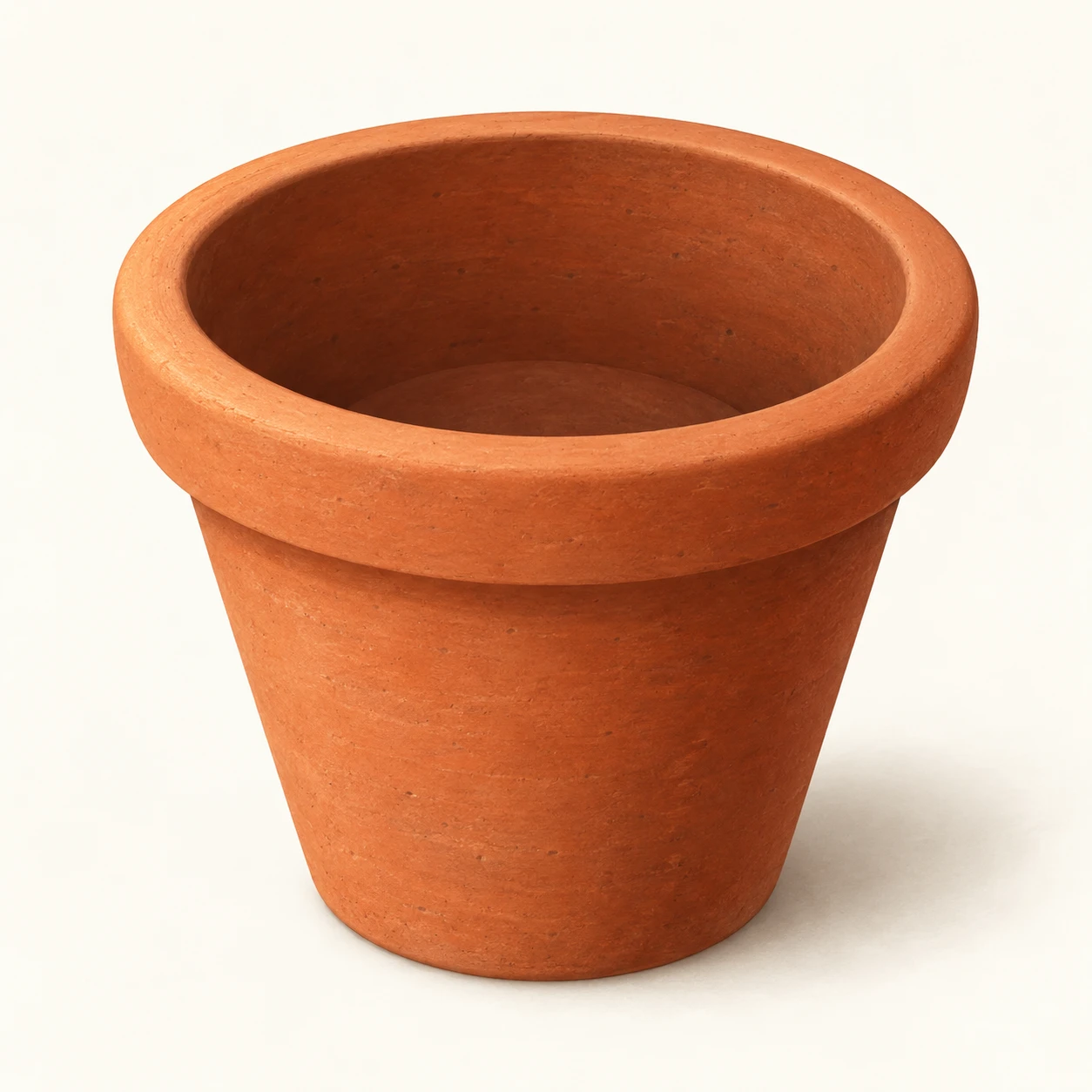
An illustration that uses nested rim ellipses and near-rim occlusion to show an empty flowerpot’s thickness and interior depth.
One Empty Flowerpot · Elliptical Opening Depth
- Shape & line
- Draw the rim’s outer and inner edges as nested horizontal ellipses with matching tilt and smoothly rounded ends. Keep a visible band between them to establish thickness, and let the image-bottom near rim cover the lower portion of the inner wall rather than drawing that wall through it.
- Color & light
- Use a restrained terracotta palette under light from the image-upper-left. Make the upper-left rim band pale orange, the outer right wall deeper rust, and the cavity darker than the exterior; place the darkest broad band just inside the near rim to make its overhang visible.
- Texture & material
- Render the clay with matte opaque fills and sparse, soft-edged grain marks that follow the curved walls. Keep the rim edges clean and the grain low in contrast so surface texture supports the form without obscuring the nested ellipses.
- Composition
- Keep both sides of the opening unobstructed and show enough inner wall between the far rim and the recessed floor to read as a cavity. Separate the pot from the pale background with a small soft shadow extending toward the image-lower-right from its base.
Priority
Prioritize coherent rim ellipses and clear near-rim occlusion so the opening reads as a thick edge around a deep cavity.
What to avoid & what to check
Avoid pointed ellipse ends, mismatched rim tilt, and interior lines that pass through the near rim.
Check that the rim forms a continuous thick band and visibly hides part of the inner wall on the image-bottom side.
Exact prompt for this example
SUBJECT
One empty terracotta flowerpot with a thick rounded rim and a body that tapers toward its base; its opening reveals the inner wall and a small recessed interior floor.

COMPOSITION
Center the entire upright pot in a square frame, viewed slightly from above so the opening reads as a broad horizontal ellipse. The near rim occupies the image-bottom side of the opening, and the far rim occupies its image-top side. Leave generous pale background around the silhouette.

STYLE GUIDE
1. Shape & line
Draw the rim’s outer and inner edges as nested horizontal ellipses with matching tilt and smoothly rounded ends. Keep a visible band between them to establish thickness, and let the image-bottom near rim cover the lower portion of the inner wall rather than drawing that wall through it.

2. Color & light
Use a restrained terracotta palette under light from the image-upper-left. Make the upper-left rim band pale orange, the outer right wall deeper rust, and the cavity darker than the exterior; place the darkest broad band just inside the near rim to make its overhang visible.

3. Texture & material
Render the clay with matte opaque fills and sparse, soft-edged grain marks that follow the curved walls. Keep the rim edges clean and the grain low in contrast so surface texture supports the form without obscuring the nested ellipses.

4. Composition
Keep both sides of the opening unobstructed and show enough inner wall between the far rim and the recessed floor to read as a cavity. Separate the pot from the pale background with a small soft shadow extending toward the image-lower-right from its base.

PRIORITY
Preserve the requested identity, count, action, composition and output settings. Apply the style rules within those constraints; a style reference must not replace the subject or layout. Within the style: Prioritize coherent rim ellipses and clear near-rim occlusion so the opening reads as a thick edge around a deep cavity.

AVOID
Avoid pointed ellipse ends, mismatched rim tilt, and interior lines that pass through the near rim.

OUTPUT
One square illustration with no lettering, labels, dimensions, or watermark.

SELF-CHECK
Check that the rim forms a continuous thick band and visibly hides part of the inner wall on the image-bottom side.
Model information comes from image provenance. The same prompt may produce a different result.