Text to imageProductStyle guide
A Wall-Mounted Soap Mill
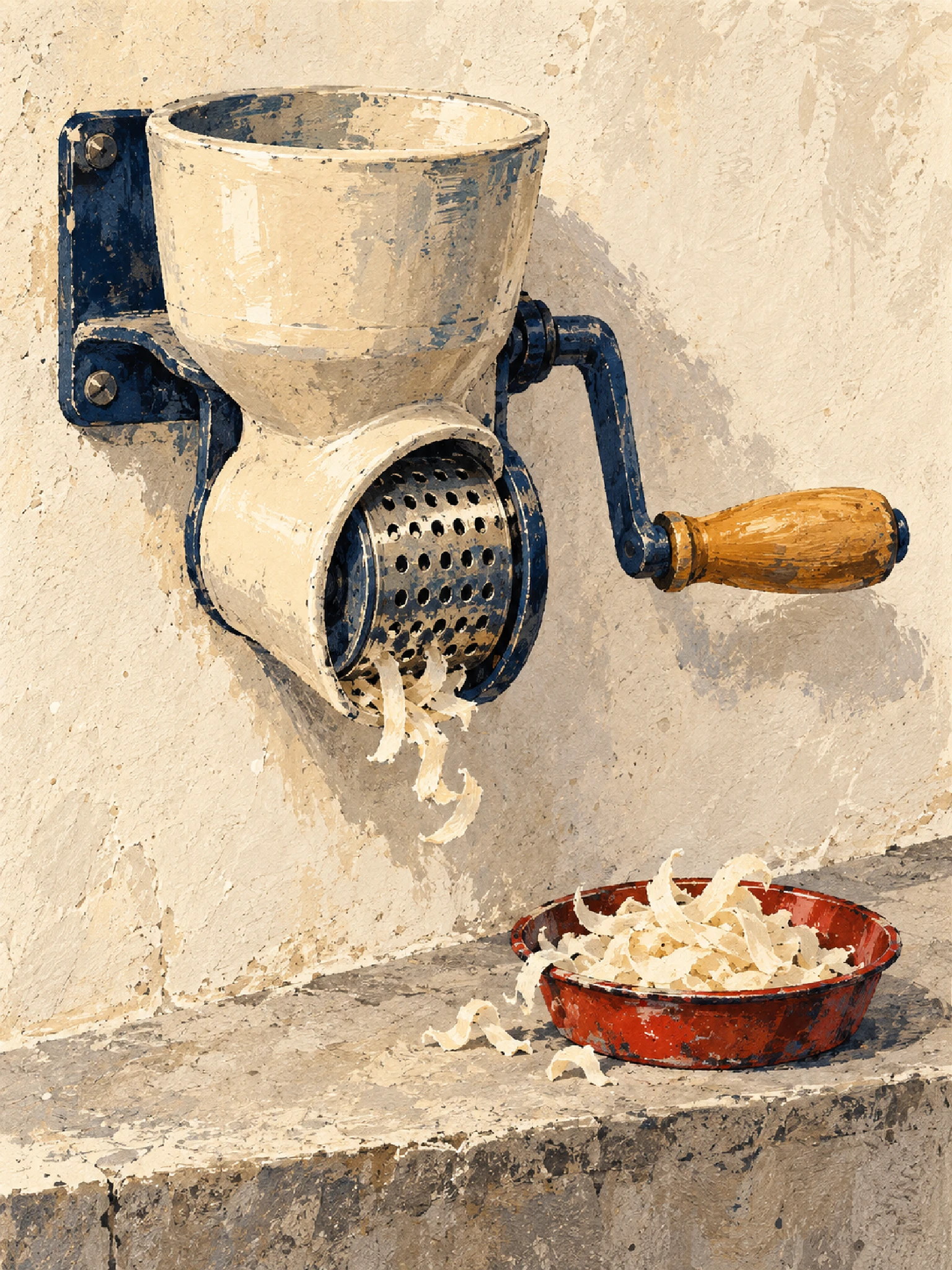
An experimental ink-and-print illustration of a ceramic soap mill and a small dish catching its curls. An off-center arrangement leaves generous wall space for the irregular evidence of hand printing.
Remix this referenceA Wall-Mounted Soap Mill
- Form language
- Simplify forms into blunt interlocking masses and open cutouts, retaining a few irregular bends for character.
- Contour
- Alternate pooled brush borders with fine broken nib lines; let edges thicken, fray and occasionally disappear.
- Mark-making
- Combine dragged bristle sweeps, sparse stamped flecks and hand-wiped gaps with naturally changing pressure.
- Surface rendering
- Overlap translucent print plates on exposed paper, using slight registration drift and compressed ink masses for tone.
Priority
Preserve the visibly experimental union of brush ink and imperfect hand printing.
What to avoid & what to check
Exact prompt for this example
MODULE OWNERSHIP
subject: Subject count, type, stable proportions and landmarks, resting face geometry, hair shape, physical materials, garment construction and permanent marks. No emotion, movement, color assignment or rendering recipe.
expression: Facial soft-tissue displacement and pupil direction, muscle coordination, regional intensity, asymmetry and onset/peak/release. No head/body pose, stable appearance, skin color or rendering.
gesture: Head/neck/body/limb orientation, joint movement, support, contact and pose-caused occlusion using existing anatomy. No eye/pupil movement, emotion, identity, props inventory or camera.
props: Prop count, type, construction, physical material and scale relative to the subject. Holding/contact belongs to gesture, position to composition, color to palette.
scene: Environment elements, terrain, backdrop/floor presence and structural detail. No canvas positions, camera, lighting, assigned colors or render texture.
camera: Projection, focal-length impression, camera elevation/yaw/roll, viewing distance and crop. No actor pose, world placement, lighting or canvas aspect ratio.
composition: Normalized 0-100% canvas positions, scale in frame, depth/overlap, focal hierarchy and margins. No joint pose, camera projection, rendering, subject/prop inventory or emotion.
palette: Color anchors, hue/saturation/value ranges, colors assigned to parts and approximate color coverage. No illumination direction, shading algorithm, physical material or layout.
lighting: Light-source direction/softness/intensity, ambient illumination, physical shadow direction/length and highlight position. Absence of directional illumination is allowed. No shading technique, palette or material changes.
style: Reusable form abstraction, contour weight/taper/edge quality, medium and mark scale/density/direction, surface rendering and tonal transition technique. No fixed subject proportions, anatomy, identity, expression, pose, palette, light-source direction, camera or layout.
output: Image count, aspect ratio, size, file/alpha requirements and global lettering/logo/watermark restrictions. No background scenery, crop, style, identity or pose.

SUBJECT
inventory: One wall-mounted, hand-cranked soap mill is the product subject.
geometry: A broad cylindrical hopper narrows to a grated outlet; a short side crank ends in an oval grip.
resting-face: No face is present.
appearance: Use a glazed stoneware housing, steel grating drum, bent-metal mounting bracket and turned wooden grip.

PRIORITY


AVOID


CHECK


PROPS
inventory: One shallow catch dish, much smaller than the mill, and a loose handful of soap curls.
construction: The dish is pressed tin with a rolled lip; the soap curls are thin, irregular ribbons.

PRIORITY


AVOID


CHECK


SCENE
inventory: A plaster washroom wall and a narrow stone ledge form the setting.
structure: The uninterrupted wall meets a projecting ledge with a slightly worn front edge.

PRIORITY


AVOID


CHECK


CAMERA
projection: Use mild perspective with a normal-lens impression and little spatial distortion.
viewpoint: Take a slightly elevated three-quarter view that reveals the hopper opening and side crank.
crop: Frame the complete mill and dish at medium distance, with the ledge continuing beyond the image edges.

PRIORITY


AVOID


CHECK


COMPOSITION
placement: Place the mill high on the left and the dish lower and farther right, leaving a broad open wall interval.
depth: The crank projects ahead of the housing; soap curls overlap the dish rim and gather inside it.
spacing: Make the mill the first focal point and the dish a smaller answering shape across the open interval.

PRIORITY


AVOID


CHECK


PALETTE
colors: Use chalk ivory, deep indigo, cinnabar red and muted honey ochre.
assignment: Keep wall, housing and soap ivory; assign indigo to metal, red to the dish and ochre to the wooden grip.
balance: Ivory occupies most of the image, indigo supplies compact dark areas, and red and ochre remain small accents.

PRIORITY


AVOID


CHECK


LIGHTING
sources: Soft daylight arrives broadly from the upper left, supported by gentle room ambience.
shadows: Short, softened shadows fall down and right against the wall and across the ledge.
highlights: Broad highlights touch the upper-left housing curve and the near portion of the dish rim.

PRIORITY


AVOID


CHECK


STYLE GUIDE
form-language: Simplify forms into blunt interlocking masses and open cutouts, retaining a few irregular bends for character.
contour: Alternate pooled brush borders with fine broken nib lines; let edges thicken, fray and occasionally disappear.
mark-making: Combine dragged bristle sweeps, sparse stamped flecks and hand-wiped gaps with naturally changing pressure.
surface-rendering: Overlap translucent print plates on exposed paper, using slight registration drift and compressed ink masses for tone.

PRIORITY
Preserve the visibly experimental union of brush ink and imperfect hand printing.

AVOID


CHECK


OUTPUT
format: One finished image, 3:4 portrait, 1536 × 2048 pixels, opaque PNG.
restrictions: No lettering, logos or watermarks.

PRIORITY


AVOID


CHECK


FINAL INTEGRATION
subject + style: Keep the product construction understandable while allowing incidental marks and edge breaks to vary naturally.
Model information comes from image provenance. The same prompt may produce a different result.