Text to imageCharacterStyle guide
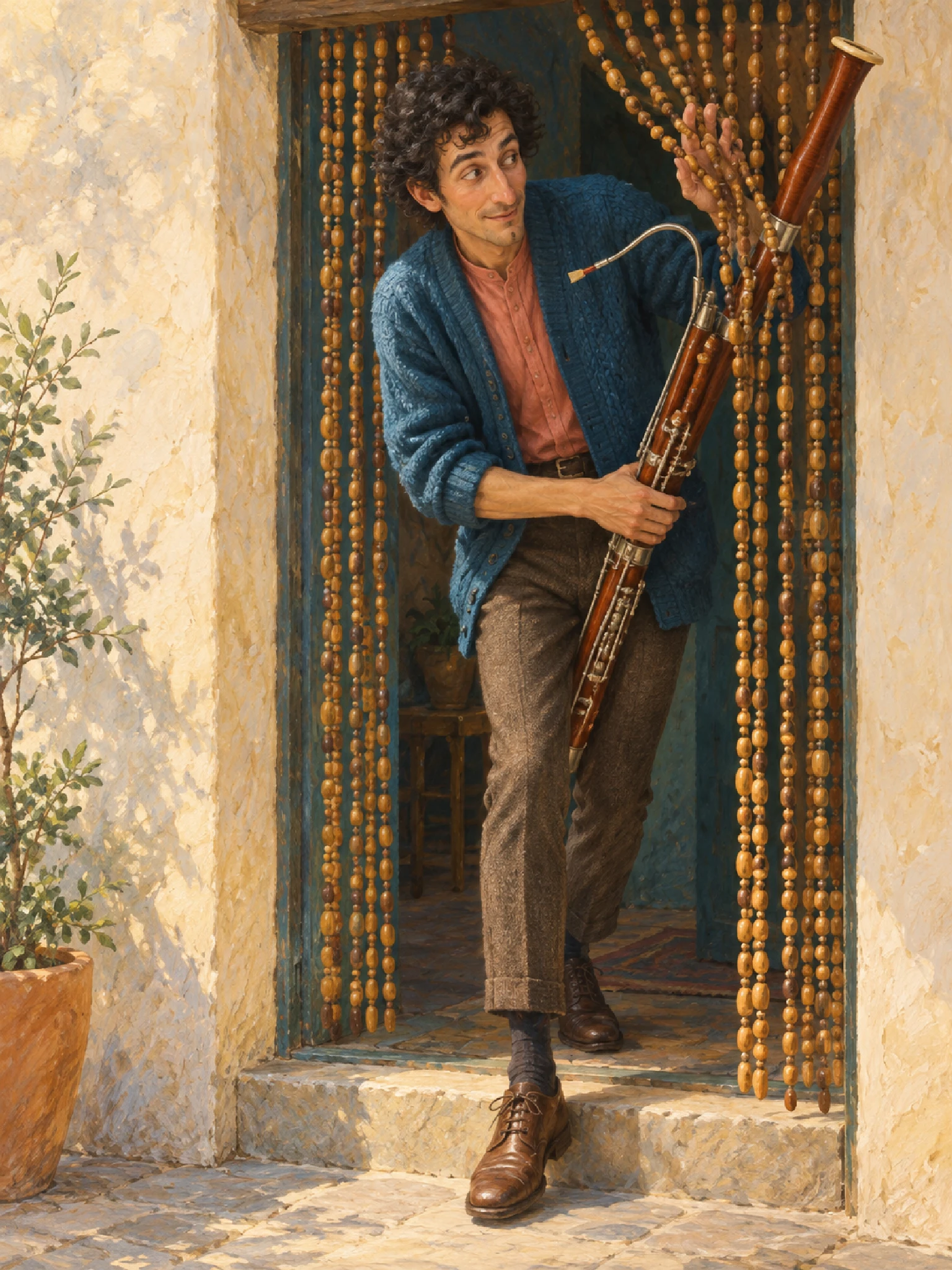
Bassoonist Parting a Beaded Curtain
A tall, wiry bassoonist squeezes through a beaded curtain with the instrument gathered close. Soft light spreads across overlapping bead strands, sleeves and wood, catching the humor of a small maneuver in luminous continuous tones.
Remix this referenceBassoonist Parting a Beaded Curtain
- Form language
- Simplify forms into supple interlocking volumes; keep construction recognizable, suggest intricate fittings with selective accents and allow incidental detail to vary.
- Contour
- Use selective painted edges: firm at important separations, feathered or lost where neighboring tones merge.
- Mark-making
- Lay broad flowing brush passes beneath smaller broken strokes; vary their length and direction with each surface.
- Surface rendering
- Build luminous continuous tones with thin translucent layers and soft opaque scumbles, retaining a few visible brush interruptions.
Priority
Maintain luminous continuous-tone painterly illustration with visibly varied brushwork.
What to avoid & what to check
Exact prompt for this example
MODULE OWNERSHIP
subject: Subject count, type, stable proportions and landmarks, resting face geometry, hair shape, physical materials, garment construction and permanent marks. No emotion, movement, color assignment or rendering recipe.
expression: Facial soft-tissue displacement and pupil direction, muscle coordination, regional intensity, asymmetry and onset/peak/release. No head/body pose, stable appearance, skin color or rendering.
gesture: Head/neck/body/limb orientation, joint movement, support, contact and pose-caused occlusion using existing anatomy. No eye/pupil movement, emotion, identity, props inventory or camera.
props: Prop count, type, construction, physical material and scale relative to the subject. Holding/contact belongs to gesture, position to composition, color to palette.
scene: Environment elements, terrain, backdrop/floor presence and structural detail. No canvas positions, camera, lighting, assigned colors or render texture.
camera: Projection, focal-length impression, camera elevation/yaw/roll, viewing distance and crop. No actor pose, world placement, lighting or canvas aspect ratio.
composition: Normalized 0-100% canvas positions, scale in frame, depth/overlap, focal hierarchy and margins. No joint pose, camera projection, rendering, subject/prop inventory or emotion.
palette: Color anchors, hue/saturation/value ranges, colors assigned to parts and approximate color coverage. No illumination direction, shading algorithm, physical material or layout.
lighting: Light-source direction/softness/intensity, ambient illumination, physical shadow direction/length and highlight position. Absence of directional illumination is allowed. No shading technique, palette or material changes.
style: Reusable form abstraction, contour weight/taper/edge quality, medium and mark scale/density/direction, surface rendering and tonal transition technique. No fixed subject proportions, anatomy, identity, expression, pose, palette, light-source direction, camera or layout.
output: Image count, aspect ratio, size, file/alpha requirements and global lettering/logo/watermark restrictions. No background scenery, crop, style, identity or pose.

SUBJECT
inventory: One original adult bassoonist, A, with a tall, wiry human build.
geometry: Long limbs, narrow shoulders and a compact head give the figure a distinctive lanky construction.
resting-face: The resting face has gently arched brows, narrow eyes, a broad nose and a small cleft in the chin.
appearance: Compact uneven curls accompany a knitted cardigan over a collarless shirt, cropped woven trousers and leather shoes.

PRIORITY


AVOID


CHECK


EXPRESSION — ACTOR A
brows: One brow lifts slightly while the other remains relaxed.
lids: The lower lids tighten lightly; the upper lids remain open.
cheeks: A small cheek lift begins on the same side as the rising mouth corner.
nose: Keep the nose relaxed without wrinkling or nostril flare.
mouth: One lip corner curls upward as the lips part slightly.
jaw: Release the jaw just enough for a small mouth opening.
gaze: Both pupils look toward the bead strands beside the raised forearm.
coordination: The unilateral brow and lip lifts lead; cheek and lower-lid tension follow lightly.
timing: Capture amusement at onset, before it becomes a broad grin.

PRIORITY


AVOID


CHECK


GESTURE
head: A ducks the head slightly and draws the neck forward through the opening.
torso: Turn the torso sideways with a small forward lean as the shoulders pass through.
limbs: One forearm lifts across the curtain; the other arm gathers the instrument close while one foot steps beyond the threshold.
contact: The raised forearm parts the bead strands; the other hand grips the bassoon, which rests against the torso.

PRIORITY


AVOID


CHECK


PROPS
inventory: One bassoon, long enough to extend from A's thigh to above the shoulder.
construction: The bassoon has a doubled wooden tube, flared bell, curved metal bocal and metal keywork.

PRIORITY


AVOID


CHECK


SCENE
inventory: A narrow shop doorway contains a hanging beaded curtain, a shallow threshold and a glimpse of an interior passage.
structure: Round beads form loose vertical strands beneath a wooden lintel; simple plaster jambs enclose the doorway.

PRIORITY


AVOID


CHECK


CAMERA
projection: Use natural perspective with a normal-lens impression and modest depth.
viewpoint: View from A's chest height at a three-quarter angle to the doorway, without roll.
crop: Use a full-figure view that includes both shoes, the instrument bell and enough lintel to establish the passage.

PRIORITY


AVOID


CHECK


COMPOSITION
placement: Place A near 62% width and 55% height, occupying most of the image height; the face leads, followed by the curtain opening.
depth: Foreground strands overlap the sleeve and bassoon, while the face stays unobstructed against the recessed passage.
spacing: Cluster the overlapping forms on the right, leave a quieter interval on the left and preserve breathing room around the shoes.

PRIORITY


AVOID


CHECK


PALETTE
colors: Use petrol blue, amber, muted coral and pale apricot, with restrained saturation.
assignment: Assign petrol blue to the cardigan and passage, amber to the bassoon and beads, coral to the shirt and apricot to skin and plaster.
balance: Cool dark masses occupy much of the image, balanced by a broad pale surround and smaller warm accents.

PRIORITY


AVOID


CHECK


LIGHTING
sources: Broad daylight enters from the left foreground, with subdued ambient illumination inside the doorway.
shadows: Soft shadows fall inward and right, deepening where strands, sleeve and instrument overlap.
highlights: Light catches the left face plane, outer sleeve, bead rims and exposed metal keys.

PRIORITY


AVOID


CHECK


STYLE GUIDE
form-language: Simplify forms into supple interlocking volumes; keep construction recognizable, suggest intricate fittings with selective accents and allow incidental detail to vary.
contour: Use selective painted edges: firm at important separations, feathered or lost where neighboring tones merge.
mark-making: Lay broad flowing brush passes beneath smaller broken strokes; vary their length and direction with each surface.
surface-rendering: Build luminous continuous tones with thin translucent layers and soft opaque scumbles, retaining a few visible brush interruptions.

PRIORITY
Maintain luminous continuous-tone painterly illustration with visibly varied brushwork.

AVOID


CHECK


OUTPUT
format: Deliver one finished 3:4 image at 1536 × 2048 pixels as an opaque PNG.
restrictions: No lettering, logos, signatures or watermarks.

PRIORITY


AVOID


CHECK


FINAL INTEGRATION
gesture + composition: The movement supplies meaningful overlaps, and the arrangement keeps the maneuver readable.
palette + lighting + style: Color relationships, illumination and continuous tonal transitions cooperate to create a luminous painted atmosphere.
Model information comes from image provenance. The same prompt may produce a different result.