Text to imageCharacterStyle guide
Penguin Friend · Coordinated Gaze
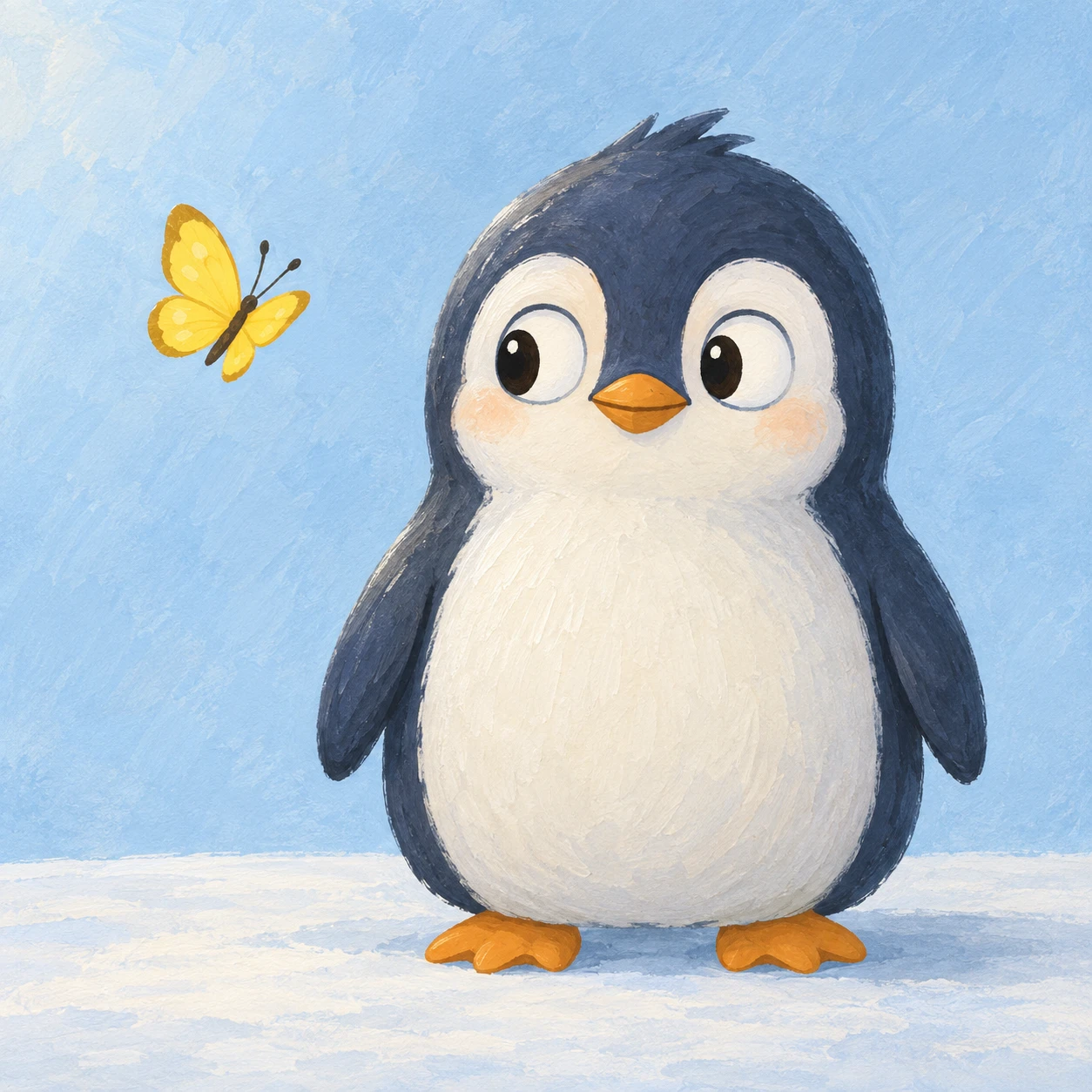
Shift both pupils toward the same side so a front-facing penguin visibly watches a small butterfly on image-left.
Penguin Friend · Coordinated Gaze
- Shape & line
- Build the penguin from a pear-shaped body, rounded flippers and two separate oval eye whites. Move both dark pupils toward the image-left edges of their eye whites, leaving visible white crescents on image-right; keep each pupil contained within its eye and keep the beak centered so the gaze reads as an eye movement.
- Color & light
- Paint the body deep blue-gray, the belly and eye whites warm ivory, and the beak and feet muted orange. Give the butterfly a clear yellow accent against a pale blue background. Use broad, gentle light from upper image-left, with a slightly darker right body edge, while preserving strong pupil-to-white contrast.
- Texture & material
- Use opaque gouache fills with subtle paper grain and a few broad brush variations across the body. Keep the eye whites smooth and the pupil edges crisp, and suggest feathers through the simple body masses rather than repeated tiny marks so surface texture does not interrupt the gaze.
- Composition
- Place the butterfly directly to image-left of the eye pair at approximately their height, making its position agree with both pupils. Keep the penguin's flippers lowered and its face unobstructed. Reserve open background around the butterfly and between it and the eyes so the viewer can follow the gaze without arrows or motion lines.
Priority
Make both pupils clearly direct attention toward the butterfly on image-left.
What to avoid & what to check
Avoid crossed eyes, a turned head or pupils that disappear into the outer body color.
Check that both eyes look toward the butterfly while the head remains front-facing.
Exact prompt for this example
SUBJECT
One original penguin character with a rounded body, two clearly visible eyes and a small closed beak, watching one small yellow butterfly hovering on image-left at eye height. The penguin's head and torso face the viewer; its pupils alone establish the sideways gaze.

COMPOSITION
Use a square, full-body view with the penguin slightly right of center and the butterfly in the open space on image-left. Keep both eyes large enough to read, leave a clear gap between butterfly and head, and show both feet along a quiet ground line.

STYLE GUIDE
1. Shape & line
Build the penguin from a pear-shaped body, rounded flippers and two separate oval eye whites. Move both dark pupils toward the image-left edges of their eye whites, leaving visible white crescents on image-right; keep each pupil contained within its eye and keep the beak centered so the gaze reads as an eye movement.

2. Color & light
Paint the body deep blue-gray, the belly and eye whites warm ivory, and the beak and feet muted orange. Give the butterfly a clear yellow accent against a pale blue background. Use broad, gentle light from upper image-left, with a slightly darker right body edge, while preserving strong pupil-to-white contrast.

3. Texture & material
Use opaque gouache fills with subtle paper grain and a few broad brush variations across the body. Keep the eye whites smooth and the pupil edges crisp, and suggest feathers through the simple body masses rather than repeated tiny marks so surface texture does not interrupt the gaze.

4. Composition
Place the butterfly directly to image-left of the eye pair at approximately their height, making its position agree with both pupils. Keep the penguin's flippers lowered and its face unobstructed. Reserve open background around the butterfly and between it and the eyes so the viewer can follow the gaze without arrows or motion lines.

PRIORITY
Preserve the requested identity, count, action, composition and output settings. Apply the style rules within those constraints; a style reference must not replace the subject or layout. Within the style: Make both pupils clearly direct attention toward the butterfly on image-left.

AVOID
Avoid crossed eyes, a turned head or pupils that disappear into the outer body color.

OUTPUT
Create one square image as a clean gouache character illustration, with no lettering, captions, logos or watermark.

SELF-CHECK
Check that both eyes look toward the butterfly while the head remains front-facing.
Model information comes from image provenance. The same prompt may produce a different result.