Text to imageSpace & architectureStyle guide
Reading Bays Between Radiator Fins
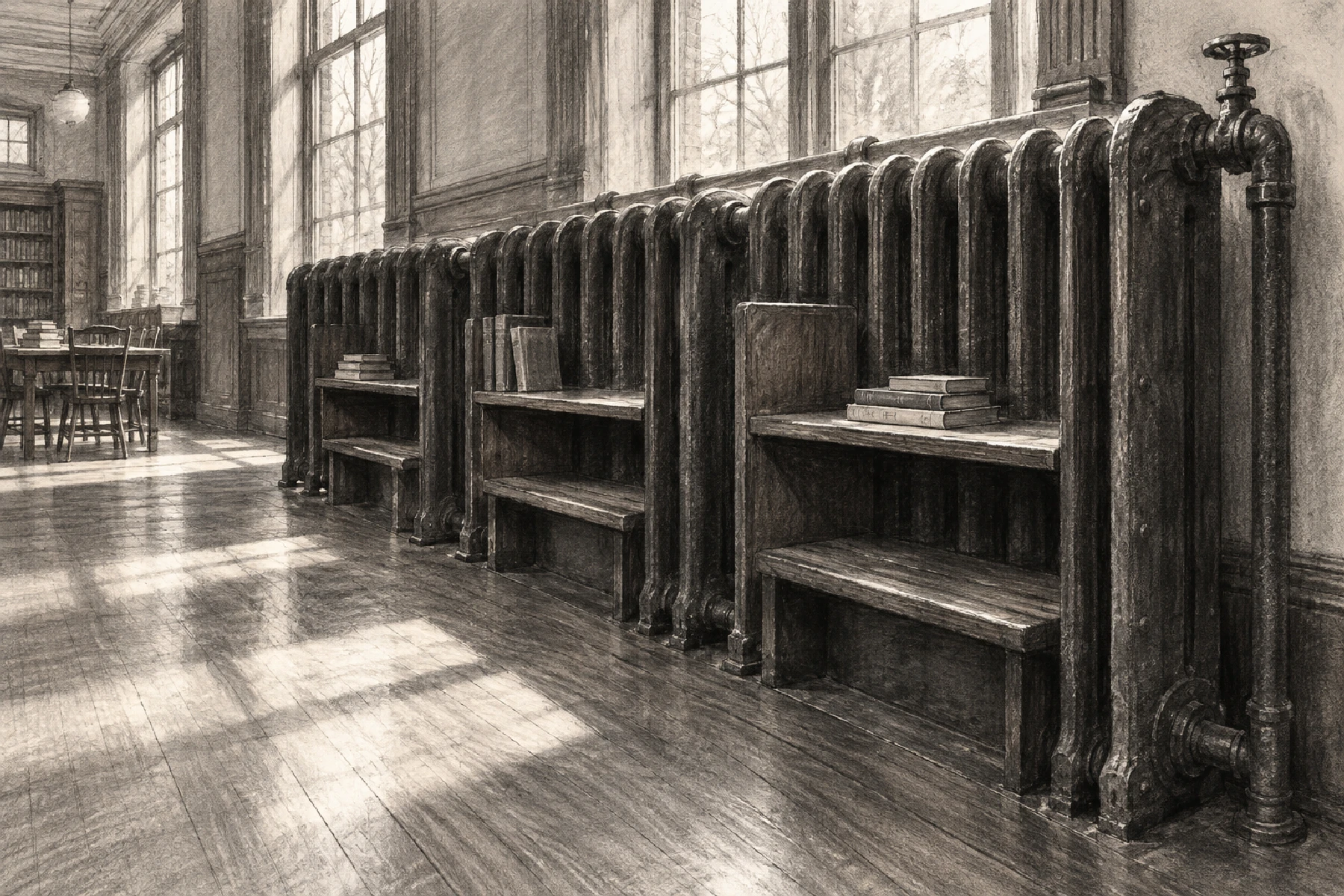
An old library turns the gaps of a room-height radiator into intimate reading bays, observed through rubbed charcoal masses and light lifted with an eraser.
Remix this referenceReading Bays Between Radiator Fins
- Form language
- Observe large structures as weighty interlocking volumes, keeping minor irregularities and simplifying detail where masses merge.
- Contour
- Alternate firm compressed edges with soft lost contours; allow searching charcoal lines to remain beside selected boundaries.
- Mark-making
- Use broad side-of-stick strokes, rubbed smudges and a few directional scratches; let pressure and paper tooth vary naturally.
- Surface rendering
- Build tones by layering and rubbing charcoal, then lift light with a kneaded eraser; retain cloudy transitions and broken pale edges.
Priority
Make rubbed charcoal and erased light visibly carry the observational drawing.
What to avoid & what to check
Exact prompt for this example
MODULE OWNERSHIP
subject: Subject count, type, stable proportions and landmarks, resting face geometry, hair shape, physical materials, garment construction and permanent marks. No emotion, movement, color assignment or rendering recipe.
expression: Facial soft-tissue displacement and pupil direction, muscle coordination, regional intensity, asymmetry and onset/peak/release. No head/body pose, stable appearance, skin color or rendering.
gesture: Head/neck/body/limb orientation, joint movement, support, contact and pose-caused occlusion using existing anatomy. No eye/pupil movement, emotion, identity, props inventory or camera.
props: Prop count, type, construction, physical material and scale relative to the subject. Holding/contact belongs to gesture, position to composition, color to palette.
scene: Environment elements, terrain, backdrop/floor presence and structural detail. No canvas positions, camera, lighting, assigned colors or render texture.
camera: Projection, focal-length impression, camera elevation/yaw/roll, viewing distance and crop. No actor pose, world placement, lighting or canvas aspect ratio.
composition: Normalized 0-100% canvas positions, scale in frame, depth/overlap, focal hierarchy and margins. No joint pose, camera projection, rendering, subject/prop inventory or emotion.
palette: Color anchors, hue/saturation/value ranges, colors assigned to parts and approximate color coverage. No illumination direction, shading algorithm, physical material or layout.
lighting: Light-source direction/softness/intensity, ambient illumination, physical shadow direction/length and highlight position. Absence of directional illumination is allowed. No shading technique, palette or material changes.
style: Reusable form abstraction, contour weight/taper/edge quality, medium and mark scale/density/direction, surface rendering and tonal transition technique. No fixed subject proportions, anatomy, identity, expression, pose, palette, light-source direction, camera or layout.
output: Image count, aspect ratio, size, file/alpha requirements and global lettering/logo/watermark restrictions. No background scenery, crop, style, identity or pose.

SUBJECT
inventory: One room-height, decommissioned cast-iron radiator; no people or animals.
geometry: Repeated rounded hollow fins connect through shared upper and lower manifolds, with one recognizable valve at an end.
resting-face: No faces or facial landmarks apply.
appearance: The iron retains raised casting seams, broad worn edges and a few shallow surface pits.

PRIORITY


AVOID


CHECK


PROPS
inventory: Three compact groups of books, small beside the radiator and ordinary in scale beside the reading ledges.
construction: Use clothbound and paperbound volumes with simple rectangular blocks and naturally varied spine widths.

PRIORITY


AVOID


CHECK


SCENE
inventory: An old municipal reading room with tall sash windows, a timber floor and built-in reading bays between the radiator fins.
structure: Each usable gap contains a fixed bench and shallow reading ledge; an uninterrupted aisle connects the bays to the existing room.

PRIORITY


AVOID


CHECK


CAMERA
projection: Use natural perspective with a moderate wide-angle impression and straight architectural verticals.
viewpoint: Observe from standing eye level, looking obliquely along the aisle with a level camera.
crop: Show the floor junctions, the radiator's upper connection and enough adjoining room to establish the full interior.

PRIORITY


AVOID


CHECK


COMPOSITION
placement: The radiator occupies the right side and recedes toward the middle; the open aisle and windows balance it on the left.
depth: A clearly revealed reading bay is the focal space; nearer fins overlap later bays, drawing attention through successive openings.
spacing: Give the foreground aisle breathing room and keep the focal bay legible; place the book groups at separated depths.

PRIORITY


AVOID


CHECK


PALETTE
colors: Use a narrow monochrome range of charcoal black, smoky gray and warm ivory.
assignment: Give the iron the deepest darks, the room middle grays and the paper openings warm ivory.
balance: Let middle values dominate, preserving a few deep anchors and generous pale passages.

PRIORITY


AVOID


CHECK


LIGHTING
sources: Broad daylight enters from the left windows, with gentle ambient fill inside the bays.
shadows: Soft elongated shadows fall rightward across the floor; the gaps deepen gradually away from the windows.
highlights: Broad highlights catch the window-facing fin edges and the exposed reading ledges.

PRIORITY


AVOID


CHECK


STYLE GUIDE
form-language: Observe large structures as weighty interlocking volumes, keeping minor irregularities and simplifying detail where masses merge.
contour: Alternate firm compressed edges with soft lost contours; allow searching charcoal lines to remain beside selected boundaries.
mark-making: Use broad side-of-stick strokes, rubbed smudges and a few directional scratches; let pressure and paper tooth vary naturally.
surface-rendering: Build tones by layering and rubbing charcoal, then lift light with a kneaded eraser; retain cloudy transitions and broken pale edges.

PRIORITY
Make rubbed charcoal and erased light visibly carry the observational drawing.

AVOID


CHECK


OUTPUT
format: One finished image, landscape 3:2, 1800 × 1200 pixels, opaque PNG.
restrictions: No readable lettering, logos, watermarks or diagram annotations.

PRIORITY


AVOID


CHECK
Model information comes from image provenance. The same prompt may produce a different result.