Text to imageArt stylesStyle guide
A Tiny Quarry in the Library Table
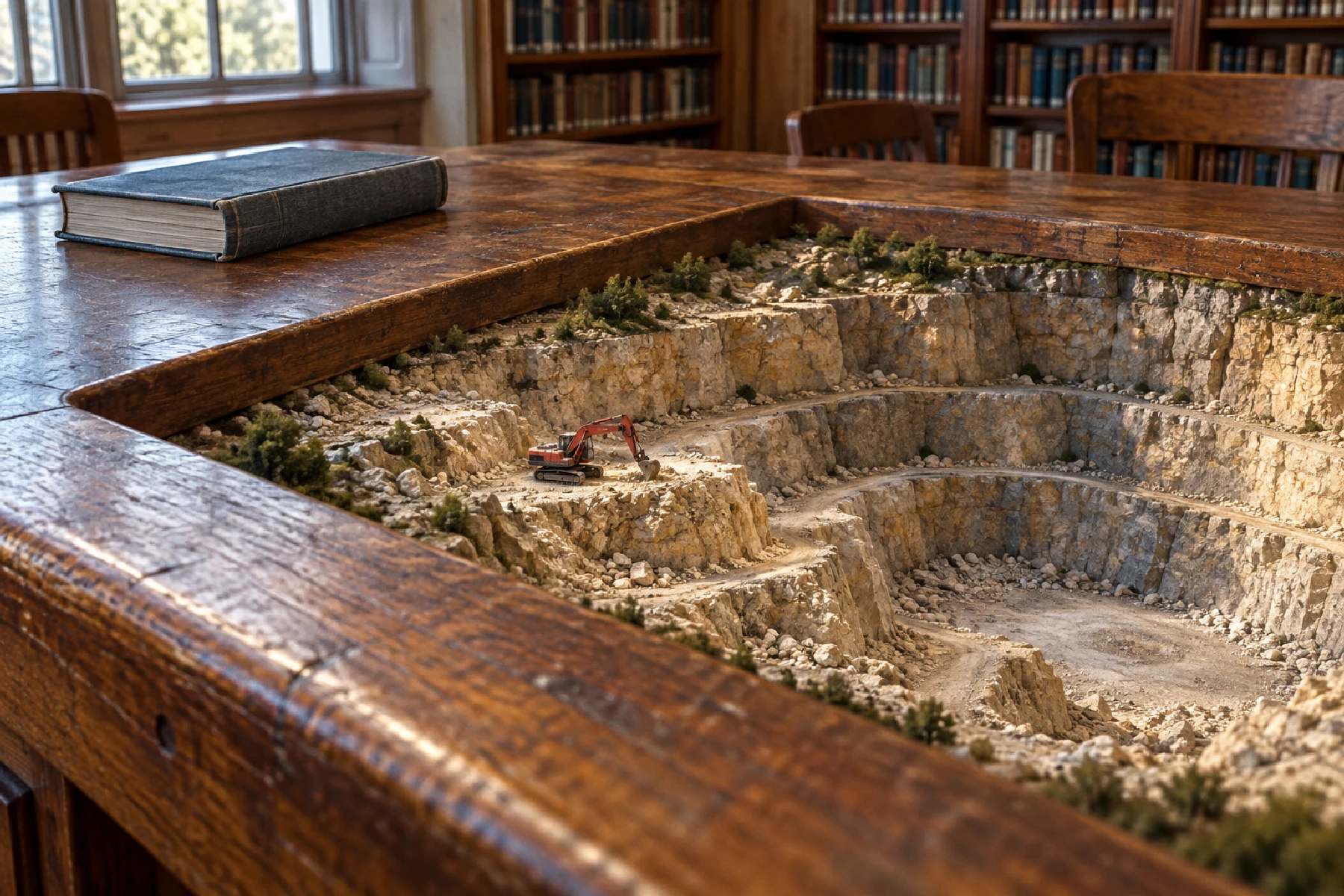
A miniature quarry descends through an old library reading table. A full-size book and a tiny excavator establish the surprising scale, captured with the soft grain and expressive depth of analog color photography.
Remix this referenceA Tiny Quarry in the Library Table
- Form language
- Keep forms photographically credible, simplifying through selective detail rather than geometric redesign; natural irregularities may vary.
- Contour
- Use unoutlined optical edges: sharply resolved boundaries within focus, gradually dissolving edges beyond it, without cutout halos.
- Mark-making
- Fine, irregular color-negative grain gathers naturally in midtones and shadows; keep its scale delicate and its distribution unpatterned.
- Surface rendering
- Suggest an analog darkroom enlargement with gently compressed highlights, open dark tones and continuous transitions; preserve uneven surface detail.
Priority
Make the analog photographic treatment visible through optical edge falloff, organic grain and supple tonal transitions.
What to avoid & what to check
Exact prompt for this example
MODULE OWNERSHIP
subject: Subject count, type, stable proportions and landmarks, resting face geometry, hair shape, physical materials, garment construction and permanent marks. No emotion, movement, color assignment or rendering recipe.
expression: Facial soft-tissue displacement and pupil direction, muscle coordination, regional intensity, asymmetry and onset/peak/release. No head/body pose, stable appearance, skin color or rendering.
gesture: Head/neck/body/limb orientation, joint movement, support, contact and pose-caused occlusion using existing anatomy. No eye/pupil movement, emotion, identity, props inventory or camera.
props: Prop count, type, construction, physical material and scale relative to the subject. Holding/contact belongs to gesture, position to composition, color to palette.
scene: Environment elements, terrain, backdrop/floor presence and structural detail. No canvas positions, camera, lighting, assigned colors or render texture.
camera: Projection, focal-length impression, camera elevation/yaw/roll, viewing distance and crop. No actor pose, world placement, lighting or canvas aspect ratio.
composition: Normalized 0-100% canvas positions, scale in frame, depth/overlap, focal hierarchy and margins. No joint pose, camera projection, rendering, subject/prop inventory or emotion.
palette: Color anchors, hue/saturation/value ranges, colors assigned to parts and approximate color coverage. No illumination direction, shading algorithm, physical material or layout.
lighting: Light-source direction/softness/intensity, ambient illumination, physical shadow direction/length and highlight position. Absence of directional illumination is allowed. No shading technique, palette or material changes.
style: Reusable form abstraction, contour weight/taper/edge quality, medium and mark scale/density/direction, surface rendering and tonal transition technique. No fixed subject proportions, anatomy, identity, expression, pose, palette, light-source direction, camera or layout.
output: Image count, aspect ratio, size, file/alpha requirements and global lettering/logo/watermark restrictions. No background scenery, crop, style, identity or pose.

SUBJECT
inventory: One old communal library reading table, made from solid timber.
geometry: A thick rectangular tabletop has a broad central opening, with a substantial wooden rim remaining around it.
resting-face: No face-bearing subject.
appearance: Rounded worn corners, an inset apron and shallow scratches give the timber a long-used construction.

PRIORITY


AVOID


CHECK


PROPS
inventory: One closed book at normal reading scale and one excavator small enough to fit on a book cover.
construction: The book has cloth-covered boards and a paper block; the excavator has metal tracks, a glazed cab and a jointed bucket boom.

PRIORITY


AVOID


CHECK


SCENE
inventory: A quiet library interior surrounds a miniature limestone quarry descending inside the tabletop opening.
structure: Uneven quarry benches and a winding haul road descend to a gravel basin; tall shelving and broad windows establish the library.

PRIORITY


AVOID


CHECK


CAMERA
projection: Natural photographic perspective with a normal-lens impression and selective optical focus.
viewpoint: Look obliquely downward from just above tabletop height, close enough to see into the quarry.
crop: Include the near wooden rim and much of the opening; crop the table ends and retain a narrow view of the library beyond.

PRIORITY


AVOID


CHECK


COMPOSITION
placement: The quarry dominates the lower right; the book sits on the upper-left rim, with the excavator small on an inner terrace.
depth: The near rim overlaps the descending terraces; successive benches lead toward the basin, with shelving well behind the table.
spacing: Make the cut wooden edge the first focal point, then the tiny excavator; leave a generous quiet stretch of tabletop beside the book.

PRIORITY


AVOID


CHECK


PALETTE
colors: Tobacco brown, chalk cream, muted blue-gray and a small rust-red accent form a restrained color family.
assignment: Use tobacco brown for timber, chalk cream for quarry stone, blue-gray for the book and library, and rust red for the excavator.
balance: Broad brown and cream areas carry the image; subdued cool surroundings support the tiny concentrated red accent.

PRIORITY


AVOID


CHECK


LIGHTING
sources: Broad soft window light enters from the left, supported by low ambient illumination; no electric lamps are lit.
shadows: Short shadows fall to the right; the quarry recesses darken gradually while retaining visible terrace structure.
highlights: Gentle highlights touch the left-facing wooden edge and exposed stone ledges.

PRIORITY


AVOID


CHECK


STYLE GUIDE
form-language: Keep forms photographically credible, simplifying through selective detail rather than geometric redesign; natural irregularities may vary.
contour: Use unoutlined optical edges: sharply resolved boundaries within focus, gradually dissolving edges beyond it, without cutout halos.
mark-making: Fine, irregular color-negative grain gathers naturally in midtones and shadows; keep its scale delicate and its distribution unpatterned.
surface-rendering: Suggest an analog darkroom enlargement with gently compressed highlights, open dark tones and continuous transitions; preserve uneven surface detail.

PRIORITY
Make the analog photographic treatment visible through optical edge falloff, organic grain and supple tonal transitions.

AVOID


CHECK


OUTPUT
format: One finished image, landscape 3:2, 1800 × 1200 pixels, opaque PNG.
restrictions: No readable lettering, logos or watermarks.

PRIORITY


AVOID


CHECK


FINAL INTEGRATION
subject + scene + props: The furniture, landscape and familiar objects should read as one physically continuous encounter across incompatible scales.
camera + composition + style: Let optical depth reinforce the spatial sequence while preserving enough context to recognize the scale surprise.
Model information comes from image provenance. The same prompt may produce a different result.