Text to imageLandscapeStyle guide
Twin Lakes in a Hoofprint
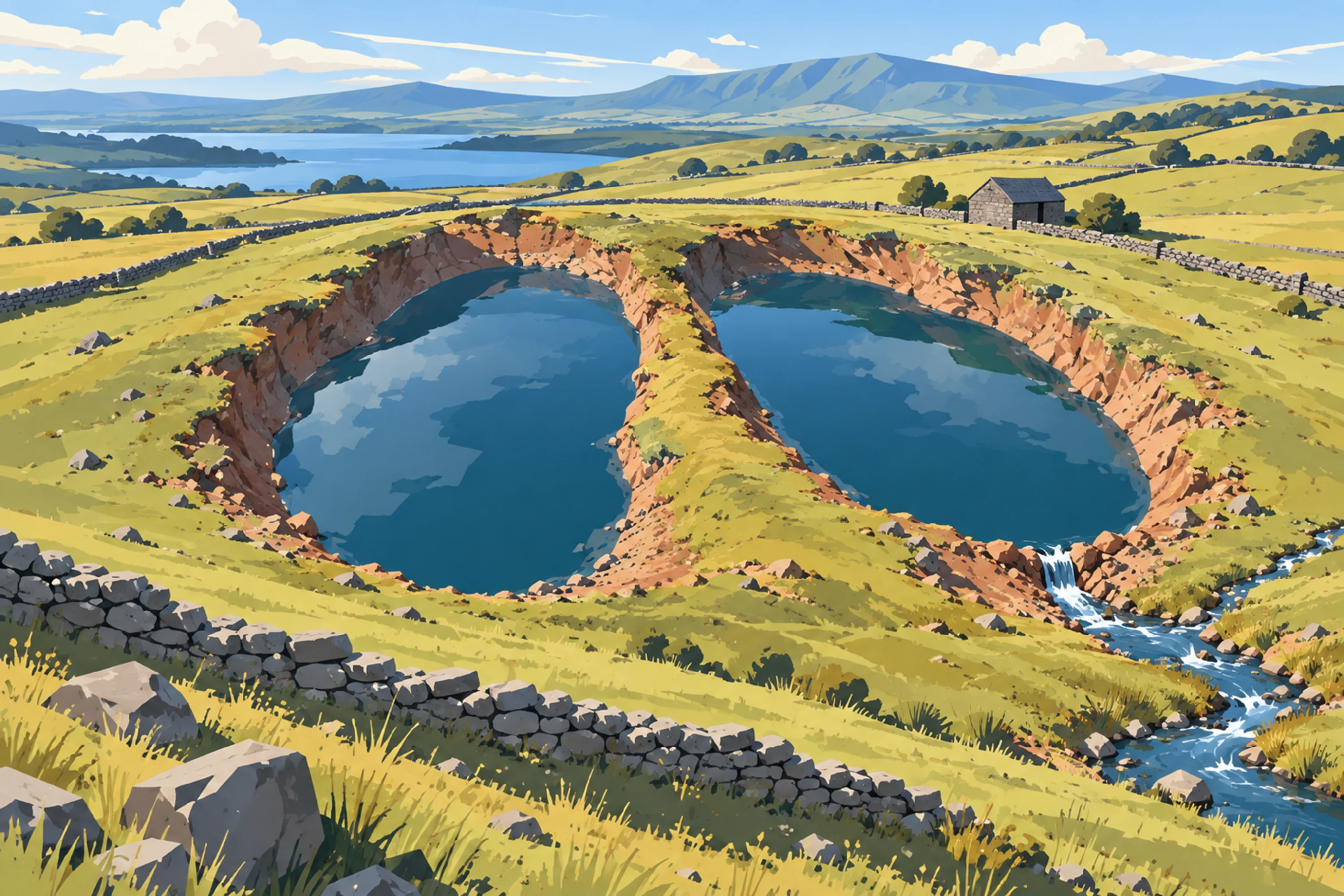
Two lakes fill an enormous cloven hoofprint in upland pasture. Small stone walls and a barn reveal its astonishing scale through playfully asymmetric vector shapes.
Remix this referenceTwin Lakes in a Hoofprint
- Form language
- Build interlocking vector shapes from lopsided curves and abrupt angular cuts; simplify small details freely within this vocabulary.
- Contour
- Use crisp, mostly unoutlined boundaries, with occasional tapered interior strokes and deliberately unequal curve lengths.
- Mark-making
- Scatter sparse vector ticks in irregular little groups; vary their lengths and let clusters end unexpectedly.
- Surface rendering
- Use broad tonal plates with a few translucent stepped bands; preserve sharp shape junctions and selective surface quiet.
Priority
Make crisp vector abstraction and playful asymmetry visible throughout.
What to avoid & what to check
Exact prompt for this example
MODULE OWNERSHIP
subject: Subject count, type, stable proportions and landmarks, resting face geometry, hair shape, physical materials, garment construction and permanent marks. No emotion, movement, color assignment or rendering recipe.
expression: Facial soft-tissue displacement and pupil direction, muscle coordination, regional intensity, asymmetry and onset/peak/release. No head/body pose, stable appearance, skin color or rendering.
gesture: Head/neck/body/limb orientation, joint movement, support, contact and pose-caused occlusion using existing anatomy. No eye/pupil movement, emotion, identity, props inventory or camera.
props: Prop count, type, construction, physical material and scale relative to the subject. Holding/contact belongs to gesture, position to composition, color to palette.
scene: Environment elements, terrain, backdrop/floor presence and structural detail. No canvas positions, camera, lighting, assigned colors or render texture.
camera: Projection, focal-length impression, camera elevation/yaw/roll, viewing distance and crop. No actor pose, world placement, lighting or canvas aspect ratio.
composition: Normalized 0-100% canvas positions, scale in frame, depth/overlap, focal hierarchy and margins. No joint pose, camera projection, rendering, subject/prop inventory or emotion.
palette: Color anchors, hue/saturation/value ranges, colors assigned to parts and approximate color coverage. No illumination direction, shading algorithm, physical material or layout.
lighting: Light-source direction/softness/intensity, ambient illumination, physical shadow direction/length and highlight position. Absence of directional illumination is allowed. No shading technique, palette or material changes.
style: Reusable form abstraction, contour weight/taper/edge quality, medium and mark scale/density/direction, surface rendering and tonal transition technique. No fixed subject proportions, anatomy, identity, expression, pose, palette, light-source direction, camera or layout.
output: Image count, aspect ratio, size, file/alpha requirements and global lettering/logo/watermark restrictions. No background scenery, crop, style, identity or pose.

SUBJECT
inventory: One colossal cloven hoof impression forms the principal landform; no visible creature.
geometry: Two elongated hollows share a broad rear edge, separated by a raised tongue of intact ground.
resting-face: No face or facial landmarks apply.
appearance: The impression exposes compressed earth and broken turf, with irregularly crumbled rims.

PRIORITY


AVOID


CHECK


PROPS
inventory: No separate props.
construction: No prop construction applies.

PRIORITY


AVOID


CHECK


SCENE
inventory: Rolling upland pasture, two still lakes, a narrow stream, dry-stone field walls, one small barn, a distant ridge and open sky.
structure: Water occupies both hollows; the stream cuts through a breached rim, while old field walls continue across surrounding slopes.

PRIORITY


AVOID


CHECK


CAMERA
projection: Moderately wide perspective with natural recession and little edge distortion.
viewpoint: An elevated oblique view looks down across the pasture while retaining the distant horizon.
crop: Show the complete impression within a broad landscape crop, with foreground pasture and ample distant country.

PRIORITY


AVOID


CHECK


COMPOSITION
placement: Pasture surrounds exposed earth; the paired lakes dominate below and right of center, with the small barn well beyond their far rim.
depth: A foreground wall overlaps the near rim; successive pasture folds lead toward the barn and distant ridge.
spacing: Keep the central dividing ridge readable and leave a spacious upper band; the tiny walls establish the scale contrast.

PRIORITY


AVOID


CHECK


PALETTE
colors: Use pale citron, dusty coral, deep petrol blue and a restrained powder blue.
assignment: Pasture is citron and exposed earth coral; petrol lakes contrast with the powder-blue sky and muted stone walls.
balance: Light land colors dominate, with concentrated dark water and only small coral interruptions.

PRIORITY


AVOID


CHECK


LIGHTING
sources: Broad sunlight arrives from the upper left through thin cloud, with generous ambient fill.
shadows: Soft, short shadows fall toward the lower right beneath the walls and inside the raised rims.
highlights: Restrained highlights touch the upper-left turf edges and a few quiet water patches.

PRIORITY


AVOID


CHECK


STYLE GUIDE
form-language: Build interlocking vector shapes from lopsided curves and abrupt angular cuts; simplify small details freely within this vocabulary.
contour: Use crisp, mostly unoutlined boundaries, with occasional tapered interior strokes and deliberately unequal curve lengths.
mark-making: Scatter sparse vector ticks in irregular little groups; vary their lengths and let clusters end unexpectedly.
surface-rendering: Use broad tonal plates with a few translucent stepped bands; preserve sharp shape junctions and selective surface quiet.

PRIORITY
Make crisp vector abstraction and playful asymmetry visible throughout.

AVOID


CHECK


OUTPUT
format: One finished image, landscape 3:2, 3000 × 2000 pixels, opaque PNG.
restrictions: No lettering, logos or watermarks.

PRIORITY


AVOID


CHECK
Model information comes from image provenance. The same prompt may produce a different result.