Text to imageAnimationStyle guide
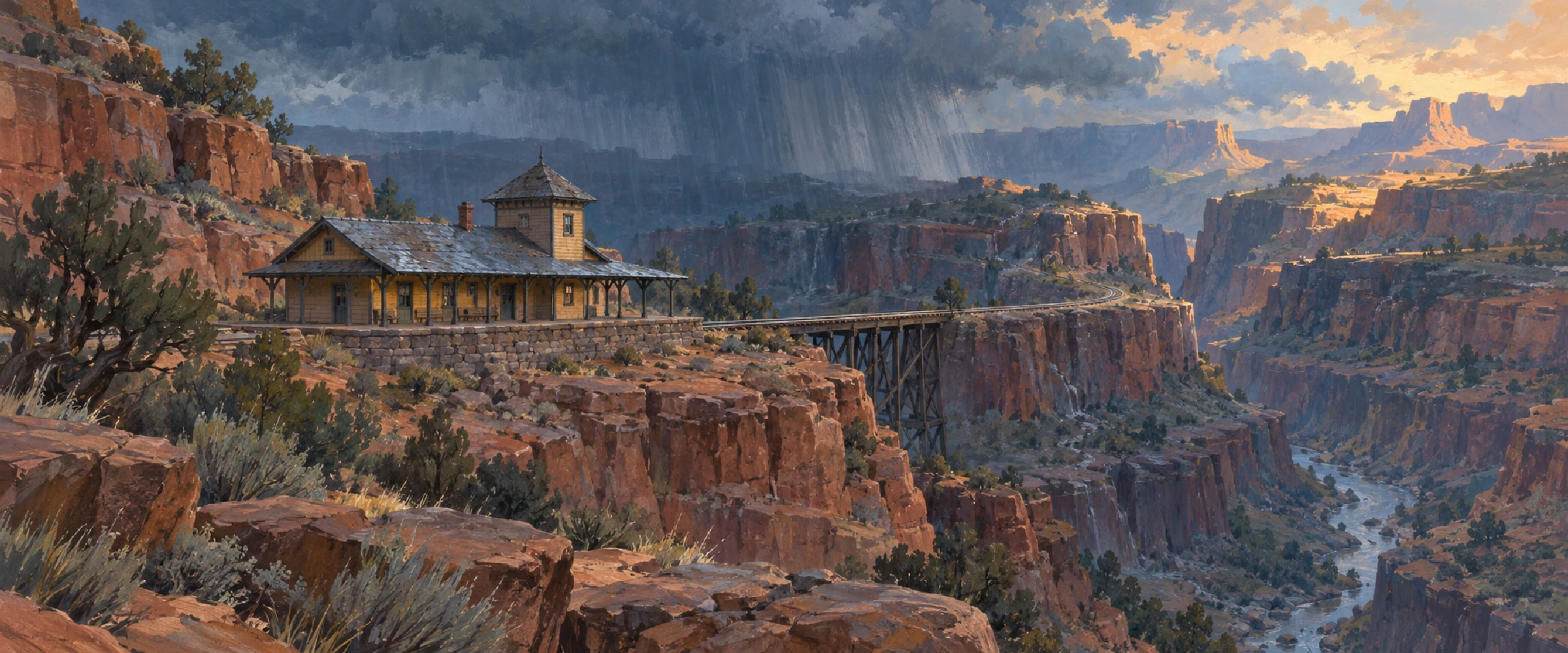
Canyon Station Beneath the Rain Curtain
Beyond a curtain of rain soaking a small canyon station, a winding railway reaches an upland still catching sunlight. Broad gouache planes and irregular painted edges evoke the beginning of a long journey.
Remix this referenceCanyon Station Beneath the Rain Curtain
- Form language
- Reduce forms to broad planar masses, joining simple curves with angular facets; vary small shapes without losing the large silhouette.
- Contour
- Define forms mainly by opaque painted boundaries; alternate firm edges with broken, slightly wandering edges instead of continuous outlines.
- Mark-making
- Leave broad brush traces inside planes and occasional dry-brush skips at edges; let stroke size and direction vary with each passage.
- Surface rendering
- Build matte opaque gouache surfaces with shallow paper grain and a few stepped tones; allow soft scumbled transitions in atmospheric passages.
Priority
Rendering medium: 2D opaque-gouache animated-film concept illustration; formal rendering reference: Walt Disney Studios · 1950s · Peter Pan concept art (1953)
What to avoid & what to check
Exact prompt for this example
MODULE OWNERSHIP
subject: Subject count, type, stable proportions and landmarks, resting face geometry, hair shape, physical materials, garment construction and permanent marks. No emotion, movement, color assignment or rendering recipe.
expression: Facial soft-tissue displacement and pupil direction, muscle coordination, regional intensity, asymmetry and onset/peak/release. No head/body pose, stable appearance, skin color or rendering.
gesture: Head/neck/body/limb orientation, joint movement, support, contact and pose-caused occlusion using existing anatomy. No eye/pupil movement, emotion, identity, props inventory or camera.
props: Prop count, type, construction, physical material and scale relative to the subject. Holding/contact belongs to gesture, position to composition, color to palette.
scene: Environment elements, terrain, backdrop/floor presence and structural detail. No canvas positions, camera, lighting, assigned colors or render texture.
camera: Projection, focal-length impression, camera elevation/yaw/roll, viewing distance and crop. No actor pose, world placement, lighting or canvas aspect ratio.
composition: Normalized 0-100% canvas positions, scale in frame, depth/overlap, focal hierarchy and margins. No joint pose, camera projection, rendering, subject/prop inventory or emotion.
palette: Color anchors, hue/saturation/value ranges, colors assigned to parts and approximate color coverage. No illumination direction, shading algorithm, physical material or layout.
lighting: Light-source direction/softness/intensity, ambient illumination, physical shadow direction/length and highlight position. Absence of directional illumination is allowed. No shading technique, palette or material changes.
style: Reusable form abstraction, contour weight/taper/edge quality, medium and mark scale/density/direction, surface rendering and tonal transition technique. No fixed subject proportions, anatomy, identity, expression, pose, palette, light-source direction, camera or layout.
output: Image count, aspect ratio, size, file/alpha requirements and global lettering/logo/watermark restrictions. No background scenery, crop, style, identity or pose.

SUBJECT
inventory: One original, unoccupied railway station: a modest building with an attached covered passenger gallery.
geometry: A long, low main block rests on a stout base; an offset square stair tower interrupts the broad overhanging roof.
resting-face: No face or facial landmarks apply to this architectural subject.
appearance: Timber walls, a weathered masonry base and overlapping roof shingles; the gallery roof is rain-wet. Small chips and repairs may vary naturally.

PRIORITY


AVOID


CHECK


PROPS
inventory: No separate props.
construction: No prop construction applies.

PRIORITY


AVOID


CHECK


SCENE
inventory: A terraced canyon, a single railway, sparse scrub, distant uplands and a localized curtain of rain beneath broken clouds.
structure: The track follows a rock shelf, crosses a short trestle and disappears through a notch; runoff threads the exposed strata.

PRIORITY


AVOID


CHECK


CAMERA
projection: Gentle linear perspective with a mild wide-angle impression; preserve an expansive distance without stretched edges.
viewpoint: Look obliquely along the canyon from a slightly elevated opposite shelf, at a distant establishing-view scale; keep roll level.
crop: Include the complete station and enough railway to reveal its route; crop the nearest rock ledges as they continue beyond the frame.

PRIORITY


AVOID


CHECK


COMPOSITION
placement: Place the station around 25% across, occupying roughly a fifth of the width; the railway leads toward the upper-right distance.
depth: Foreground ledges overlap the station terrace; successive canyon shelves open toward the distant notch without closing the route.
spacing: Make the station the first visual pause and the distant opening the second; give the ravine broad space and keep the route readable.

PRIORITY


AVOID


CHECK


PALETTE
colors: Use smoky petrol blue, dusty terracotta, pale apricot and muted straw yellow, with restrained saturation and a generous value range.
assignment: Assign petrol blue to clouds and rain, terracotta to canyon rock, straw to station walls and pale apricot to sky openings.
balance: Let blue and terracotta carry most of the image; use straw and apricot sparingly, with natural hue variation inside each family.

PRIORITY


AVOID


CHECK


LIGHTING
sources: Low sunlight enters from the upper right through a cloud break; soft overcast illumination predominates beneath the rain.
shadows: Exposed rock casts long shadows toward the lower left; beneath the rain, shadow edges soften and their contrast diminishes.
highlights: Catch the upper-right edges of distant ledges; allow only faint broad highlights on the gallery roof.

PRIORITY


AVOID


CHECK


STYLE GUIDE
form-language: Reduce forms to broad planar masses, joining simple curves with angular facets; vary small shapes without losing the large silhouette.
contour: Define forms mainly by opaque painted boundaries; alternate firm edges with broken, slightly wandering edges instead of continuous outlines.
mark-making: Leave broad brush traces inside planes and occasional dry-brush skips at edges; let stroke size and direction vary with each passage.
surface-rendering: Build matte opaque gouache surfaces with shallow paper grain and a few stepped tones; allow soft scumbled transitions in atmospheric passages.

PRIORITY
Rendering medium: 2D opaque-gouache animated-film concept illustration; formal rendering reference: Walt Disney Studios · 1950s · Peter Pan concept art (1953)

AVOID


CHECK


OUTPUT
format: One finished image, 12:5 aspect ratio, 2400 × 1000 pixels, opaque PNG without an alpha channel.
restrictions: No lettering, logos or watermarks.

PRIORITY


AVOID


CHECK


FINAL INTEGRATION
scene + camera + composition: Let the environment's connected route support the panoramic viewing journey while maintaining clear separation between depth layers.
palette + lighting + style: Translate the weather's illumination changes through the chosen color families and painted tonal language without sacrificing brush variation.
Art direction
디즈니 / Walt Disney Studios · 1950s · 피터 팬 콘셉트 아트(1953) / Peter Pan concept art (1953) ↗- Render forms as broad planar masses with simplified curved and angular facets
- Separate forms primarily through opaque painted boundaries rather than continuous outlines
- Broad brush traces within planes and small dry-brush interruptions at their edges
- Matte opaque gouache planes, shallow paper texture and a small set of tonal levels
Model information comes from image provenance. The same prompt may produce a different result.