Text to imageCharacterStyle guide
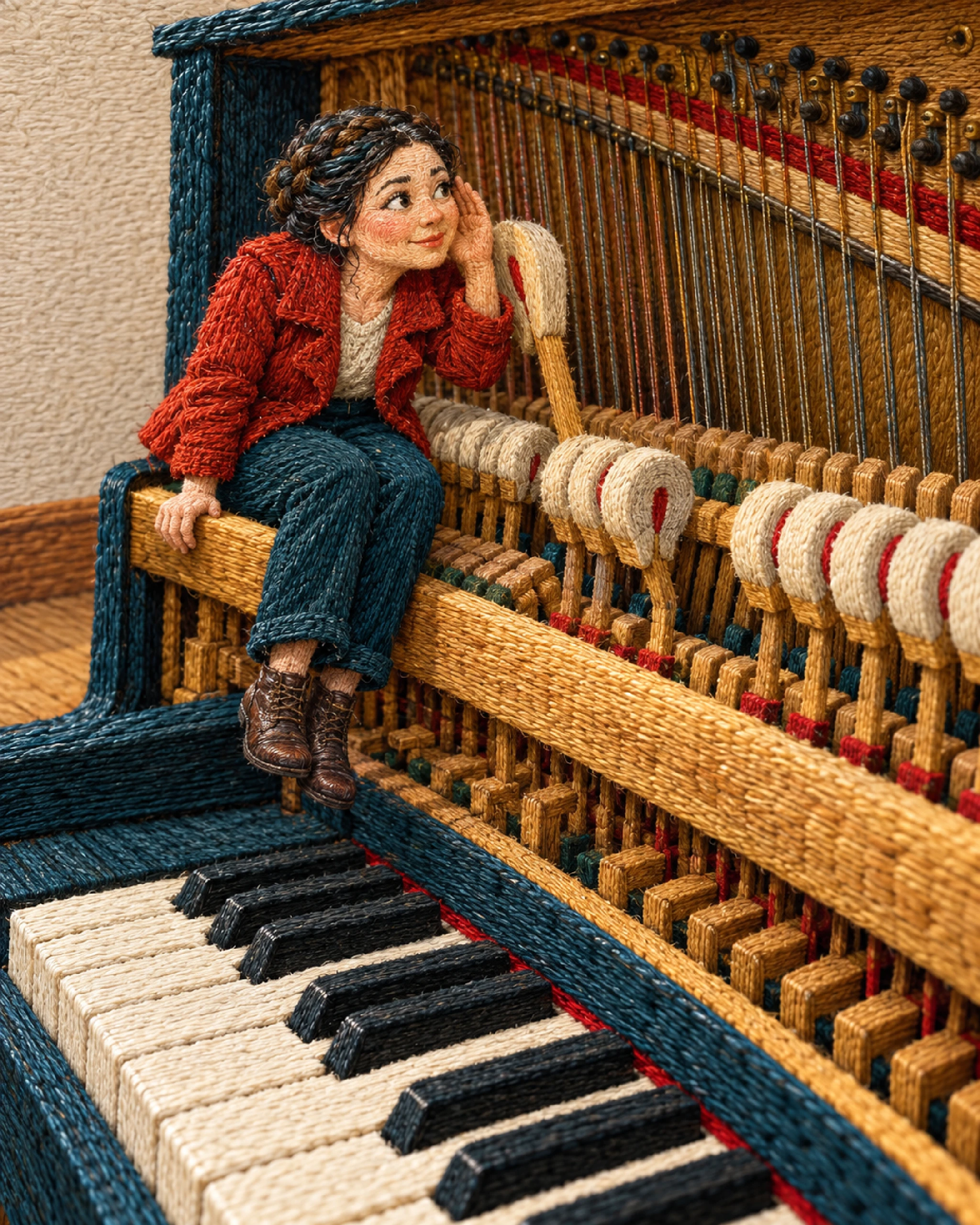
Tiny Woman on a Piano Hammer
A tiny woman sits on a hammer inside an open upright piano, listening closely. Raised embroidery and slender strings transform the familiar instrument into an immense listening chamber.
Remix this referenceTiny Woman on a Piano Hammer
- Form language
- Simplify forms into supple, interlocking shapes; preserve a few descriptive notches rather than uniform geometric regularity.
- Contour
- Build edges from narrow stitched cords that thicken at overlaps and occasionally dissolve into loose fiber ends.
- Mark-making
- Use visibly hand-laid embroidery: long directional stitches across broad forms, shorter curved stitches around small turns, with natural variation.
- Surface rendering
- Layer floss into palpable relief; blend tones through interleaved strands and let occasional cloth gaps interrupt dense stitched passages.
Priority
The finished illustration must visibly read as raised embroidery, with individual strands and built-up stitch edges.
What to avoid & what to check
Exact prompt for this example
MODULE OWNERSHIP
subject: Subject count, type, stable proportions and landmarks, resting face geometry, hair shape, physical materials, garment construction and permanent marks. No emotion, movement, color assignment or rendering recipe.
expression: Facial soft-tissue displacement and pupil direction, muscle coordination, regional intensity, asymmetry and onset/peak/release. No head/body pose, stable appearance, skin color or rendering.
gesture: Head/neck/body/limb orientation, joint movement, support, contact and pose-caused occlusion using existing anatomy. No eye/pupil movement, emotion, identity, props inventory or camera.
props: Prop count, type, construction, physical material and scale relative to the subject. Holding/contact belongs to gesture, position to composition, color to palette.
scene: Environment elements, terrain, backdrop/floor presence and structural detail. No canvas positions, camera, lighting, assigned colors or render texture.
camera: Projection, focal-length impression, camera elevation/yaw/roll, viewing distance and crop. No actor pose, world placement, lighting or canvas aspect ratio.
composition: Normalized 0-100% canvas positions, scale in frame, depth/overlap, focal hierarchy and margins. No joint pose, camera projection, rendering, subject/prop inventory or emotion.
palette: Color anchors, hue/saturation/value ranges, colors assigned to parts and approximate color coverage. No illumination direction, shading algorithm, physical material or layout.
lighting: Light-source direction/softness/intensity, ambient illumination, physical shadow direction/length and highlight position. Absence of directional illumination is allowed. No shading technique, palette or material changes.
style: Reusable form abstraction, contour weight/taper/edge quality, medium and mark scale/density/direction, surface rendering and tonal transition technique. No fixed subject proportions, anatomy, identity, expression, pose, palette, light-source direction, camera or layout.
output: Image count, aspect ratio, size, file/alpha requirements and global lettering/logo/watermark restrictions. No background scenery, crop, style, identity or pose.

SUBJECT
inventory: A is one original adult woman and the only figure.
geometry: She has a compact adult build, broad hands, a rounded nose and a thick braid wrapped around her crown.
resting-face: Her resting face has a broad forehead, gently hooded eyes, full cheeks and a short, rounded chin.
appearance: She wears a wool jacket with a wide collar, cotton trousers and leather ankle boots; small garment details may vary.

PRIORITY


AVOID


CHECK


EXPRESSION — ACTOR A
brows: Both brows lift slightly, with one arch a little higher.
lids: Upper lids open attentively; lower lids remain relaxed.
cheeks: A faint cheek lift accompanies the small smile.
nose: The nose remains relaxed without wrinkling or nostril flare.
mouth: Closed lips curve into a small, uneven smile.
jaw: The jaw stays loose with no visible clenching.
gaze: Pupils turn toward the nearby strings, slightly above eye level.
coordination: Alert eyes and a restrained mouth convey absorbed curiosity.
timing: Hold the apex of listening, before curiosity becomes a larger reaction.

PRIORITY


AVOID


CHECK


GESTURE
head: A inclines her head toward the strings.
torso: She sits sideways on a hammer shank and leans forward slightly from the hips.
limbs: One hand cups her ear, the other reaches down for support, and both feet hang freely.
contact: Her seated weight rests on the shank; her supporting palm presses its top beside her hip.

PRIORITY


AVOID


CHECK


PROPS
inventory: One ordinary upright piano dwarfs A; a single full-length key is longer than her leg. No loose accessories.
construction: Its wooden case has an open upper front, exposing metal strings and felt-headed wooden hammers above the keyboard.

PRIORITY


AVOID


CHECK


SCENE
inventory: A quiet practice room contains a plaster wall and a wooden floor.
structure: A simple skirting board joins wall and floor; the room has no decorative architectural features.

PRIORITY


AVOID


CHECK


CAMERA
projection: Use gentle perspective with a normal-lens impression.
viewpoint: Look slightly downward from the piano's front-right, without camera roll.
crop: Frame A's whole body within a close view of the open mechanism and keyboard; crop the piano's outer ends.

PRIORITY


AVOID


CHECK


COMPOSITION
placement: A occupies the upper-left interior; the keyboard forms a broad lower band, with open space beside her face.
depth: The near case edge overlaps the lowest mechanism; hammers overlap in depth, and strings recede behind A without crossing her face.
spacing: The face and hand lead the focal hierarchy, followed by the hammer and keyboard; leave the right side spacious.

PRIORITY


AVOID


CHECK


PALETTE
colors: Use deep petrol, honey ochre, warm ivory and vermilion, with restrained saturation outside the vermilion.
assignment: Assign petrol to case, hair and trousers; ochre to the mechanism; ivory to skin and white keys; vermilion to the jacket.
balance: Petrol and ochre occupy most of the image; ivory opens lighter intervals and vermilion remains a small accent.

PRIORITY


AVOID


CHECK


LIGHTING
sources: Broad, soft light enters from the upper left, with gentle ambient illumination inside the piano.
shadows: Short shadows fall toward the lower right, deepening at support contacts and existing overlaps.
highlights: Soft highlights catch the upper-left-facing edges of the face and jacket folds.

PRIORITY


AVOID


CHECK


STYLE GUIDE
form-language: Simplify forms into supple, interlocking shapes; preserve a few descriptive notches rather than uniform geometric regularity.
contour: Build edges from narrow stitched cords that thicken at overlaps and occasionally dissolve into loose fiber ends.
mark-making: Use visibly hand-laid embroidery: long directional stitches across broad forms, shorter curved stitches around small turns, with natural variation.
surface-rendering: Layer floss into palpable relief; blend tones through interleaved strands and let occasional cloth gaps interrupt dense stitched passages.

PRIORITY
The finished illustration must visibly read as raised embroidery, with individual strands and built-up stitch edges.

AVOID


CHECK


OUTPUT
format: Deliver one 4:5 image at 2048 × 2560 pixels as an opaque PNG.
restrictions: No lettering, logos, signatures or watermarks.

PRIORITY


AVOID


CHECK


FINAL INTEGRATION
gesture + props + composition: Keep the seated contact readable while allowing the instrument's familiar construction to establish the scale surprise.
style + lighting: Let illumination reveal the embroidery's physical relief without replacing the stitched tonal transitions.
Model information comes from image provenance. The same prompt may produce a different result.