Text to imageArt stylesStyle guide
A Snail Crossing the Fiddle
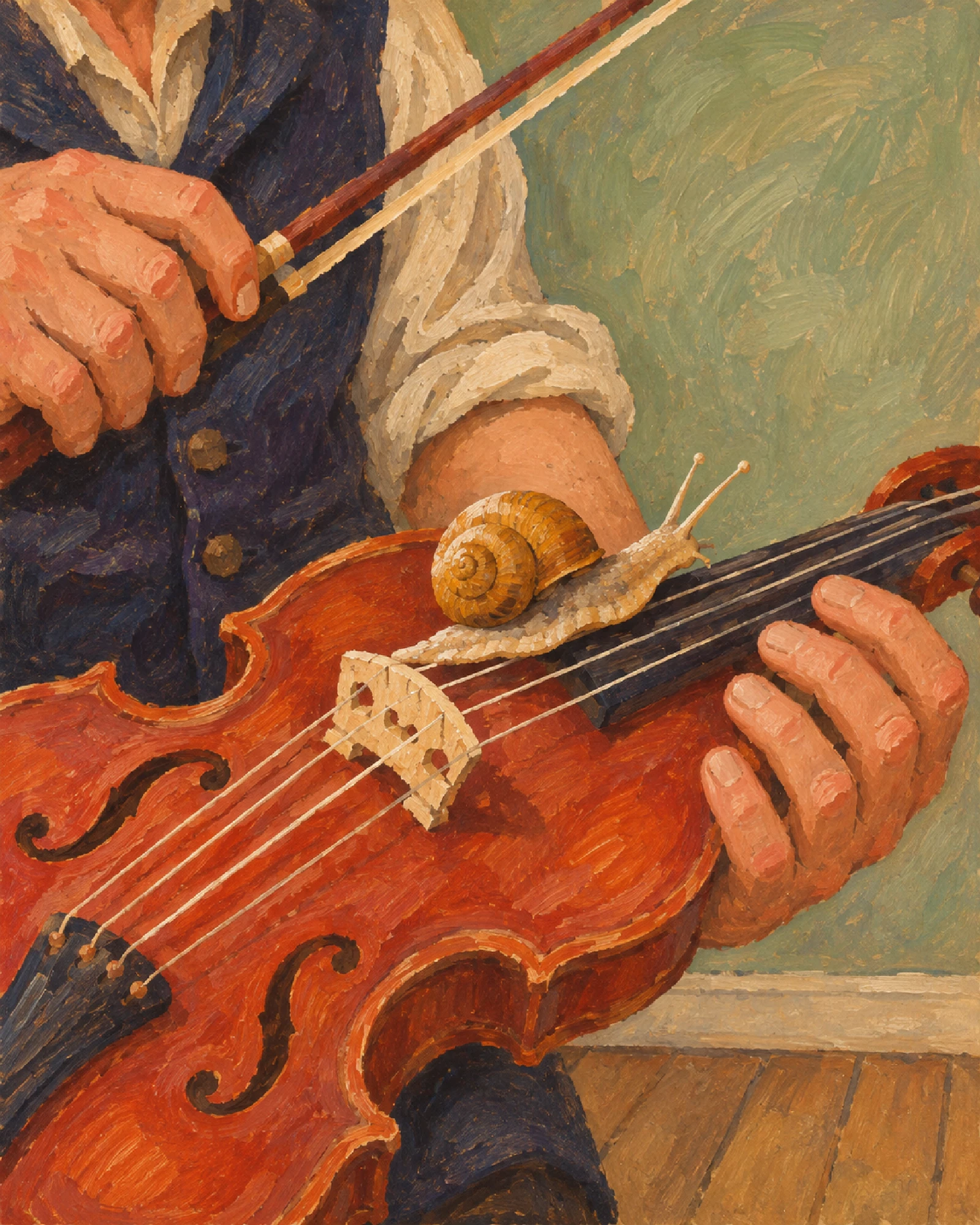
A fiddler’s hands pause while a snail crosses the strings. Boldly cropped woodwork and sleeves become an intimate folk painting of wandering brush lines and decorative rhythms.
Remix this referenceA Snail Crossing the Fiddle
- Form language
- Simplify forms into lopsided, interlocking shapes; recurring curves become loose decorative rhythms rather than mechanically repeated units.
- Contour
- Use wandering brush contours that swell at turns and sometimes dissolve into adjacent paint; retain small hesitations and blunt endings.
- Mark-making
- Build accents from flat-brush dabs, short hooks and uneven scallops; spacing and pressure may vary naturally within this shared vocabulary.
- Surface rendering
- Paint matte tempera on a prepared wood panel; thin scumbles interrupt opaque passages, with stepped tonal changes and occasional exposed underpaint.
Priority
Make naive folk painting’s lively decorative simplification visible in the brushwork.
What to avoid & what to check
Exact prompt for this example
MODULE OWNERSHIP
subject: Subject count, type, stable proportions and landmarks, resting face geometry, hair shape, physical materials, garment construction and permanent marks. No emotion, movement, color assignment or rendering recipe.
expression: Facial soft-tissue displacement and pupil direction, muscle coordination, regional intensity, asymmetry and onset/peak/release. No head/body pose, stable appearance, skin color or rendering.
gesture: Head/neck/body/limb orientation, joint movement, support, contact and pose-caused occlusion using existing anatomy. No eye/pupil movement, emotion, identity, props inventory or camera.
props: Prop count, type, construction, physical material and scale relative to the subject. Holding/contact belongs to gesture, position to composition, color to palette.
scene: Environment elements, terrain, backdrop/floor presence and structural detail. No canvas positions, camera, lighting, assigned colors or render texture.
camera: Projection, focal-length impression, camera elevation/yaw/roll, viewing distance and crop. No actor pose, world placement, lighting or canvas aspect ratio.
composition: Normalized 0-100% canvas positions, scale in frame, depth/overlap, focal hierarchy and margins. No joint pose, camera projection, rendering, subject/prop inventory or emotion.
palette: Color anchors, hue/saturation/value ranges, colors assigned to parts and approximate color coverage. No illumination direction, shading algorithm, physical material or layout.
lighting: Light-source direction/softness/intensity, ambient illumination, physical shadow direction/length and highlight position. Absence of directional illumination is allowed. No shading technique, palette or material changes.
style: Reusable form abstraction, contour weight/taper/edge quality, medium and mark scale/density/direction, surface rendering and tonal transition technique. No fixed subject proportions, anatomy, identity, expression, pose, palette, light-source direction, camera or layout.
output: Image count, aspect ratio, size, file/alpha requirements and global lettering/logo/watermark restrictions. No background scenery, crop, style, identity or pose.

SUBJECT
inventory: A is one adult fiddler; B is one garden snail.
geometry: A has broad hands and blunt fingertips; B has a thumb-width spiral shell, broad foot and two long upper feelers.
resting-face: Resting facial geometry for A and B is left unspecified.
appearance: A wears rolled linen sleeves and a wool waistcoat; B has a ridged shell and a soft, unmarked body.

PRIORITY


AVOID


CHECK


EXPRESSION — ACTOR A
brows: Brow action is unseen; leave it unprescribed.
lids: Lid movement is unseen; leave it unprescribed.
cheeks: Cheek displacement is unseen; leave it unprescribed.
nose: Nasal tension is unseen; leave it unprescribed.
mouth: Mouth action is unseen; leave it unprescribed.
jaw: Jaw action is unseen; leave it unprescribed.
gaze: Pupil direction is unseen; leave it unprescribed.
coordination: No readable facial coordination or asymmetry is prescribed.
timing: The neutral apex has no visible facial timing cue.

PRIORITY


AVOID


CHECK


EXPRESSION — ACTOR B
brows: No readable brow action; leave it unprescribed.
lids: No readable lid action; leave it unprescribed.
cheeks: No readable cheek displacement; leave it unprescribed.
nose: No readable nasal action; leave it unprescribed.
mouth: Mouth action is too small to read; leave it unprescribed.
jaw: No readable jaw action; leave it unprescribed.
gaze: Pupil direction is too small to read; leave it unprescribed.
coordination: No readable facial coordination or asymmetry is prescribed.
timing: The neutral apex has no visible facial timing cue.

PRIORITY


AVOID


CHECK


GESTURE
head: A’s head and neck are unprescribed; B extends its feelers toward the bridge.
torso: A’s upper body holds still; B lengthens its body across the strings.
limbs: A loosens the left fingers around the neck and lifts the bow with the right wrist; B advances on its foot.
contact: A supports the fiddle without stopping the strings; the bow clears them, and B’s foot spans adjacent strings.

PRIORITY


AVOID


CHECK


PROPS
inventory: One adult-sized wooden fiddle and one matching bow.
construction: The fiddle has a curved hollow body, paired sound holes, strings and a raised bridge; the bow uses wood and horsehair.

PRIORITY


AVOID


CHECK


SCENE
inventory: A modest rehearsal room with a plaster wall and timber floor.
structure: A simple skirting board joins wall and floor; other furnishings remain unspecified.

PRIORITY


AVOID


CHECK


CAMERA
projection: Natural perspective with a mild normal-lens impression.
viewpoint: Look closely down from just above chest height, slightly to the player’s right.
crop: Include hands, fiddle and a waistcoat fragment; exclude the head and crop the bow at the frame edge.

PRIORITY


AVOID


CHECK


COMPOSITION
placement: The fiddle sweeps from lower left to upper right; the snail beside the bridge leads the focal hierarchy.
depth: The snail overlaps the strings, the hands bracket the fiddle, and the waistcoat recedes behind them.
spacing: The fiddle fills most of the frame; an uneven pocket of wall beside the snail provides breathing room.

PRIORITY


AVOID


CHECK


PALETTE
colors: Anchor the palette in rusty vermilion, deep indigo, mustard ochre, chalk cream and muted sage.
assignment: Use vermilion for fiddle, indigo for waistcoat, ochre for shell, cream for sleeves, sage for wall and peach for hands.
balance: Broad warm passages meet a smaller dark indigo mass; reserve the strongest ochre for the shell.

PRIORITY


AVOID


CHECK


LIGHTING
sources: Soft window light arrives from the upper left with gentle room ambience.
shadows: Short, soft shadows fall lower right beneath the shell, strings and fingers.
highlights: Broad, subdued highlights touch the upper-left edges of the shell and curved fiddle body.

PRIORITY


AVOID


CHECK


STYLE GUIDE
form-language: Simplify forms into lopsided, interlocking shapes; recurring curves become loose decorative rhythms rather than mechanically repeated units.
contour: Use wandering brush contours that swell at turns and sometimes dissolve into adjacent paint; retain small hesitations and blunt endings.
mark-making: Build accents from flat-brush dabs, short hooks and uneven scallops; spacing and pressure may vary naturally within this shared vocabulary.
surface-rendering: Paint matte tempera on a prepared wood panel; thin scumbles interrupt opaque passages, with stepped tonal changes and occasional exposed underpaint.

PRIORITY
Make naive folk painting’s lively decorative simplification visible in the brushwork.

AVOID


CHECK


OUTPUT
format: One finished image, portrait 4:5, 1600 × 2000 pixels, opaque PNG.
restrictions: No lettering, logos or watermarks.

PRIORITY


AVOID


CHECK


FINAL INTEGRATION
gesture + composition: The interrupted playing and surrounding visual pause make the tiny crossing feel consequential.
style + lighting: Translate illumination through the painted tonal transitions while retaining the handmade decorative character.
Model information comes from image provenance. The same prompt may produce a different result.