Text to imageArt stylesStyle guide
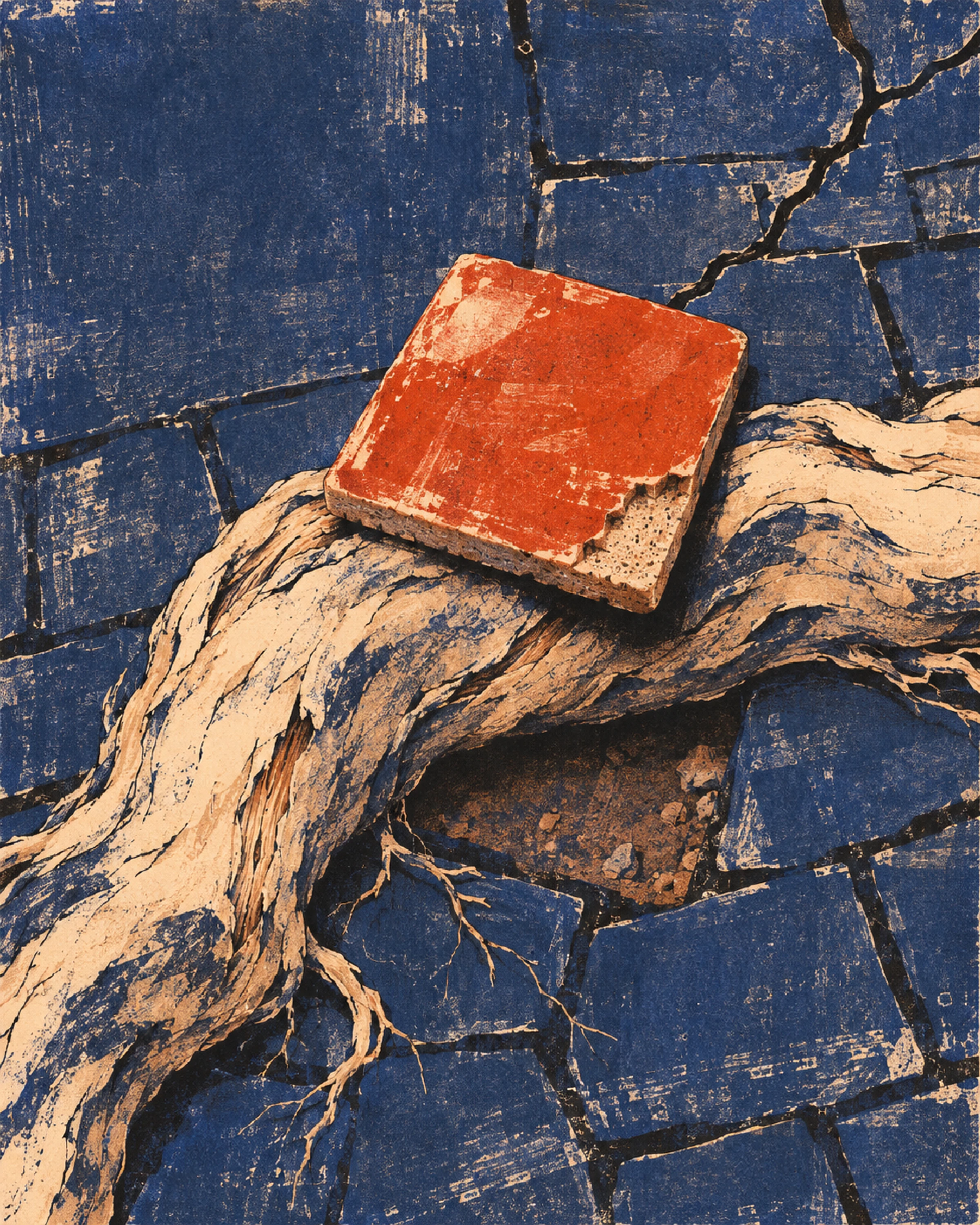
A Root Lifting a Mosaic Tile
An intimate view of a thick root levering one mosaic tile out of a cracked pavement. Rough ink transfers, fine scratched lines and slipping overprints turn a small rupture into an experimental poster illustration.
Remix this referenceA Root Lifting a Mosaic Tile
- Form language
- Reduce volumes to interlocking cutout-like masses, preserving irregular notches and a few abrupt changes of plane rather than describing every detail.
- Contour
- Alternate heavy, pressure-broken ink edges with wiry pen lines; allow contours to disappear where adjacent printed masses meet.
- Mark-making
- Combine broad rolled monotype transfers with sparse dragged-brush streaks and scratched interruptions; let individual marks vary naturally.
- Surface rendering
- Build midtones through translucent overprinting, uneven ink pickup and exposed paper reserves; slight registration slips make the layers visibly separate.
Priority
Make the ink-and-print experiment visible through the friction between transferred masses and hand-drawn interruptions.
What to avoid & what to check
Exact prompt for this example
MODULE OWNERSHIP
subject: Subject count, type, stable proportions and landmarks, resting face geometry, hair shape, physical materials, garment construction and permanent marks. No emotion, movement, color assignment or rendering recipe.
expression: Facial soft-tissue displacement and pupil direction, muscle coordination, regional intensity, asymmetry and onset/peak/release. No head/body pose, stable appearance, skin color or rendering.
gesture: Head/neck/body/limb orientation, joint movement, support, contact and pose-caused occlusion using existing anatomy. No eye/pupil movement, emotion, identity, props inventory or camera.
props: Prop count, type, construction, physical material and scale relative to the subject. Holding/contact belongs to gesture, position to composition, color to palette.
scene: Environment elements, terrain, backdrop/floor presence and structural detail. No canvas positions, camera, lighting, assigned colors or render texture.
camera: Projection, focal-length impression, camera elevation/yaw/roll, viewing distance and crop. No actor pose, world placement, lighting or canvas aspect ratio.
composition: Normalized 0-100% canvas positions, scale in frame, depth/overlap, focal hierarchy and margins. No joint pose, camera projection, rendering, subject/prop inventory or emotion.
palette: Color anchors, hue/saturation/value ranges, colors assigned to parts and approximate color coverage. No illumination direction, shading algorithm, physical material or layout.
lighting: Light-source direction/softness/intensity, ambient illumination, physical shadow direction/length and highlight position. Absence of directional illumination is allowed. No shading technique, palette or material changes.
style: Reusable form abstraction, contour weight/taper/edge quality, medium and mark scale/density/direction, surface rendering and tonal transition technique. No fixed subject proportions, anatomy, identity, expression, pose, palette, light-source direction, camera or layout.
output: Image count, aspect ratio, size, file/alpha requirements and global lettering/logo/watermark restrictions. No background scenery, crop, style, identity or pose.

SUBJECT
inventory: One exposed woody tree root with a few attached fine rootlets; no human or animal subjects.
geometry: A thick, irregularly swollen root forms a low arch, tapering into narrower branches at its ends.
resting-face: No face or facial landmarks apply.
appearance: Ridged woody bark has shallow splits and occasional exposed fibers; small surface details may vary naturally.

PRIORITY


AVOID


CHECK


PROPS
inventory: One loose ceramic mosaic tile, broad enough to span the thick section of the root.
construction: A thick square tile has a chipped corner, a glazed face and an exposed porous ceramic edge.

PRIORITY


AVOID


CHECK


SCENE
inventory: An outdoor mosaic pavement fills the environment; no horizon, buildings or additional vegetation appear.
structure: Embedded tiles have uneven grout, a narrow branching crack and one empty socket exposing compacted earth.

PRIORITY


AVOID


CHECK


CAMERA
projection: Use restrained perspective with a short-telephoto detail-study impression and little near-to-far distortion.
viewpoint: Look almost straight down, with enough obliqueness to reveal the raised tile edge; keep the camera level in roll.
crop: Move close enough to crop both root ends and the surrounding pavement while retaining the entire loose tile.

PRIORITY


AVOID


CHECK


COMPOSITION
placement: The root sweeps from the lower-left edge to the right edge; the loose tile occupies the upper-middle bend.
depth: The tile overlaps the root, which crosses the empty socket; this lifted junction is the primary focal point.
spacing: Leave a generous quieter patch toward the upper left; let the crack lead away toward the upper-right edge.

PRIORITY


AVOID


CHECK


PALETTE
colors: Anchor the image in deep indigo, brick vermilion, warm ivory and near-black; reserve strongest saturation for vermilion.
assignment: Give the root ivory with indigo accents, the loose tile vermilion, the pavement indigo and the grout near-black.
balance: Indigo occupies the largest color area; ivory opens breathing room and vermilion provides one concentrated counterweight.

PRIORITY


AVOID


CHECK


LIGHTING
sources: Broad daylight arrives softly from the upper left, with gentle ambient fill across the pavement.
shadows: Short shadows fall toward the lower right; a deeper narrow shadow beneath the loose tile reveals its separation.
highlights: Keep highlights broad and subdued on upper-left-facing bark ridges and the raised tile edge.

PRIORITY


AVOID


CHECK


STYLE GUIDE
form-language: Reduce volumes to interlocking cutout-like masses, preserving irregular notches and a few abrupt changes of plane rather than describing every detail.
contour: Alternate heavy, pressure-broken ink edges with wiry pen lines; allow contours to disappear where adjacent printed masses meet.
mark-making: Combine broad rolled monotype transfers with sparse dragged-brush streaks and scratched interruptions; let individual marks vary naturally.
surface-rendering: Build midtones through translucent overprinting, uneven ink pickup and exposed paper reserves; slight registration slips make the layers visibly separate.

PRIORITY
Make the ink-and-print experiment visible through the friction between transferred masses and hand-drawn interruptions.

AVOID


CHECK


OUTPUT
format: Deliver one finished image, portrait 4:5, 2400 × 3000 pixels, opaque PNG.
restrictions: No lettering, logos, signatures or watermarks.

PRIORITY


AVOID


CHECK


FINAL INTEGRATION
composition + lighting + style: Keep the focal junction readable as illumination and irregular print edges interact; surrounding detail can remain suggestive.
Model information comes from image provenance. The same prompt may produce a different result.