Text to imageCharacterStyle guide
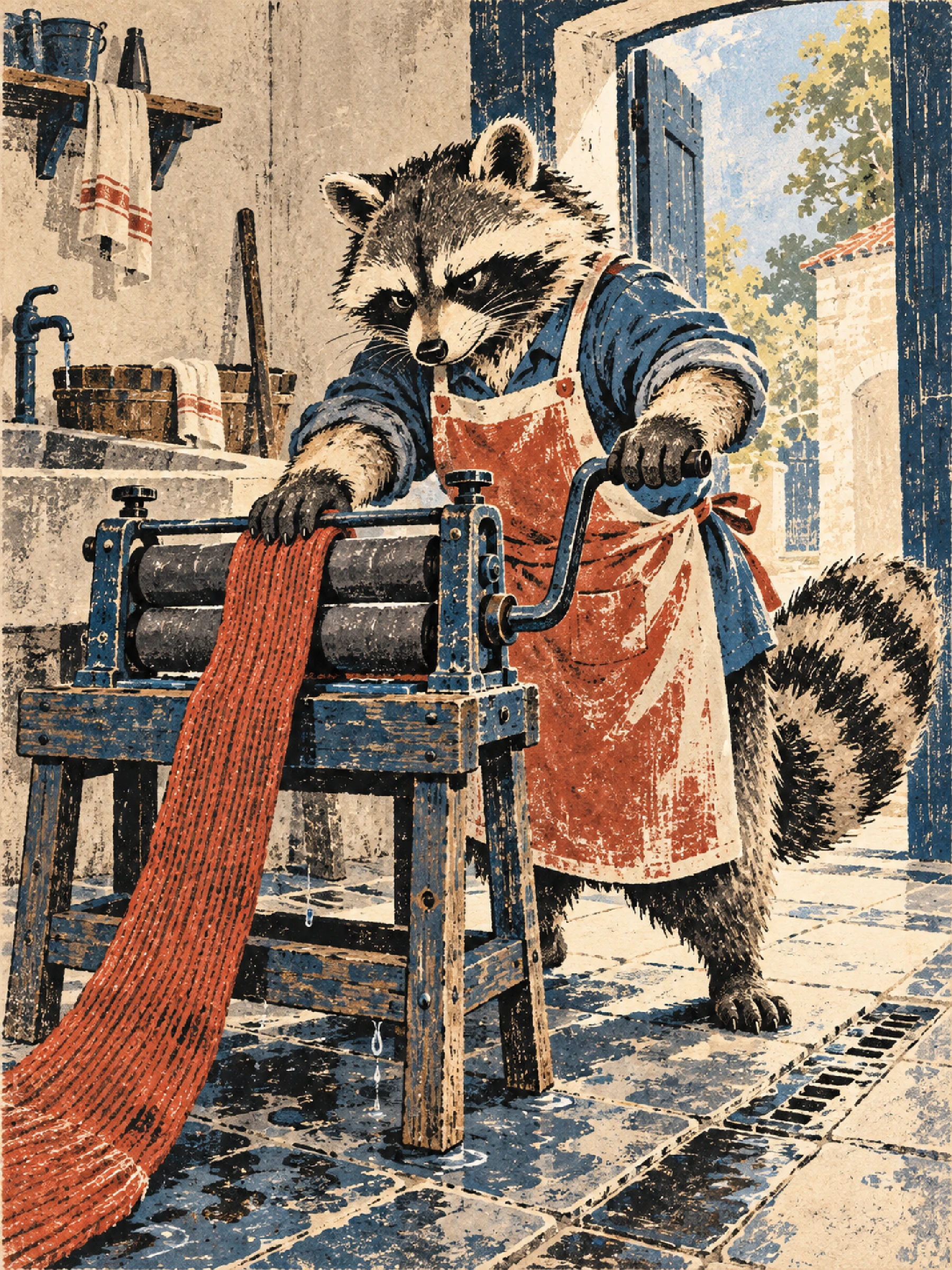
Raccoon at the Laundry Wringer
An apron-clad raccoon turns a laundry wringer while guiding an unusually long sock through it. Overlapping forms, rough ink and offset printed fields animate a bustling little washhouse.
Remix this referenceRaccoon at the Laundry Wringer
- Form language
- Reduce forms to bold, slightly irregular cut masses, interrupted by a few loose ink gestures rather than evenly described detail.
- Contour
- Alternate thick brush edges with abrupt thin scratches and open contour gaps; let pressure changes remain visible.
- Mark-making
- Use dragged ink streaks and broken roller impressions with natural local variation; reserve sparse scratches for internal articulation.
- Surface rendering
- Combine opaque print fields with translucent overprints, slight registration slips and ragged ink loss; model tone through layered patches.
Priority
Preserve the visible dialogue between spontaneous ink drawing and imperfect printed fields.
What to avoid & what to check
Exact prompt for this example
MODULE OWNERSHIP
subject: Subject count, type, stable proportions and landmarks, resting face geometry, hair shape, physical materials, garment construction and permanent marks. No emotion, movement, color assignment or rendering recipe.
expression: Facial soft-tissue displacement and pupil direction, muscle coordination, regional intensity, asymmetry and onset/peak/release. No head/body pose, stable appearance, skin color or rendering.
gesture: Head/neck/body/limb orientation, joint movement, support, contact and pose-caused occlusion using existing anatomy. No eye/pupil movement, emotion, identity, props inventory or camera.
props: Prop count, type, construction, physical material and scale relative to the subject. Holding/contact belongs to gesture, position to composition, color to palette.
scene: Environment elements, terrain, backdrop/floor presence and structural detail. No canvas positions, camera, lighting, assigned colors or render texture.
camera: Projection, focal-length impression, camera elevation/yaw/roll, viewing distance and crop. No actor pose, world placement, lighting or canvas aspect ratio.
composition: Normalized 0-100% canvas positions, scale in frame, depth/overlap, focal hierarchy and margins. No joint pose, camera projection, rendering, subject/prop inventory or emotion.
palette: Color anchors, hue/saturation/value ranges, colors assigned to parts and approximate color coverage. No illumination direction, shading algorithm, physical material or layout.
lighting: Light-source direction/softness/intensity, ambient illumination, physical shadow direction/length and highlight position. Absence of directional illumination is allowed. No shading technique, palette or material changes.
style: Reusable form abstraction, contour weight/taper/edge quality, medium and mark scale/density/direction, surface rendering and tonal transition technique. No fixed subject proportions, anatomy, identity, expression, pose, palette, light-source direction, camera or layout.
output: Image count, aspect ratio, size, file/alpha requirements and global lettering/logo/watermark restrictions. No background scenery, crop, style, identity or pose.

SUBJECT
inventory: One original anthropomorphic raccoon, actor A, with handlike forepaws and a cotton bib apron over a loose shirt.
geometry: A stocky body, tapered muzzle, rounded ears and thick ring-marked tail establish a compact, sturdy character.
resting-face: At rest, short brow tufts sit level above oval eyes; the broad muzzle has a small straight mouth.
appearance: Dense fur, permanent eye-mask markings and a soft apron with a neck loop define the appearance; minor fur details may vary.

PRIORITY


AVOID


CHECK


EXPRESSION — ACTOR A
brows: Brow tufts draw inward and slightly downward.
lids: Upper lids narrow the eyes; lower lids firm without closing them.
cheeks: Cheeks tighten mildly beside the muzzle.
nose: The nose stays unwrinkled, with nostrils only faintly widened.
mouth: Lips press together, with one corner pulled slightly sideways.
jaw: The jaw remains closed with modest muscular tension.
gaze: Pupils aim downward.
coordination: The narrowed eyes carry most of the effort; mouth tension stays smaller and asymmetric.
timing: Capture the apex of concentration.

PRIORITY


AVOID


CHECK


GESTURE
head: The head dips toward the rollers, with the neck extended just enough to clear the shoulder.
torso: The torso leans into the crank while the tail curves backward as a counterbalance.
limbs: One forepaw drives the crank downward; the other guides the sock, with a forward foot braced and the rear foot planted.
contact: A forepaw wraps around the crank grip; the other rests on the sock before the rollers, clear of their gap.

PRIORITY


AVOID


CHECK


PROPS
inventory: Two props: a waist-high manual laundry wringer and one knitted sock with an exceptionally long calf.
construction: The wringer has a timber stand, metal frame, paired rubber rollers and a side crank; the sock is supple wool knit.

PRIORITY


AVOID


CHECK


SCENE
inventory: A modest washhouse interior with a tiled floor, low washing ledge and tall open doorway.
structure: Broad plaster walls surround the doorway; a shallow drainage channel runs through the floor.

PRIORITY


AVOID


CHECK


CAMERA
projection: Use a moderate wide-angle impression, giving the foreground equipment a little extra presence.
viewpoint: View from slightly below the raccoon's eye level, obliquely across the crank side, without camera roll.
crop: Show the complete character and wringer at medium distance; let the far end of the sock leave the frame.

PRIORITY


AVOID


CHECK


COMPOSITION
placement: The raccoon occupies the right-middle, the wringer fills the lower left, and the doorway opens above them.
depth: The wringer overlaps the apron; the sock crosses the foreground, while the doorway remains behind both.
spacing: The face and working paws form the focal group; leave air above it and separate the tail from the doorway edge.

PRIORITY


AVOID


CHECK


PALETTE
colors: Use soot black, chalk cream, rusty vermilion and dusty cobalt in a restrained print palette.
assignment: Cream and black define the fur; vermilion belongs to the apron and sock, cobalt to the shirt and equipment.
balance: Cream occupies the largest fields; black provides strong punctuation, with limited vermilion and cobalt accents.

PRIORITY


AVOID


CHECK


LIGHTING
sources: Soft daylight enters from upper image-right; broad room bounce keeps the working area legible.
shadows: Soft moderately short shadows extend leftward beneath the feet and wringer stand.
highlights: Light catches the right ear, upper muzzle and top of the roller frame without sharp glints.

PRIORITY


AVOID


CHECK


STYLE GUIDE
form-language: Reduce forms to bold, slightly irregular cut masses, interrupted by a few loose ink gestures rather than evenly described detail.
contour: Alternate thick brush edges with abrupt thin scratches and open contour gaps; let pressure changes remain visible.
mark-making: Use dragged ink streaks and broken roller impressions with natural local variation; reserve sparse scratches for internal articulation.
surface-rendering: Combine opaque print fields with translucent overprints, slight registration slips and ragged ink loss; model tone through layered patches.

PRIORITY
Preserve the visible dialogue between spontaneous ink drawing and imperfect printed fields.

AVOID


CHECK


OUTPUT
format: Deliver one finished 3:4 image, 1800 × 2400 pixels, as an opaque PNG.
restrictions: No lettering, logos or watermarks.

PRIORITY


AVOID


CHECK


FINAL INTEGRATION
gesture + composition + style: Keep the working contacts readable through the overlaps while allowing the print treatment to stay loose elsewhere.
expression + gesture: Align the downward gaze with the sock entering the rollers, and pair the facial apex with the demanding crank turn.
Model information comes from image provenance. The same prompt may produce a different result.