Text to imageCharacterStyle guide
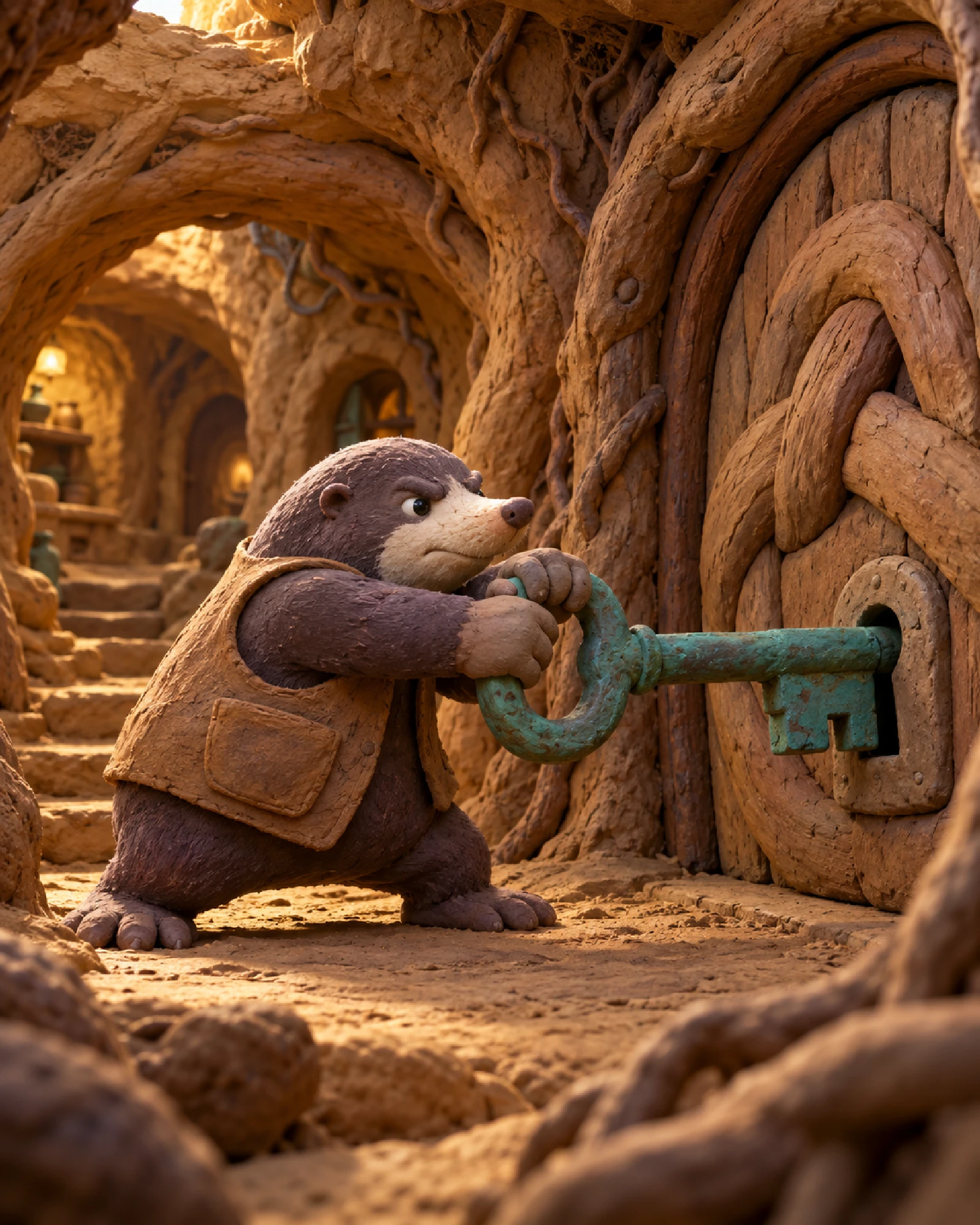
A Mole Turning a Giant Key
A small mole locksmith puts its whole weight into a giant key in a root door, surrounded by layered burrows and clay surfaces bearing the maker's touch.
Remix this referenceA Mole Turning a Giant Key
- Form language
- Build forms from rounded pinched masses and pressed slabs; allow slight lumpiness and unequal handmade repetitions throughout the miniature.
- Contour
- Let sculpted edges define contours without drawn outlines; alternate softly thumbed rims with occasional blunt tool-cut edges.
- Mark-making
- Retain selective fingertip dents, dragged tool grooves and compressed joins; vary their scale and spacing naturally across the handworked set.
- Surface rendering
- Render matte clay with broad rounded tonal transitions and rubbed pigment caught in recesses; preserve small uneven patches instead of polished uniformity.
Priority
Make the scene visibly a sculptural clay miniature with tactile handmade surfaces.
What to avoid & what to check
Exact prompt for this example
MODULE OWNERSHIP
subject: Subject count, type, stable proportions and landmarks, resting face geometry, hair shape, physical materials, garment construction and permanent marks. No emotion, movement, color assignment or rendering recipe.
expression: Facial soft-tissue displacement and pupil direction, muscle coordination, regional intensity, asymmetry and onset/peak/release. No head/body pose, stable appearance, skin color or rendering.
gesture: Head/neck/body/limb orientation, joint movement, support, contact and pose-caused occlusion using existing anatomy. No eye/pupil movement, emotion, identity, props inventory or camera.
props: Prop count, type, construction, physical material and scale relative to the subject. Holding/contact belongs to gesture, position to composition, color to palette.
scene: Environment elements, terrain, backdrop/floor presence and structural detail. No canvas positions, camera, lighting, assigned colors or render texture.
camera: Projection, focal-length impression, camera elevation/yaw/roll, viewing distance and crop. No actor pose, world placement, lighting or canvas aspect ratio.
composition: Normalized 0-100% canvas positions, scale in frame, depth/overlap, focal hierarchy and margins. No joint pose, camera projection, rendering, subject/prop inventory or emotion.
palette: Color anchors, hue/saturation/value ranges, colors assigned to parts and approximate color coverage. No illumination direction, shading algorithm, physical material or layout.
lighting: Light-source direction/softness/intensity, ambient illumination, physical shadow direction/length and highlight position. Absence of directional illumination is allowed. No shading technique, palette or material changes.
style: Reusable form abstraction, contour weight/taper/edge quality, medium and mark scale/density/direction, surface rendering and tonal transition technique. No fixed subject proportions, anatomy, identity, expression, pose, palette, light-source direction, camera or layout.
output: Image count, aspect ratio, size, file/alpha requirements and global lettering/logo/watermark restrictions. No background scenery, crop, style, identity or pose.

SUBJECT
inventory: A is one original anthropomorphic mole locksmith, physically built as a clay miniature.
geometry: A low pear-shaped body supports a blunt tapered muzzle, tiny inset ears, broad digging hands and short flat feet.
resting-face: Small round eyes sit beneath low brow pads; a broad nose ends the muzzle above a short horizontal mouth.
appearance: The solid clay body wears a slab-clay waistcoat with an open front and a single broad patch pocket.

PRIORITY


AVOID


CHECK


EXPRESSION — ACTOR A
brows: The brow pads pull inward and slightly down.
lids: The lower lids tighten while the upper lids narrow the eyes.
cheeks: Both cheeks compress subtly toward the muzzle.
nose: The nostrils widen a little without wrinkling the nose bridge.
mouth: The lips press together, with one corner drawn slightly sideways.
jaw: The jaw sets firmly without exposing teeth.
gaze: Both pupils aim toward the key's entry point.
coordination: Concentrated eyes and a compressed mouth share the effort without becoming a grimace.
timing: Hold the apex of facial effort.

PRIORITY


AVOID


CHECK


GESTURE
head: The head reaches forward with the muzzle slightly lifted, leaving the near cheek visible.
torso: The torso folds sideways and downward as the body's weight follows the key's initial turning motion.
limbs: Both arms pull down together; bent knees and widely planted feet provide a compact, readable brace.
contact: Both hands wrap over the key bow while both feet press against the earthen threshold.

PRIORITY


AVOID


CHECK


PROPS
inventory: One oversized clay key, roughly as long as the mole's body.
construction: The key has a thick oval bow, a stout shaft and a broad stepped bit, all sturdy enough to read as handbuilt clay.

PRIORITY


AVOID


CHECK


SCENE
inventory: A root-walled underground vestibule contains a thick knot-shaped door, an earthen threshold and branching burrow passages.
structure: Interlocking roots form nested arches; shallow steps link adjoining chambers, and a large keyhole pierces the door.

PRIORITY


AVOID


CHECK


CAMERA
projection: Use photographic perspective with a normal-lens impression and a convincing miniature sense of scale.
viewpoint: Look from slightly below the mole's face at a three-quarter angle to the door.
crop: Include the whole figure and key, with surrounding arches cropped by the frame.

PRIORITY


AVOID


CHECK


COMPOSITION
placement: Place the mole below and left of center; let the key connect it to the door occupying the right half.
depth: Partial foreground roots frame the action, while overlapping arches reveal smaller chambers beyond it.
spacing: The hands and face lead the image; keep a clear pocket around them and let peripheral architecture grow denser.

PRIORITY


AVOID


CHECK


PALETTE
colors: Use smoked plum, warm ocher, chalk cream and a small accent of oxidized turquoise.
assignment: The mole is smoked plum, its muzzle chalk cream, the burrow warm ocher and the key oxidized turquoise.
balance: Earthy middle values dominate, with the pale muzzle and restrained turquoise providing small contrasting notes.

PRIORITY


AVOID


CHECK


LIGHTING
sources: A broad opening above left supplies soft directional light, with weak ambient illumination inside the passages.
shadows: Short soft shadows fall down and right; deeper occlusion remains beneath the key and inside root junctions.
highlights: Broad subdued highlights catch the muzzle, upper hands and key rim, with tiny glints on the eyes.

PRIORITY


AVOID


CHECK


STYLE GUIDE
form-language: Build forms from rounded pinched masses and pressed slabs; allow slight lumpiness and unequal handmade repetitions throughout the miniature.
contour: Let sculpted edges define contours without drawn outlines; alternate softly thumbed rims with occasional blunt tool-cut edges.
mark-making: Retain selective fingertip dents, dragged tool grooves and compressed joins; vary their scale and spacing naturally across the handworked set.
surface-rendering: Render matte clay with broad rounded tonal transitions and rubbed pigment caught in recesses; preserve small uneven patches instead of polished uniformity.

PRIORITY
Make the scene visibly a sculptural clay miniature with tactile handmade surfaces.

AVOID


CHECK


OUTPUT
format: Deliver one opaque image, 4:5 portrait, 1600 × 2000 pixels, without lettering, logos or watermarks.
restrictions: Deliver one opaque image, 4:5 portrait, 1600 × 2000 pixels, without lettering, logos or watermarks.

PRIORITY


AVOID


CHECK


FINAL INTEGRATION
gesture + props + scene: The working contact between figure, key and doorway should make the action immediately understandable.
composition + lighting + style: Layered staging and light should reveal the handbuilt volume without letting surface detail compete with the action.
expression + gesture: Synchronize the facial effort apex with the moment the key begins to turn.
Model information comes from image provenance. The same prompt may produce a different result.