Text to imageCharacterStyle guide
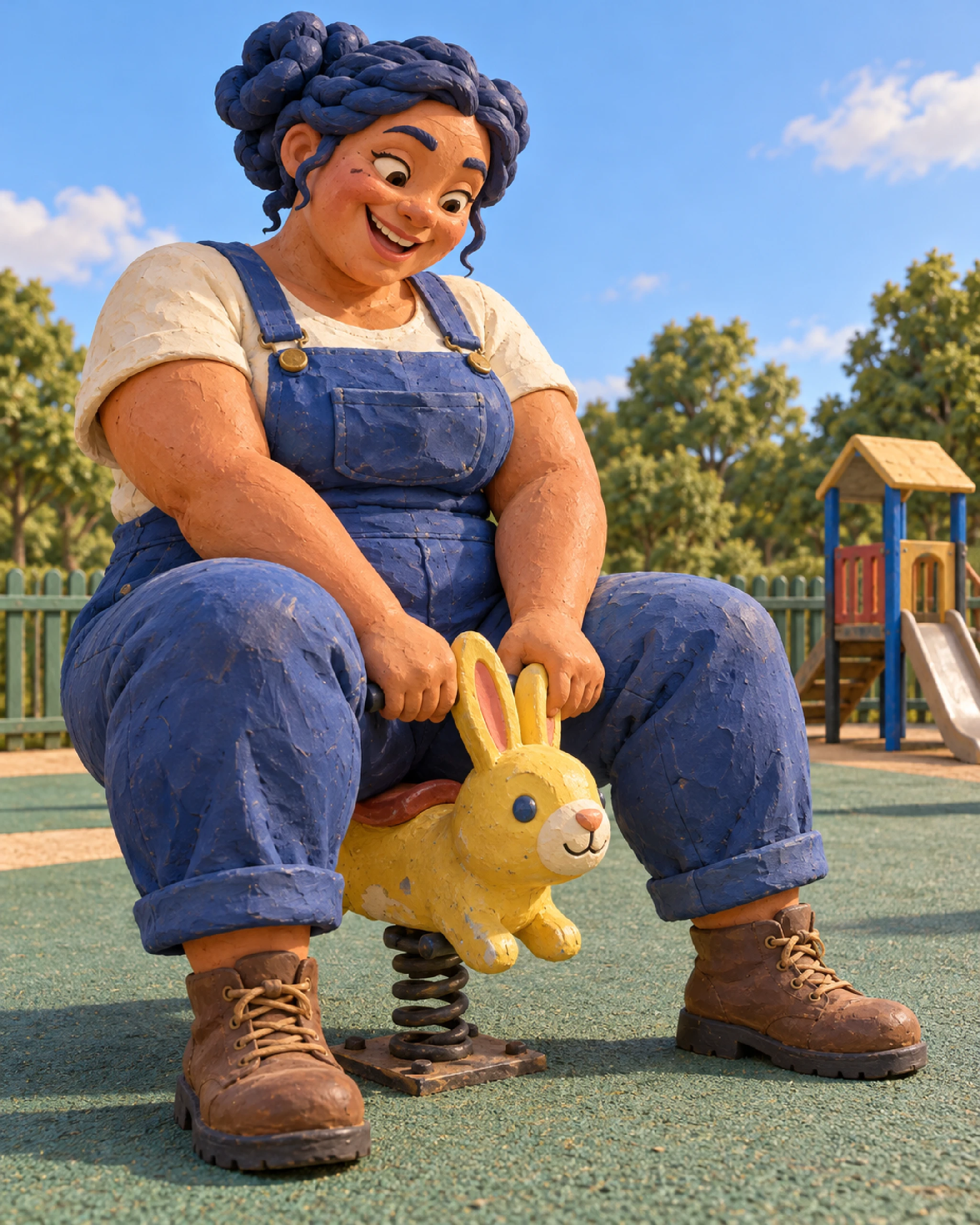
A Giant Woman Riding a Playground Rabbit
A giant woman folds herself onto a tiny rabbit spring rider, barely containing her delight. Pressed clay surfaces and uneven edges give the neighborhood playground's impossible scale a gentle, handmade warmth.
Remix this referenceA Giant Woman Riding a Playground Rabbit
- Form language
- Build a sculptural clay miniature from softly compressed masses and simplified planes; let small irregularities vary naturally within the handbuilt language.
- Contour
- Use actual modeled edges instead of drawn outlines; alternate gently rounded rims with occasional thumb-flattened corners.
- Mark-making
- Retain selective finger drags, broad tool presses and uneven joins; marks follow the modeled volume without covering every surface.
- Surface rendering
- Favor matte, softly yielding surfaces with rubbed transitions and occasional exposed clay flecks; avoid a uniformly polished finish.
Priority
Make the pressed, handbuilt clay surfaces visibly integral to the finished miniature.
What to avoid & what to check
Exact prompt for this example
MODULE OWNERSHIP
subject: Subject count, type, stable proportions and landmarks, resting face geometry, hair shape, physical materials, garment construction and permanent marks. No emotion, movement, color assignment or rendering recipe.
expression: Facial soft-tissue displacement and pupil direction, muscle coordination, regional intensity, asymmetry and onset/peak/release. No head/body pose, stable appearance, skin color or rendering.
gesture: Head/neck/body/limb orientation, joint movement, support, contact and pose-caused occlusion using existing anatomy. No eye/pupil movement, emotion, identity, props inventory or camera.
props: Prop count, type, construction, physical material and scale relative to the subject. Holding/contact belongs to gesture, position to composition, color to palette.
scene: Environment elements, terrain, backdrop/floor presence and structural detail. No canvas positions, camera, lighting, assigned colors or render texture.
camera: Projection, focal-length impression, camera elevation/yaw/roll, viewing distance and crop. No actor pose, world placement, lighting or canvas aspect ratio.
composition: Normalized 0-100% canvas positions, scale in frame, depth/overlap, focal hierarchy and margins. No joint pose, camera projection, rendering, subject/prop inventory or emotion.
palette: Color anchors, hue/saturation/value ranges, colors assigned to parts and approximate color coverage. No illumination direction, shading algorithm, physical material or layout.
lighting: Light-source direction/softness/intensity, ambient illumination, physical shadow direction/length and highlight position. Absence of directional illumination is allowed. No shading technique, palette or material changes.
style: Reusable form abstraction, contour weight/taper/edge quality, medium and mark scale/density/direction, surface rendering and tonal transition technique. No fixed subject proportions, anatomy, identity, expression, pose, palette, light-source direction, camera or layout.
output: Image count, aspect ratio, size, file/alpha requirements and global lettering/logo/watermark restrictions. No background scenery, crop, style, identity or pose.

SUBJECT
inventory: One original adult woman, gigantic relative to an ordinary neighborhood playground; no other figures.
geometry: A substantial adult build with a compact trunk, broad hands and sturdy feet; retain adult proportions.
resting-face: A broad oval face, blunt nose, thick brows and rounded chin establish her resting facial construction.
appearance: A clay figure with hair formed into two interlocking coils, pocket-front overalls, a short-sleeved shirt and ankle boots.

PRIORITY


AVOID


CHECK


EXPRESSION — ACTOR A
brows: The outer brows lift softly, with one slightly higher.
lids: Lower lids rise into shallow crescents beneath relaxed upper lids.
cheeks: Both cheeks bunch upward, more strongly on the higher-smiling side.
nose: The nostril wings lift faintly without wrinkling the bridge.
mouth: Lips spread into an open smile with one corner higher and a glimpse of upper teeth.
jaw: The jaw releases a little, keeping the opening easy rather than stretched.
gaze: Both pupils turn downward toward the rabbit's ears.
coordination: Cheek lift and mouth spread lead the expression; the brow response remains gentle.
timing: Hold the peak of delight just before the smile breaks into laughter.

PRIORITY


AVOID


CHECK


GESTURE
head: Her head inclines toward the rabbit with a small sideways tilt; the neck stays relaxed.
torso: Her hips settle on the saddle while her torso leans slightly back to balance.
limbs: Knees fold high and apart, boot soles planted wide; bent arms bring fingertips to the handles.
contact: Thumbs and forefingers pinch the handles; the saddle supports her hips and the spring compresses beneath her.

PRIORITY


AVOID


CHECK


PROPS
inventory: One rabbit-shaped playground spring rider, its saddle scarcely wider than the woman's palm.
construction: A clay-built representation of a molded rabbit shell, stub handles, shallow saddle and thick metal coil on a base plate.

PRIORITY


AVOID


CHECK


SCENE
inventory: A neighborhood playground with a rubber ground surface, a low slatted fence and a straight slide beneath open sky.
structure: A continuous ground plane joins the equipment and fence; the slide has recognizable steps and a simple chute.

PRIORITY


AVOID


CHECK


CAMERA
projection: Use natural perspective with a moderately long focal-length impression and restrained size distortion.
viewpoint: A slightly elevated three-quarter frontal view reveals the face, saddle and ground contact together.
crop: A medium-wide view includes the complete figure and enough playground to establish the scale change.

PRIORITY


AVOID


CHECK


COMPOSITION
placement: Place the woman left of center, with the rabbit low near the middle and the slide small at the far right.
depth: The face leads, the rabbit supplies the second discovery, and the fence and slide recede behind them.
spacing: Let the figure dominate the frame while keeping breathing room above her hair and an open ground wedge to the right.

PRIORITY


AVOID


CHECK


PALETTE
colors: Anchor the image in warm terracotta, deep cobalt, butter yellow and muted sage, with warm ivory accents.
assignment: Use terracotta for skin, cobalt for overalls and hair, ivory for shirt, yellow for rabbit, and sage for ground and fence.
balance: Broad muted surroundings support concentrated cobalt and terracotta; keep the yellow accent small and clear.

PRIORITY


AVOID


CHECK


LIGHTING
sources: A broad soft source from the upper left provides gentle daylight, supported by ample ambient fill.
shadows: Soft shadows fall toward the lower right; deeper contact shadows sit beneath boots, saddle and spring base.
highlights: Broad quiet highlights touch the forehead, upper cheeks and upper-left edges of the rabbit.

PRIORITY


AVOID


CHECK


STYLE GUIDE
form-language: Build a sculptural clay miniature from softly compressed masses and simplified planes; let small irregularities vary naturally within the handbuilt language.
contour: Use actual modeled edges instead of drawn outlines; alternate gently rounded rims with occasional thumb-flattened corners.
mark-making: Retain selective finger drags, broad tool presses and uneven joins; marks follow the modeled volume without covering every surface.
surface-rendering: Favor matte, softly yielding surfaces with rubbed transitions and occasional exposed clay flecks; avoid a uniformly polished finish.

PRIORITY
Make the pressed, handbuilt clay surfaces visibly integral to the finished miniature.

AVOID


CHECK


OUTPUT
format: One image, portrait 4:5, 2048 × 2560 pixels, PNG with an opaque background.
restrictions: No lettering, logos or watermarks.

PRIORITY


AVOID


CHECK


FINAL INTEGRATION
subject + props + scene: The familiar playground and undersized equipment make the woman's extraordinary scale immediately legible.
expression + gesture + composition: Keep the visible performance readable while allowing the equipment to emerge as the scene's second discovery.
Model information comes from image provenance. The same prompt may produce a different result.