Text to imageSpace & architectureStyle guide
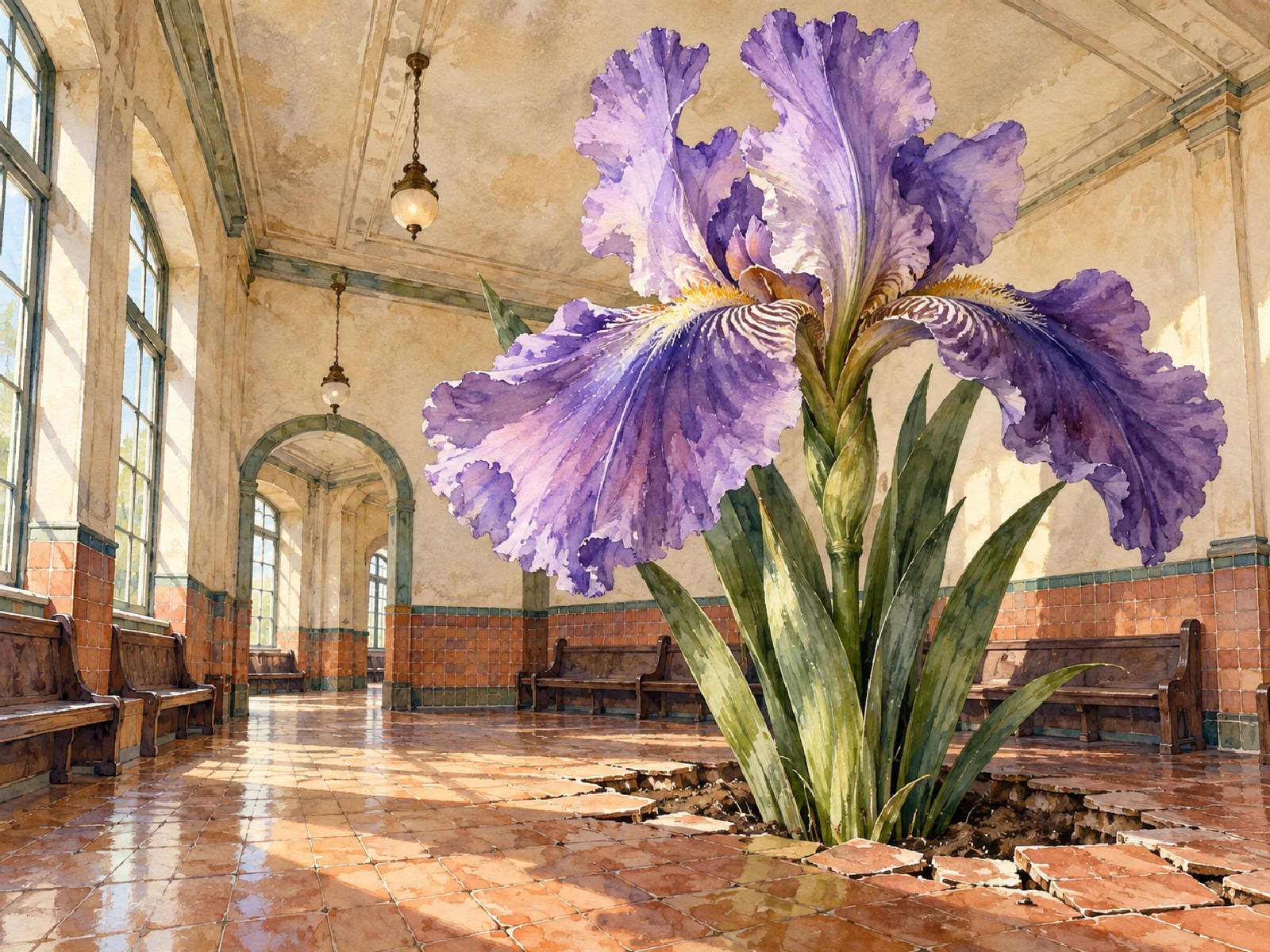
A Giant Iris in the Waiting Room
A single iris rises almost to the ceiling of an old station waiting room, its petals opening passages through the familiar interior. Watercolor blooms and broken edges make the improbable scale feel quietly tangible.
Remix this referenceA Giant Iris in the Waiting Room
- Form language
- Build large forms from broad, breathing shapes with selective folds and slightly irregular architectural planes; allow minor details to vary coherently.
- Contour
- Alternate sharp wet-brush edges with lost, feathered boundaries; use brief tapered brush lines only where a form needs definition.
- Mark-making
- Lay generous wet washes, then interrupt them with dry-brush skips and a few decisive strokes; let blooms emerge unevenly as washes meet.
- Surface rendering
- Model volume through transparent wash overlaps, reserved paper, pooled pigment, and soft backruns; keep granular settling visible in quiet passages.
Priority
Expressive watercolor blooms and broken edges must remain visible in the finished spatial illustration.
What to avoid & what to check
Exact prompt for this example
MODULE OWNERSHIP
subject: Subject count, type, stable proportions and landmarks, resting face geometry, hair shape, physical materials, garment construction and permanent marks. No emotion, movement, color assignment or rendering recipe.
expression: Facial soft-tissue displacement and pupil direction, muscle coordination, regional intensity, asymmetry and onset/peak/release. No head/body pose, stable appearance, skin color or rendering.
gesture: Head/neck/body/limb orientation, joint movement, support, contact and pose-caused occlusion using existing anatomy. No eye/pupil movement, emotion, identity, props inventory or camera.
props: Prop count, type, construction, physical material and scale relative to the subject. Holding/contact belongs to gesture, position to composition, color to palette.
scene: Environment elements, terrain, backdrop/floor presence and structural detail. No canvas positions, camera, lighting, assigned colors or render texture.
camera: Projection, focal-length impression, camera elevation/yaw/roll, viewing distance and crop. No actor pose, world placement, lighting or canvas aspect ratio.
composition: Normalized 0-100% canvas positions, scale in frame, depth/overlap, focal hierarchy and margins. No joint pose, camera projection, rendering, subject/prop inventory or emotion.
palette: Color anchors, hue/saturation/value ranges, colors assigned to parts and approximate color coverage. No illumination direction, shading algorithm, physical material or layout.
lighting: Light-source direction/softness/intensity, ambient illumination, physical shadow direction/length and highlight position. Absence of directional illumination is allowed. No shading technique, palette or material changes.
style: Reusable form abstraction, contour weight/taper/edge quality, medium and mark scale/density/direction, surface rendering and tonal transition technique. No fixed subject proportions, anatomy, identity, expression, pose, palette, light-source direction, camera or layout.
output: Image count, aspect ratio, size, file/alpha requirements and global lettering/logo/watermark restrictions. No background scenery, crop, style, identity or pose.

SUBJECT
inventory: One colossal flowering iris plant, with a single open flower and a small fan of leaves; no people or animals.
geometry: Use a stout stalk, long sword-shaped leaves, upright inner petals, and broad outer petals with folded throats.
resting-face: No face or anthropomorphic facial features.
appearance: Petals have thin, gently ruffled margins and raised central ribs; leaves have firm blades and visible longitudinal veins.

PRIORITY


AVOID


CHECK


PROPS
inventory: No separate props.
construction: No prop construction applies.

PRIORITY


AVOID


CHECK


SCENE
inventory: An old station waiting room with tiled wainscoting, built-in benches, tall windows, an arched passage, and a tiled floor.
structure: A high plaster ceiling spans the room; one lifted floor section exposes the soil bed from which the plant grows.

PRIORITY


AVOID


CHECK


CAMERA
projection: Use a natural wide-angle perspective with readable architectural depth and gently converging verticals.
viewpoint: View from adult standing height near the entrance, looking diagonally across the room with a slight upward pitch.
crop: Include the flower crown, its floor opening, and enough ceiling and wall junctions to establish an enclosed room.

PRIORITY


AVOID


CHECK


COMPOSITION
placement: Set the flower just right of center, spanning floor to ceiling; keep the open passage visible on the left and the tall windows along the left side.
depth: A broad petal overlaps the far benches while a clear floor route passes beneath it; the flower leads, the room explains scale.
spacing: Keep a generous open floor wedge in front and small gaps around the upper petals so the architecture remains legible.

PRIORITY


AVOID


CHECK


PALETTE
colors: Use diluted violet, moss green, warm plaster ivory, and muted terracotta, with very dark violet only in small accents.
assignment: Give the petals violet, the stalk and leaves moss green, the walls ivory, and the floor and lower tiles terracotta.
balance: Keep the architectural colors pale and spacious; concentrate richer saturation in the flower with a few softened color minglings.

PRIORITY


AVOID


CHECK


LIGHTING
sources: Soft daylight comes from the left, with gentle reflected illumination throughout the room.
shadows: Broad petal shadows fall softly toward the right across the floor and benches, deepening only near overlaps.
highlights: Light rests on the left-facing petal folds and leaf ridges; retain a gentle distinction between lit and sheltered surfaces.

PRIORITY


AVOID


CHECK


STYLE GUIDE
form-language: Build large forms from broad, breathing shapes with selective folds and slightly irregular architectural planes; allow minor details to vary coherently.
contour: Alternate sharp wet-brush edges with lost, feathered boundaries; use brief tapered brush lines only where a form needs definition.
mark-making: Lay generous wet washes, then interrupt them with dry-brush skips and a few decisive strokes; let blooms emerge unevenly as washes meet.
surface-rendering: Model volume through transparent wash overlaps, reserved paper, pooled pigment, and soft backruns; keep granular settling visible in quiet passages.

PRIORITY
Expressive watercolor blooms and broken edges must remain visible in the finished spatial illustration.

AVOID


CHECK


OUTPUT
format: Deliver one opaque image, landscape 4:3, 1600 × 1200 pixels, as PNG.
restrictions: No lettering, logos, signatures, or watermarks.

PRIORITY


AVOID


CHECK
Model information comes from image provenance. The same prompt may produce a different result.