Text to imageComicsStyle guide
A Tiny Tram on the Turntable
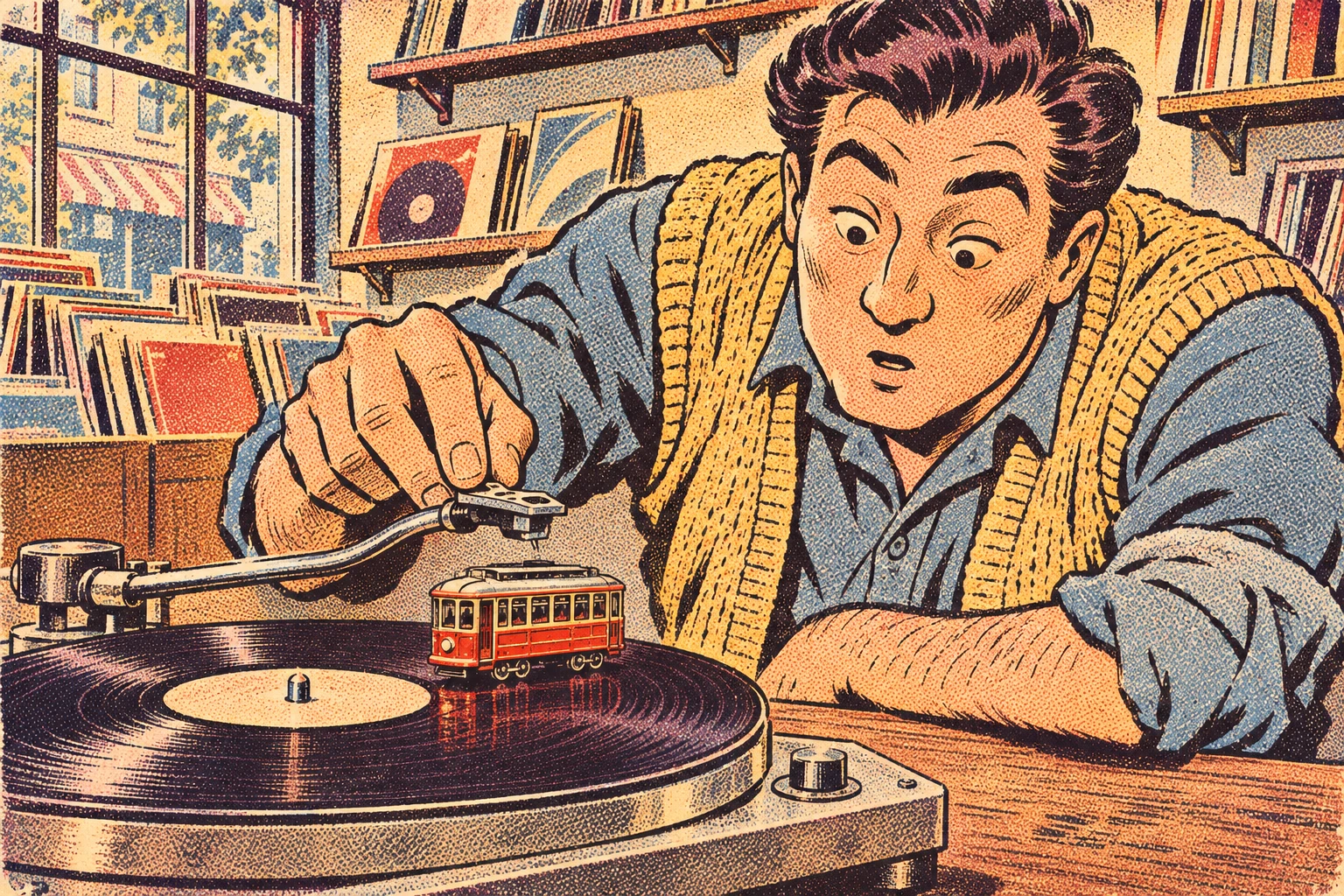
A record-shop keeper lifts the tonearm to let a hand-sized tram pass across a record. Springy ink contours, coarse halftones, and slightly misregistered colors give the surprising encounter a lively printed character.
Remix this referenceA Tiny Tram on the Turntable
- Form language
- Simplify forms into buoyant rounded masses interrupted by crisp wedges; allow small irregularities within this graphic vocabulary.
- Contour
- Use elastic brush-ink contours with thick turns, tapered exits, and occasional dry breaks; keep interior lines lighter.
- Mark-making
- Build midtones from visibly coarse halftone dots; mix in brief directional ink hatches and let dot edges vary with ink spread.
- Surface rendering
- Alternate solid ink pools, open paper, and screened tones; slight color misregistration and uneven ink bite evoke an inexpensive vintage comic print.
Priority
Rendering medium: Retro halftone comic illustration with brush-ink drawing and offset-print color separations.
What to avoid & what to check
Exact prompt for this example
MODULE OWNERSHIP
subject: Subject count, type, stable proportions and landmarks, resting face geometry, hair shape, physical materials, garment construction and permanent marks. No emotion, movement, color assignment or rendering recipe.
expression: Facial soft-tissue displacement and pupil direction, muscle coordination, regional intensity, asymmetry and onset/peak/release. No head/body pose, stable appearance, skin color or rendering.
gesture: Head/neck/body/limb orientation, joint movement, support, contact and pose-caused occlusion using existing anatomy. No eye/pupil movement, emotion, identity, props inventory or camera.
props: Prop count, type, construction, physical material and scale relative to the subject. Holding/contact belongs to gesture, position to composition, color to palette.
scene: Environment elements, terrain, backdrop/floor presence and structural detail. No canvas positions, camera, lighting, assigned colors or render texture.
camera: Projection, focal-length impression, camera elevation/yaw/roll, viewing distance and crop. No actor pose, world placement, lighting or canvas aspect ratio.
composition: Normalized 0-100% canvas positions, scale in frame, depth/overlap, focal hierarchy and margins. No joint pose, camera projection, rendering, subject/prop inventory or emotion.
palette: Color anchors, hue/saturation/value ranges, colors assigned to parts and approximate color coverage. No illumination direction, shading algorithm, physical material or layout.
lighting: Light-source direction/softness/intensity, ambient illumination, physical shadow direction/length and highlight position. Absence of directional illumination is allowed. No shading technique, palette or material changes.
style: Reusable form abstraction, contour weight/taper/edge quality, medium and mark scale/density/direction, surface rendering and tonal transition technique. No fixed subject proportions, anatomy, identity, expression, pose, palette, light-source direction, camera or layout.
output: Image count, aspect ratio, size, file/alpha requirements and global lettering/logo/watermark restrictions. No background scenery, crop, style, identity or pose.

SUBJECT
inventory: A is one adult human record-shop keeper; no other people are visible.
geometry: A has a sturdy build, broad cheekbones, a tapered chin, and a short neck.
resting-face: Straight brows, rounded eye openings, a long rounded nose, and a small resting mouth define A's face.
appearance: A has short swept-back hair and wears a cotton work shirt with turned cuffs beneath an open knitted vest.

PRIORITY


AVOID


CHECK


EXPRESSION — ACTOR A
brows: Both brows lift, with A's left brow slightly higher.
lids: Upper lids rise clearly; lower lids remain relaxed.
cheeks: Cheeks remain loose without a smile-driven lift.
nose: The nose stays unwrinkled and the nostrils remain relaxed.
mouth: Lips part into a small uneven oval.
jaw: The jaw releases only slightly.
gaze: Both pupils turn downward toward the miniature tram.
coordination: The lifted brows lead the reaction while the mouth is only beginning to open.
timing: Catch the first instant of recognition, before surprise reaches its peak.

PRIORITY


AVOID


CHECK


GESTURE
head: A extends the neck slightly and tips the head down toward the counter.
torso: A bends forward from the waist, with one shoulder reaching farther over the counter.
limbs: One forearm braces on the counter; the other hand delicately raises the tonearm headshell between thumb and forefinger.
contact: The supporting forearm rests firmly; fingertips touch only the headshell, leaving clearance above the tram.

PRIORITY


AVOID


CHECK


PROPS
inventory: One turntable, one vinyl record, and one miniature streetcar shorter than A's hand.
construction: The turntable has a low metal deck and slender tonearm; the streetcar has a metal body, glazed windows, and small flanged wheels.

PRIORITY


AVOID


CHECK


SCENE
inventory: A neighborhood record shop with a wooden listening counter, sleeve bins, shallow wall shelves, and a shopfront window.
structure: Upright record sleeves form irregular rows; simple shelf brackets and counter edges establish the familiar interior.

PRIORITY


AVOID


CHECK


CAMERA
projection: Use moderate perspective with a natural focal-length impression.
viewpoint: Look obliquely across the counter from slightly above platter height, with no camera roll.
crop: Frame a close shop encounter, including A from the chest upward and the complete record surface.

PRIORITY


AVOID


CHECK


COMPOSITION
placement: The platter spreads across the lower left, with the record on it; A occupies the upper right, with the tram beneath the lifted headshell.
depth: The turntable overlaps A's lower torso; the shop recedes behind. The tram is the first read, followed by A's face.
spacing: Leave clear breathing room around the tram and raised fingers; let peripheral sleeves crowd together naturally.

PRIORITY
Keep one continuous scene without panel divisions or speech balloons.

AVOID


CHECK


PALETTE
colors: Anchor the image in warm paper cream, aubergine-black, butter yellow, vermilion, and muted blue.
assignment: Use vermilion for the tram, muted blue for the shirt, butter yellow for the vest, and aubergine-black for hair and vinyl.
balance: Cream and dark ink dominate; yellow and blue support them, while vermilion remains a compact saturated accent.

PRIORITY


AVOID


CHECK


LIGHTING
sources: Broad, soft shopfront daylight enters from the upper left, supported by gentle room ambience.
shadows: Short soft shadows fall to the lower right, with deeper shade beneath the tram and A's supporting arm.
highlights: Keep restrained highlights on upper-left edges of the tonearm, tram roof, and cheek.

PRIORITY


AVOID


CHECK


STYLE GUIDE
form-language: Simplify forms into buoyant rounded masses interrupted by crisp wedges; allow small irregularities within this graphic vocabulary.
contour: Use elastic brush-ink contours with thick turns, tapered exits, and occasional dry breaks; keep interior lines lighter.
mark-making: Build midtones from visibly coarse halftone dots; mix in brief directional ink hatches and let dot edges vary with ink spread.
surface-rendering: Alternate solid ink pools, open paper, and screened tones; slight color misregistration and uneven ink bite evoke an inexpensive vintage comic print.

PRIORITY
Rendering medium: Retro halftone comic illustration with brush-ink drawing and offset-print color separations.

AVOID


CHECK


OUTPUT
format: Deliver one finished image, landscape 3:2, 1536 × 1024 pixels, opaque PNG.
restrictions: No lettering, logos, or watermarks.

PRIORITY


AVOID


CHECK


FINAL INTEGRATION
expression + gesture: Let the facial reaction and careful hand action belong to the same suspended instant.
Model information comes from image provenance. The same prompt may produce a different result.