Text to imageSpace & architectureStyle guide
A Rehearsal Hall Open to the Reeds
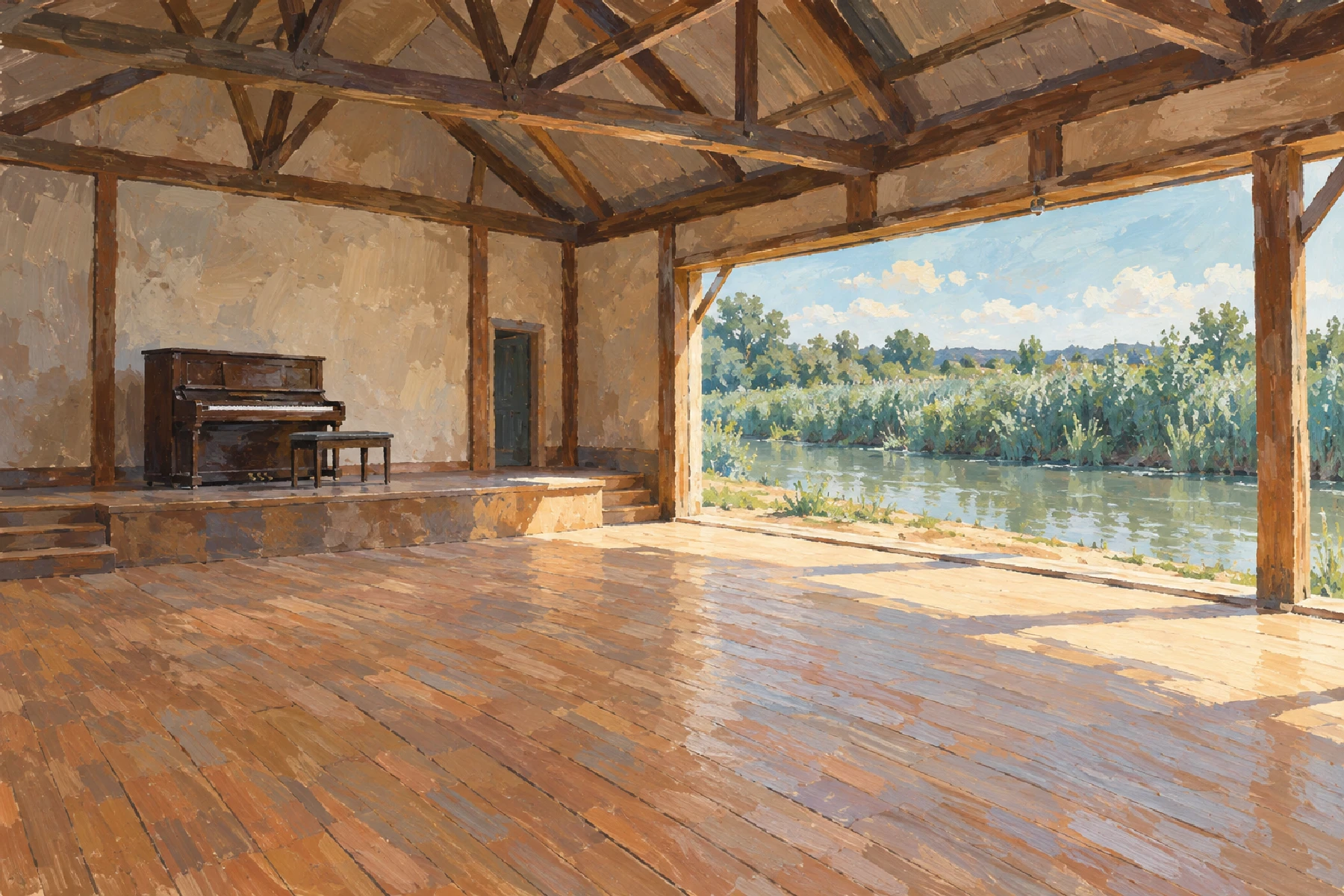
A small rehearsal hall opens broadly onto a reed-lined channel, with a piano to one side and an expansive timber floor painted in loose, opaque gouache.
Remix this referenceA Rehearsal Hall Open to the Reeds
- Form language
- Reduce forms to loosely fitted planes and uneven rectangular masses; allow small structural details to resolve through suggestion.
- Contour
- Let edges emerge from neighboring brushstrokes, alternating soft lost boundaries with a few decisive, blunt painted edges.
- Mark-making
- Use broad opaque gouache strokes with visible bristle splits, interrupted drags and occasional loaded dabs; vary marks naturally.
- Surface rendering
- Build matte surfaces from overlapping patches, leaving underpainting between strokes; make tonal changes through stepped paint mixtures.
Priority
Preserve the visibly opaque, loosely brushed character of gouache throughout the finished image.
What to avoid & what to check
Exact prompt for this example
MODULE OWNERSHIP
subject: Subject count, type, stable proportions and landmarks, resting face geometry, hair shape, physical materials, garment construction and permanent marks. No emotion, movement, color assignment or rendering recipe.
expression: Facial soft-tissue displacement and pupil direction, muscle coordination, regional intensity, asymmetry and onset/peak/release. No head/body pose, stable appearance, skin color or rendering.
gesture: Head/neck/body/limb orientation, joint movement, support, contact and pose-caused occlusion using existing anatomy. No eye/pupil movement, emotion, identity, props inventory or camera.
props: Prop count, type, construction, physical material and scale relative to the subject. Holding/contact belongs to gesture, position to composition, color to palette.
scene: Environment elements, terrain, backdrop/floor presence and structural detail. No canvas positions, camera, lighting, assigned colors or render texture.
camera: Projection, focal-length impression, camera elevation/yaw/roll, viewing distance and crop. No actor pose, world placement, lighting or canvas aspect ratio.
composition: Normalized 0-100% canvas positions, scale in frame, depth/overlap, focal hierarchy and margins. No joint pose, camera projection, rendering, subject/prop inventory or emotion.
palette: Color anchors, hue/saturation/value ranges, colors assigned to parts and approximate color coverage. No illumination direction, shading algorithm, physical material or layout.
lighting: Light-source direction/softness/intensity, ambient illumination, physical shadow direction/length and highlight position. Absence of directional illumination is allowed. No shading technique, palette or material changes.
style: Reusable form abstraction, contour weight/taper/edge quality, medium and mark scale/density/direction, surface rendering and tonal transition technique. No fixed subject proportions, anatomy, identity, expression, pose, palette, light-source direction, camera or layout.
output: Image count, aspect ratio, size, file/alpha requirements and global lettering/logo/watermark restrictions. No background scenery, crop, style, identity or pose.

SUBJECT
inventory: One unoccupied rehearsal hall is the architectural subject.
geometry: A long rectangular hall has a low stage, shallow side steps and a broad side opening beneath exposed roof trusses.
resting-face: No faces or facial geometry apply.
appearance: Plastered walls meet exposed timber framing and a plank floor; worn thresholds reveal the building's ordinary use.

PRIORITY


AVOID


CHECK


PROPS
inventory: One upright piano and one low piano bench, both at ordinary room scale.
construction: The piano has a wooden cabinet and an exposed keyboard; the bench is a simple wooden seat with square legs.

PRIORITY


AVOID


CHECK


SCENE
inventory: The hall stands beside a shallow river channel, with an earth bank, dense reeds and open sky outside.
structure: The narrow bank separates the building from the water; reeds gather along the opposite bank in irregular stands.

PRIORITY


AVOID


CHECK


CAMERA
projection: Use gentle wide-angle perspective with straight architectural verticals and an unforced sense of room depth.
viewpoint: Look diagonally across the hall from seated eye height near its rear corner, with no camera roll.
crop: Include the stage, much of the floor and the full side opening, with the nearest ceiling beams partly cropped.

PRIORITY


AVOID


CHECK


COMPOSITION
placement: Cluster the stage, piano and bench in the left third; the broad opening extends across the middle-right.
depth: The opening leads the hierarchy, followed by the piano; interior surfaces frame the exterior view, with foreground floor, interior framing and distant reeds in clear layers.
spacing: Keep the lower half spacious, with an uninterrupted interval of floor between the piano group and the right edge.

PRIORITY


AVOID


CHECK


PALETTE
colors: Use warm putty, muted apricot, smoky blue-green and deep brown, with a little pale celadon.
assignment: Give walls putty, floor apricot, reeds blue-green, piano deep brown, and water and sky pale celadon.
balance: Low-saturation warm hues occupy more area than the cool hues; the piano supplies the deepest value.

PRIORITY


AVOID


CHECK


LIGHTING
sources: Soft daylight enters through the side opening from the right, with ample ambient fill inside.
shadows: Broad soft shadows extend leftward from the framing and piano; the far wall stays gently shaded.
highlights: Light gathers along the opening's sill, the nearest floorboards and the piano's right-facing edges.

PRIORITY


AVOID


CHECK


STYLE GUIDE
form-language: Reduce forms to loosely fitted planes and uneven rectangular masses; allow small structural details to resolve through suggestion.
contour: Let edges emerge from neighboring brushstrokes, alternating soft lost boundaries with a few decisive, blunt painted edges.
mark-making: Use broad opaque gouache strokes with visible bristle splits, interrupted drags and occasional loaded dabs; vary marks naturally.
surface-rendering: Build matte surfaces from overlapping patches, leaving underpainting between strokes; make tonal changes through stepped paint mixtures.

PRIORITY
Preserve the visibly opaque, loosely brushed character of gouache throughout the finished image.

AVOID


CHECK


OUTPUT
format: Produce one opaque PNG image, 1800 × 1200 pixels, with a 3:2 aspect ratio; no lettering, logos or watermarks.
restrictions: One image, 3:2, 1800 × 1200 pixels, opaque PNG; no lettering, logos or watermarks.

PRIORITY


AVOID


CHECK


FINAL INTEGRATION
camera + composition + style: Keep the architectural perspective legible while allowing brush-built edges to soften secondary spatial divisions.
Model information comes from image provenance. The same prompt may produce a different result.