Text to imageIllustrationStyle guide
One Closed Cardboard Box · Parallel Projection
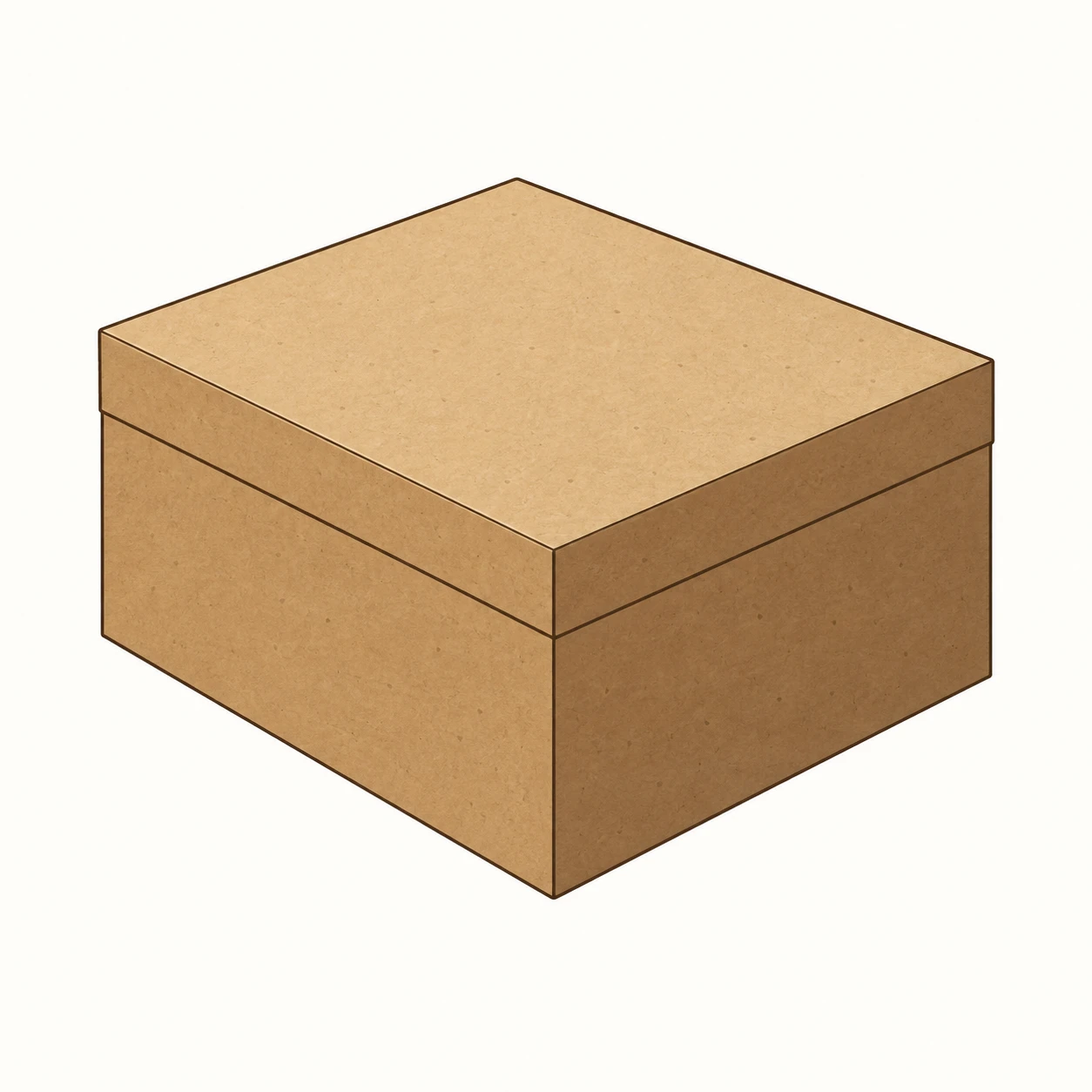
An illustration that gives a cardboard box clear volume without vanishing points by keeping three edge families parallel and separating face values.
One Closed Cardboard Box · Parallel Projection
- Shape & line
- Construct the box with three consistent edge families: vertical lines and diagonals rising toward image-left and image-right. Keep all edges within each family parallel, including the lid seam, and do not shrink the rear edges to suggest a vanishing point. Use clean, evenly weighted brown contours.
- Color & light
- Assign a flat warm tan to the top, a medium ochre to the image-left side face, and a deeper brown to the image-right side face, suggesting light from the upper left. Let these three broad values explain the volume; keep each face largely uniform and the boundaries crisp.
- Texture & material
- Suggest matte cardboard with sparse, low-contrast flecks confined inside the faces. Draw the lid seam as a thin darker line that follows the projected edges and wraps continuously around the visible corner; keep the surface grain quieter than the structural lines.
- Composition
- Give the top and both side faces enough visible area to compare their edge directions. Keep the nearest vertical corner unobstructed and leave clear space around every outer edge, so the parallel construction reads immediately at thumbnail size.
Priority
Prioritize consistent parallel edge families and clear separation of the three visible faces.
What to avoid & what to check
Avoid converging edges, glossy highlights, and texture that obscures the lid seam.
Check that matching edges remain parallel and the lid seam continues coherently across the visible corner.
Exact prompt for this example
SUBJECT
Show exactly one closed, plain rectangular cardboard box with a fitted lid. The lid sits flush on the box; a fine seam separates it from the body. Show the top and two adjoining side faces as parts of one coherent solid.

COMPOSITION
Use an elevated three-quarter view with the nearest vertical corner slightly left of image center. The two horizontal edge families slope toward the upper left and upper right of the image. Center the complete box with generous blank margins on an off-white field.

STYLE GUIDE
1. Shape & line
Construct the box with three consistent edge families: vertical lines and diagonals rising toward image-left and image-right. Keep all edges within each family parallel, including the lid seam, and do not shrink the rear edges to suggest a vanishing point. Use clean, evenly weighted brown contours.

2. Color & light
Assign a flat warm tan to the top, a medium ochre to the image-left side face, and a deeper brown to the image-right side face, suggesting light from the upper left. Let these three broad values explain the volume; keep each face largely uniform and the boundaries crisp.

3. Texture & material
Suggest matte cardboard with sparse, low-contrast flecks confined inside the faces. Draw the lid seam as a thin darker line that follows the projected edges and wraps continuously around the visible corner; keep the surface grain quieter than the structural lines.

4. Composition
Give the top and both side faces enough visible area to compare their edge directions. Keep the nearest vertical corner unobstructed and leave clear space around every outer edge, so the parallel construction reads immediately at thumbnail size.

PRIORITY
Preserve the requested identity, count, action, composition and output settings. Apply the style rules within those constraints; a style reference must not replace the subject or layout. Within the style: Prioritize consistent parallel edge families and clear separation of the three visible faces.

AVOID
Avoid converging edges, glossy highlights, and texture that obscures the lid seam.

OUTPUT
Create one square illustration with no lettering, labels, dimensions, logos, or watermark.

SELF-CHECK
Check that matching edges remain parallel and the lid seam continues coherently across the visible corner.
Model information comes from image provenance. The same prompt may produce a different result.