Text to imageComicsStyle guide
A Moth in the Accordion
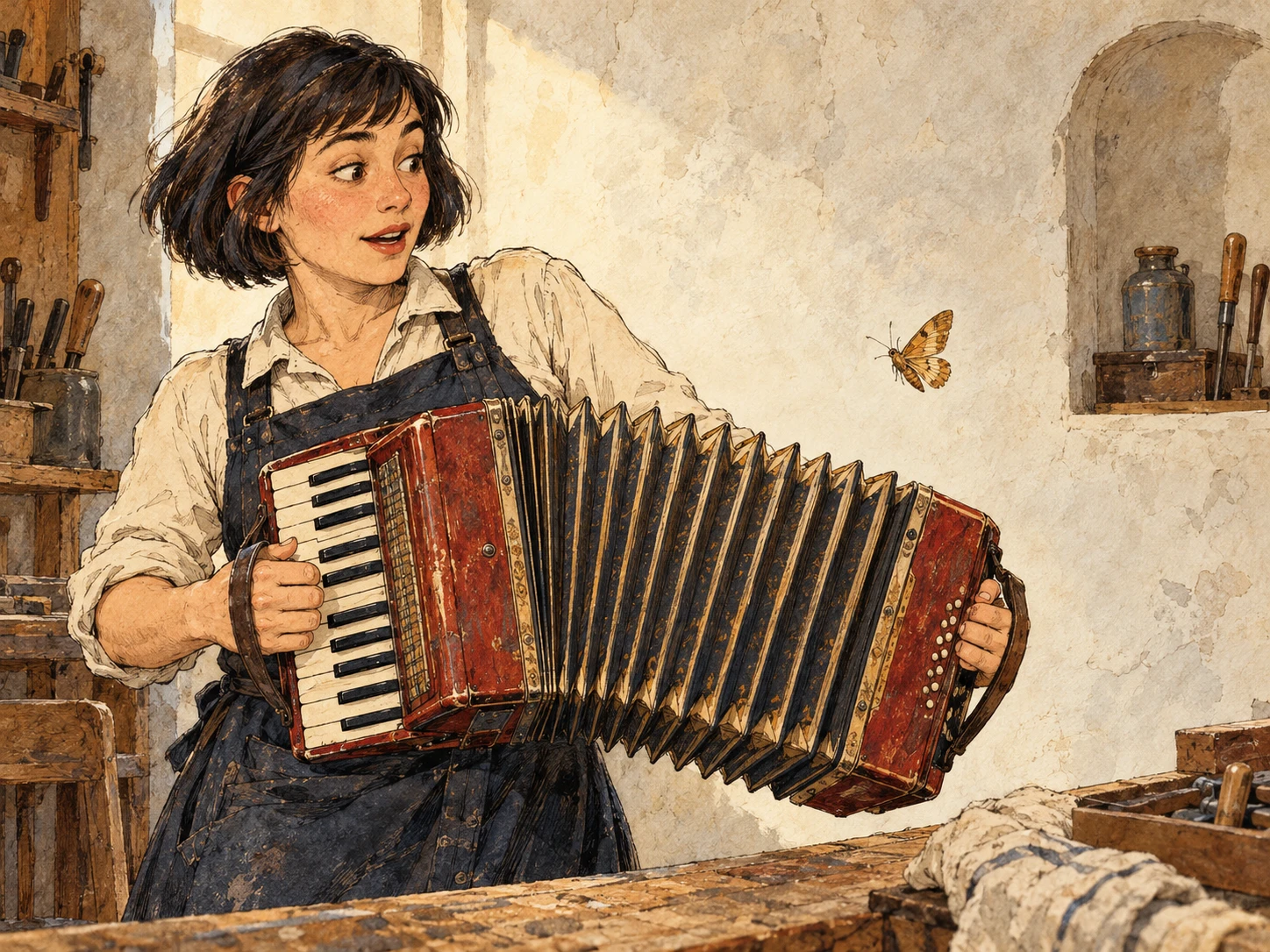
A repairer opens an accordion’s bellows and releases a small moth. Ragged penwork, spreading washes and an expansive bare wall give the unexpected discovery its own silent comic beat.
Remix this referenceA Moth in the Accordion
- Form language
- Compress forms into irregular wedges and blunt curves; simplify secondary detail while retaining useful structural breaks.
- Contour
- Use scratchy nib contours with pressure jumps, occasional doubled searching lines and abrupt gaps where the stroke runs dry.
- Mark-making
- Let short, restless hatches gather beside longer wandering strokes; vary their rhythm naturally and leave quieter passages sparse.
- Surface rendering
- Float translucent washes across and beyond pen edges; retain tide marks, uneven pooling and paper breaks instead of uniformly filled shapes.
Priority
Rendering medium: rough independent-comic pen-and-ink illustration with watercolor wash on paper.
What to avoid & what to check
Exact prompt for this example
MODULE OWNERSHIP
subject: Subject count, type, stable proportions and landmarks, resting face geometry, hair shape, physical materials, garment construction and permanent marks. No emotion, movement, color assignment or rendering recipe.
expression: Facial soft-tissue displacement and pupil direction, muscle coordination, regional intensity, asymmetry and onset/peak/release. No head/body pose, stable appearance, skin color or rendering.
gesture: Head/neck/body/limb orientation, joint movement, support, contact and pose-caused occlusion using existing anatomy. No eye/pupil movement, emotion, identity, props inventory or camera.
props: Prop count, type, construction, physical material and scale relative to the subject. Holding/contact belongs to gesture, position to composition, color to palette.
scene: Environment elements, terrain, backdrop/floor presence and structural detail. No canvas positions, camera, lighting, assigned colors or render texture.
camera: Projection, focal-length impression, camera elevation/yaw/roll, viewing distance and crop. No actor pose, world placement, lighting or canvas aspect ratio.
composition: Normalized 0-100% canvas positions, scale in frame, depth/overlap, focal hierarchy and margins. No joint pose, camera projection, rendering, subject/prop inventory or emotion.
palette: Color anchors, hue/saturation/value ranges, colors assigned to parts and approximate color coverage. No illumination direction, shading algorithm, physical material or layout.
lighting: Light-source direction/softness/intensity, ambient illumination, physical shadow direction/length and highlight position. Absence of directional illumination is allowed. No shading technique, palette or material changes.
style: Reusable form abstraction, contour weight/taper/edge quality, medium and mark scale/density/direction, surface rendering and tonal transition technique. No fixed subject proportions, anatomy, identity, expression, pose, palette, light-source direction, camera or layout.
output: Image count, aspect ratio, size, file/alpha requirements and global lettering/logo/watermark restrictions. No background scenery, crop, style, identity or pose.

SUBJECT
inventory: One adult woman, actor A, and one small moth without individualized facial controls.
geometry: A has a long oval head, a broad nose and a compact build; the moth has broad triangular wings and fine antennae.
resting-face: A has straight brows, hooded upper lids, a broad nasal tip and a wide mouth with a fuller lower lip.
appearance: A wears her hair in a short blunt bob, a cotton work shirt with rolled cuffs and a canvas apron.

PRIORITY


AVOID


CHECK


EXPRESSION — ACTOR A
brows: Both brows lift, with the brow nearer the moth rising slightly farther.
lids: Upper lids lift while lower lids stay softly supported.
cheeks: One cheek begins to lift with a barely forming smile.
nose: Nostrils remain relaxed, with no wrinkling across the bridge.
mouth: Lips part slightly; one corner curls upward before the other.
jaw: The jaw releases only enough to open a narrow gap between the lips.
gaze: Both pupils track the moth.
coordination: The upper face registers discovery before the mouth settles into amusement.
timing: Catch the onset of recognition, before a full smile develops.

PRIORITY


AVOID


CHECK


GESTURE
head: A draws her chin back slightly and turns her head toward the open bellows.
torso: Her torso leans away a little while her shoulders remain uneven from pulling the instrument open.
limbs: Her elbows separate as both hands draw the accordion ends apart, pausing midway through the pull.
contact: Both hands stay beneath the accordion’s straps; the instrument rests against her apron without hiding her face.

PRIORITY


AVOID


CHECK


PROPS
inventory: One full-size accordion with its bellows open and a loose edge of its end casing.
construction: Wooden end boxes enclose pleated fabric bellows with reinforced corners, a piano keyboard and leather hand straps.

PRIORITY


AVOID


CHECK


SCENE
inventory: A modest instrument repair room with a plaster wall, a shallow wall niche and the edge of a wooden workbench.
structure: The wall is largely uninterrupted; the niche has a simple recessed lip, and the workbench has a worn solid top.

PRIORITY


AVOID


CHECK


CAMERA
projection: Use natural perspective with a normal-lens impression and little depth exaggeration.
viewpoint: View from chest height at a shallow three-quarter angle, with no camera roll.
crop: Frame A from the hips upward, keeping the entire accordion and moth inside the image.

PRIORITY


AVOID


CHECK


COMPOSITION
placement: Set A left of center; the accordion stretches toward the lower right, with the moth just above its outer end and just beyond the bellows opening.
depth: The accordion overlaps the apron; the moth reads separately against the wall, with the niche receding behind.
spacing: Make the face and tiny moth the paired focus; leave generous upper-right space and let the workbench enter at the bottom.

PRIORITY


AVOID


CHECK


PALETTE
colors: Use warm paper ivory, near-black indigo, muted brick red and a restrained ochre accent.
assignment: Give the apron and hair indigo, accordion ends brick red, shirt pale ivory, skin diluted ochre and moth deeper ochre.
balance: Ivory dominates; indigo provides the main dark mass, while red and ochre remain small, distinct accents.

PRIORITY


AVOID


CHECK


LIGHTING
sources: Soft daylight enters from the upper left, supported by gentle room ambience.
shadows: Short, soft shadows fall down and right beneath the hands and projecting bellows folds.
highlights: Broad highlights touch the upper-left edges of the face, casing and exposed folds.

PRIORITY


AVOID


CHECK


STYLE GUIDE
form-language: Compress forms into irregular wedges and blunt curves; simplify secondary detail while retaining useful structural breaks.
contour: Use scratchy nib contours with pressure jumps, occasional doubled searching lines and abrupt gaps where the stroke runs dry.
mark-making: Let short, restless hatches gather beside longer wandering strokes; vary their rhythm naturally and leave quieter passages sparse.
surface-rendering: Float translucent washes across and beyond pen edges; retain tide marks, uneven pooling and paper breaks instead of uniformly filled shapes.

PRIORITY
Rendering medium: rough independent-comic pen-and-ink illustration with watercolor wash on paper.

AVOID


CHECK


OUTPUT
format: Create one finished illustration.
restrictions: One image, landscape 4:3, 2048 × 1536 pixels, opaque PNG; no lettering, speech balloons, logos or watermarks.

PRIORITY


AVOID


CHECK


FINAL INTEGRATION
expression + gesture + composition: Let the interrupted handling and early facial response read together, with open space giving the small discovery time to register.
style + lighting + palette: Let the wash carry the broad illumination while broken penwork stays visible through the restrained colors.
Model information comes from image provenance. The same prompt may produce a different result.