Text to imageIllustrationStyle guide
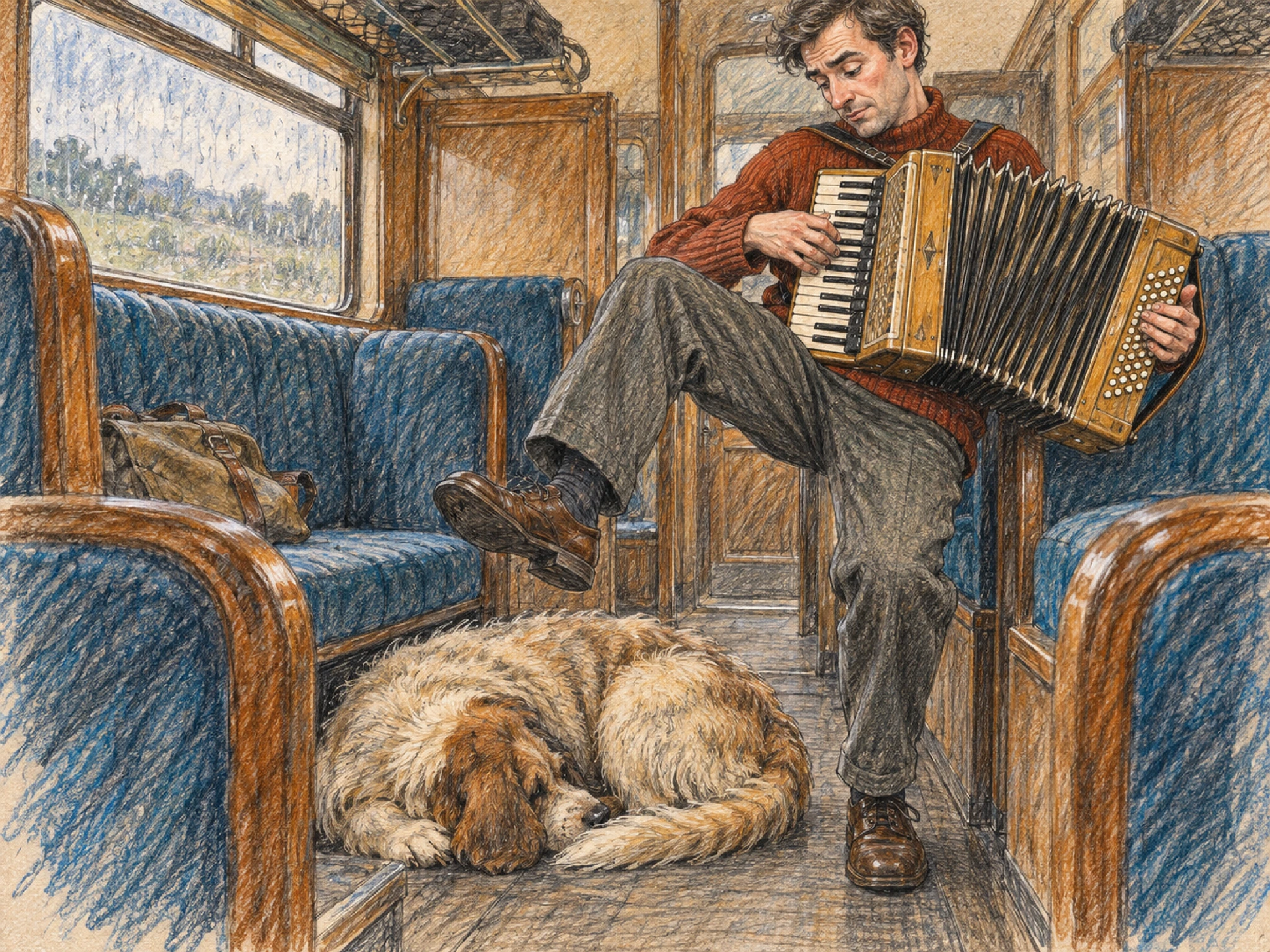
Accordionist Stepping Over a Dog
An accordionist carefully steps over a curled dog in a narrow train aisle. Overlapping knees, bellows and benches form a gently comic travel scene in rough pencil and broken colored-pencil marks.
Remix this referenceAccordionist Stepping Over a Dog
- Form language
- Abstract forms into elastic volumes and irregular interlocking shapes; small descriptive details may vary naturally.
- Contour
- Use rough graphite contours with searching double lines, varied pressure and occasional unfinished edges.
- Mark-making
- Quick pencil hatches follow surfaces; blunt colored-pencil strokes cross them loosely, with irregular spacing and visible starts.
- Surface rendering
- Build tone with broken colored-pencil scumbles over visible paper tooth; let dense layers meet airy reserves through ragged transitions.
Priority
Maintain the visibly worked character of a rough pencil and colored-pencil sketchbook drawing.
What to avoid & what to check
Exact prompt for this example
MODULE OWNERSHIP
subject: Subject count, type, stable proportions and landmarks, resting face geometry, hair shape, physical materials, garment construction and permanent marks. No emotion, movement, color assignment or rendering recipe.
expression: Facial soft-tissue displacement and pupil direction, muscle coordination, regional intensity, asymmetry and onset/peak/release. No head/body pose, stable appearance, skin color or rendering.
gesture: Head/neck/body/limb orientation, joint movement, support, contact and pose-caused occlusion using existing anatomy. No eye/pupil movement, emotion, identity, props inventory or camera.
props: Prop count, type, construction, physical material and scale relative to the subject. Holding/contact belongs to gesture, position to composition, color to palette.
scene: Environment elements, terrain, backdrop/floor presence and structural detail. No canvas positions, camera, lighting, assigned colors or render texture.
camera: Projection, focal-length impression, camera elevation/yaw/roll, viewing distance and crop. No actor pose, world placement, lighting or canvas aspect ratio.
composition: Normalized 0-100% canvas positions, scale in frame, depth/overlap, focal hierarchy and margins. No joint pose, camera projection, rendering, subject/prop inventory or emotion.
palette: Color anchors, hue/saturation/value ranges, colors assigned to parts and approximate color coverage. No illumination direction, shading algorithm, physical material or layout.
lighting: Light-source direction/softness/intensity, ambient illumination, physical shadow direction/length and highlight position. Absence of directional illumination is allowed. No shading technique, palette or material changes.
style: Reusable form abstraction, contour weight/taper/edge quality, medium and mark scale/density/direction, surface rendering and tonal transition technique. No fixed subject proportions, anatomy, identity, expression, pose, palette, light-source direction, camera or layout.
output: Image count, aspect ratio, size, file/alpha requirements and global lettering/logo/watermark restrictions. No background scenery, crop, style, identity or pose.

SUBJECT
inventory: A is one adult male accordionist; B is one medium-sized dog. No other figures.
geometry: A has a lanky build and large hands; B has a long barrel-shaped body, short legs and floppy ears.
resting-face: A has a long oval face, broad nose and nearly straight brows. B has a blunt muzzle and heavy cheek folds.
appearance: A has short swept hair, a ribbed wool pullover, loose trousers and leather shoes. B has a shaggy coat.

PRIORITY


AVOID


CHECK


EXPRESSION — ACTOR A
brows: Inner brows gather slightly, with one brow a little higher.
lids: Upper lids lower slightly; lower lids remain lightly firm.
cheeks: Cheeks remain relaxed except for slight tension beside the mouth.
nose: Nostrils stay relaxed, without wrinkling the nose.
mouth: Lips part narrowly, with one corner pulled slightly sideways.
jaw: Jaw releases just enough for the narrow lip opening.
gaze: Pupils point downward toward B.
coordination: Gathered brows and sideways lip tension convey restrained concentration.
timing: Capture the brief apex of concentration before facial tension releases.

PRIORITY


AVOID


CHECK


EXPRESSION — ACTOR B
brows: Brow action is unprescribed.
lids: Lid opening is unprescribed.
cheeks: The exposed cheek remains slack, without bunching.
nose: The exposed nose stays relaxed, without flaring or wrinkling.
mouth: The visible lip edge rests closed, with no corner pull.
jaw: The jaw rests softly closed, without clenching.
gaze: Pupil direction is unprescribed.
coordination: Visible muzzle muscles remain relaxed; hidden facial action is unspecified.
timing: Show a settled resting state after facial tension has released.

PRIORITY


AVOID


CHECK


GESTURE
head: A inclines his head toward the aisle. B tucks its muzzle beneath one ear; the ear covers the upper face.
torso: A twists his shoulders through the gap while leaning slightly back. B curls into a loose crescent.
limbs: A raises one knee over B while the other leg supports him; bent elbows accommodate the open bellows.
contact: A's hands rest on the keyboard and button board; straps support the accordion. His raised shoe clears B.

PRIORITY


AVOID


CHECK


PROPS
inventory: One accordion, broad enough to span A's chest.
construction: Wooden end boxes flank fabric bellows, with a piano keyboard, button board and leather straps.

PRIORITY


AVOID


CHECK


SCENE
inventory: An older railway carriage with facing upholstered benches, a narrow aisle, a window and luggage racks.
structure: Rounded bench ends constrict the floor passage; timber partitions and rain-streaked glass enclose the carriage.

PRIORITY


AVOID


CHECK


CAMERA
projection: Moderate wide-angle perspective with natural depth and little edge distortion.
viewpoint: View from standing chest height in the aisle, looking obliquely across the benches with no roll.
crop: Include A's full figure and all of B; crop the nearest benches and the upper luggage rack.

PRIORITY


AVOID


CHECK


COMPOSITION
placement: A fills most of the right half, his face in the upper third; B extends across the lower middle.
depth: Near bench ends overlap the lower action; the accordion overlaps A's torso and partly overlaps his knee.
spacing: Lead from face to bellows to dog; keep the shoe-to-dog gap readable and leave breathing room beside the window.

PRIORITY


AVOID


CHECK


PALETTE
colors: Warm oat, graphite gray, muted petrol blue, brick rust, mustard and soft peach.
assignment: Oat for paper and dog, blue for benches, rust for the pullover, mustard for accordion ends, peach for skin.
balance: Pale oat and gray dominate; muted blue forms broad secondary passages, with smaller warm accents.

PRIORITY


AVOID


CHECK


LIGHTING
sources: Soft daylight enters from the upper left window, supported by gentle ambient carriage light.
shadows: Broad soft shadows fall toward the lower right; contact shadows beneath the supporting shoe and B stay modest.
highlights: Restrained highlights touch the window-facing cheek, upper bellows folds and rounded bench edges.

PRIORITY


AVOID


CHECK


STYLE GUIDE
form-language: Abstract forms into elastic volumes and irregular interlocking shapes; small descriptive details may vary naturally.
contour: Use rough graphite contours with searching double lines, varied pressure and occasional unfinished edges.
mark-making: Quick pencil hatches follow surfaces; blunt colored-pencil strokes cross them loosely, with irregular spacing and visible starts.
surface-rendering: Build tone with broken colored-pencil scumbles over visible paper tooth; let dense layers meet airy reserves through ragged transitions.

PRIORITY
Maintain the visibly worked character of a rough pencil and colored-pencil sketchbook drawing.

AVOID


CHECK


OUTPUT
format: One finished illustration, landscape 4:3, 2048 × 1536 pixels, opaque PNG.
restrictions: Omit lettering, logos and watermarks.

PRIORITY


AVOID


CHECK


FINAL INTEGRATION
gesture + composition: Coordinate the action and overlaps so the awkward passage remains immediately understandable.
style + expression: Let the loose drawing preserve the prescribed visible facial cues without elaborating concealed features.
Model information comes from image provenance. The same prompt may produce a different result.