Text to imageComicsStyle guide
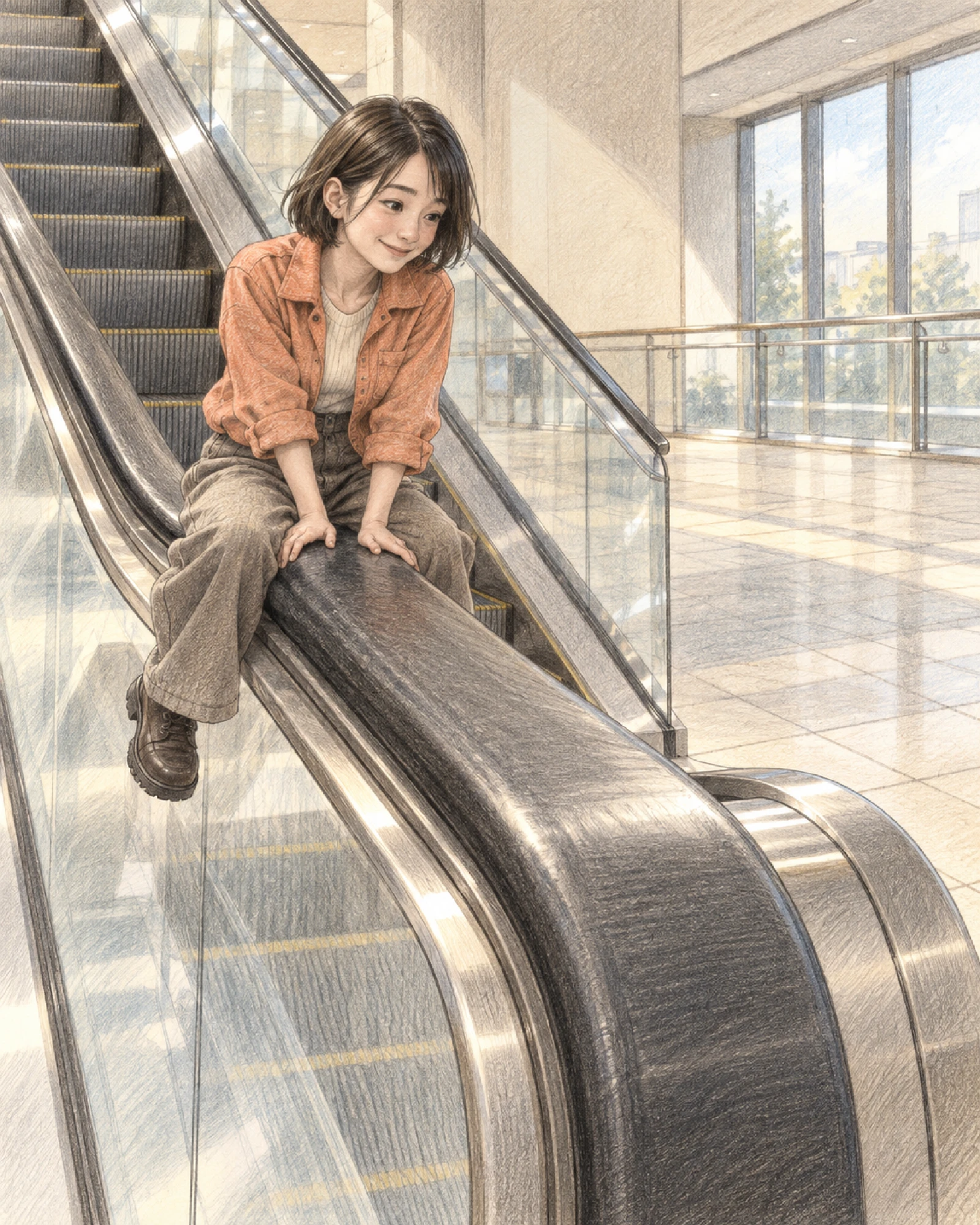
Tiny Commuter Riding an Escalator Handrail
A palm-sized woman rides a department-store escalator handrail. Pressure-varied pencil lines and loose hatching give an ordinary commute an unexpected scale and playful intimacy.
Remix this referenceTiny Commuter Riding an Escalator Handrail
- Form language
- Simplify forms into broad interlocking masses and economical planes; let minor mechanical details vary within this spare vocabulary.
- Contour
- Use pressure-varied graphite contours with tapered releases, occasional doubled searches and softly broken edges.
- Mark-making
- Alternate loose slanted hatch clusters with broad side-of-pencil strokes; keep spacing and stroke lengths naturally uneven.
- Surface rendering
- Build midtones through uneven pencil veils, reveal paper with eraser lifts, and use selective rubbing for soft tonal transitions.
Priority
Rendering medium: pencil-led slice-of-life manga illustration with graphite and restrained colored pencil on paper.
What to avoid & what to check
Exact prompt for this example
MODULE OWNERSHIP
subject: Subject count, type, stable proportions and landmarks, resting face geometry, hair shape, physical materials, garment construction and permanent marks. No emotion, movement, color assignment or rendering recipe.
expression: Facial soft-tissue displacement and pupil direction, muscle coordination, regional intensity, asymmetry and onset/peak/release. No head/body pose, stable appearance, skin color or rendering.
gesture: Head/neck/body/limb orientation, joint movement, support, contact and pose-caused occlusion using existing anatomy. No eye/pupil movement, emotion, identity, props inventory or camera.
props: Prop count, type, construction, physical material and scale relative to the subject. Holding/contact belongs to gesture, position to composition, color to palette.
scene: Environment elements, terrain, backdrop/floor presence and structural detail. No canvas positions, camera, lighting, assigned colors or render texture.
camera: Projection, focal-length impression, camera elevation/yaw/roll, viewing distance and crop. No actor pose, world placement, lighting or canvas aspect ratio.
composition: Normalized 0-100% canvas positions, scale in frame, depth/overlap, focal hierarchy and margins. No joint pose, camera projection, rendering, subject/prop inventory or emotion.
palette: Color anchors, hue/saturation/value ranges, colors assigned to parts and approximate color coverage. No illumination direction, shading algorithm, physical material or layout.
lighting: Light-source direction/softness/intensity, ambient illumination, physical shadow direction/length and highlight position. Absence of directional illumination is allowed. No shading technique, palette or material changes.
style: Reusable form abstraction, contour weight/taper/edge quality, medium and mark scale/density/direction, surface rendering and tonal transition technique. No fixed subject proportions, anatomy, identity, expression, pose, palette, light-source direction, camera or layout.
output: Image count, aspect ratio, size, file/alpha requirements and global lettering/logo/watermark restrictions. No background scenery, crop, style, identity or pose.

SUBJECT
inventory: One original adult woman, actor A; no other people.
geometry: A is palm-sized, with adult proportions, a long torso and broad hands.
resting-face: An oval face with a straight nose, broad-set eyes and a gently squared chin.
appearance: A blunt bob with one tucked side; a cotton work jacket over a ribbed top, wide trousers and rubber-soled shoes.

PRIORITY


AVOID


CHECK


EXPRESSION — ACTOR A
brows: Both brows lift slightly, with the nearer brow a little higher.
lids: Lower lids rise gently while the upper lids remain relaxed.
cheeks: Cheeks gather upward, more strongly beneath the higher mouth corner.
nose: The nose stays unwrinkled and the nostrils relaxed.
mouth: A closed smile pulls one corner higher, gently compressing the lower lip.
jaw: The jaw remains loose with no visible clenching.
gaze: Pupils aim ahead and slightly downward toward the approaching handrail bend.
coordination: The cheek lift and uneven smile carry the amusement; the brow response stays mild.
timing: Hold the apex of a quiet private chuckle, before the lips open.

PRIORITY


AVOID


CHECK


GESTURE
head: A extends her neck slightly and turns her head toward the handrail's approaching curve.
torso: She straddles the handrail with her torso inclined forward and her shoulders uneven.
limbs: Her knees bend around the rail, feet hanging clear; both arms reach down beside her thighs.
contact: Her pelvis rests on the rail; her palms press its edges for balance, with the nearer thigh hiding part of its side.

PRIORITY


AVOID


CHECK


PROPS
inventory: No separate props.
construction: No prop construction applies.

PRIORITY


AVOID


CHECK


SCENE
inventory: A quiet department-store escalator landing with tiled flooring, a window bank and an unlettered wall.
structure: The normal-sized escalator has ribbed steps, glass balustrades and a broad rubber handrail rounding into its end housing.

PRIORITY


AVOID


CHECK


CAMERA
projection: Moderately wide perspective makes the nearby handrail expansive while preserving readable architecture.
viewpoint: View from near A's eye level in a front three-quarter angle, with a slight downward pitch and no roll.
crop: A close environmental view includes her entire figure, the rounded handrail end and enough steps to identify the escalator.

PRIORITY


AVOID


CHECK


COMPOSITION
placement: Place A in the left third, centered roughly one-third down from the top; her figure spans about one-third of the image height. The handrail sweeps diagonally across the lower field
depth: The broad foreground rail overlaps receding steps; the landing and windows form a spacious, lightly occupied distance.
spacing: Her face leads, the sweeping rail follows; leave open room before her and separate her silhouette from busy step edges.

PRIORITY


AVOID


CHECK


PALETTE
colors: Use warm ivory, graphite gray, cool slate and a restrained muted apricot.
assignment: Ivory serves the paper and pale skin; graphite anchors hair and handrail, slate the surroundings, and apricot the jacket.
balance: Keep ivory dominant and most tones quiet; the jacket supplies the only substantial chromatic accent.

PRIORITY


AVOID


CHECK


LIGHTING
sources: Broad daylight enters from high left, supported by weaker diffuse interior illumination.
shadows: Soft shadows fall down-right, with close contact shadows wherever surfaces meet.
highlights: Broad highlights touch upper-left-facing planes, with a narrow glint along the glass rim.

PRIORITY


AVOID


CHECK


STYLE GUIDE
form-language: Simplify forms into broad interlocking masses and economical planes; let minor mechanical details vary within this spare vocabulary.
contour: Use pressure-varied graphite contours with tapered releases, occasional doubled searches and softly broken edges.
mark-making: Alternate loose slanted hatch clusters with broad side-of-pencil strokes; keep spacing and stroke lengths naturally uneven.
surface-rendering: Build midtones through uneven pencil veils, reveal paper with eraser lifts, and use selective rubbing for soft tonal transitions.

PRIORITY
Rendering medium: pencil-led slice-of-life manga illustration with graphite and restrained colored pencil on paper.

AVOID


CHECK


OUTPUT
format: One finished illustration, portrait 4:5, 1600 × 2000 pixels, opaque PNG.
restrictions: No lettering, logos or watermarks.

PRIORITY


AVOID


CHECK


FINAL INTEGRATION
scene + camera + composition: Keep the familiar setting legible enough for the scale surprise to register immediately.
Model information comes from image provenance. The same prompt may produce a different result.