Text to imageComicsStyle guide
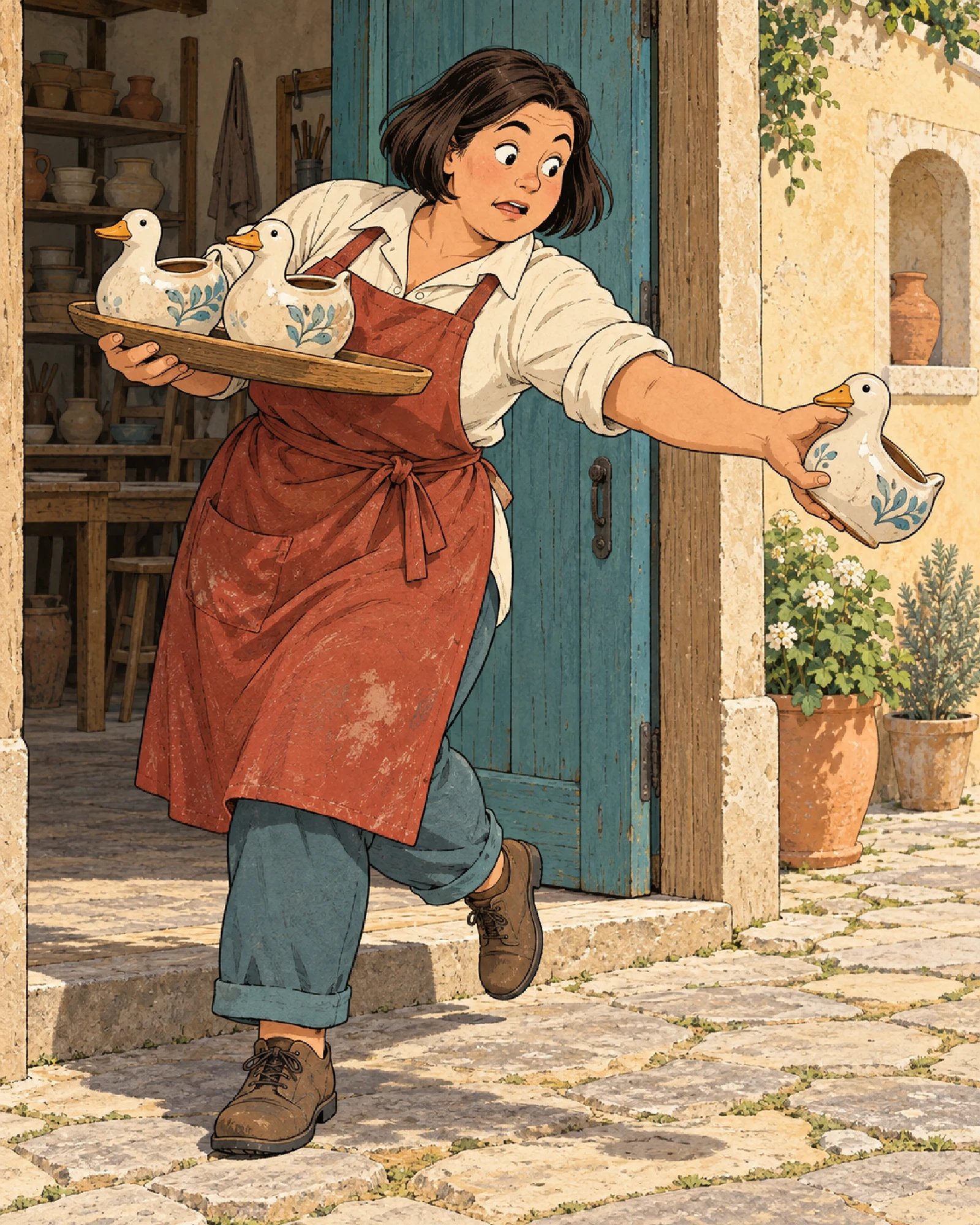
Catching a Ceramic Duck at the Doorway
A potter catches a ceramic duck slipping from a tray while crossing her studio threshold. Even ink contours and subtly paper-grained color planes give this lively European clear-line comic illustration its character.
Remix this referenceCatching a Ceramic Duck at the Doorway
- Form language
- Reduce forms to lucid rounded volumes and economical planar details, retaining small irregularities rather than mechanical repetition.
- Contour
- Use slender, nearly even ink contours with smooth turns, crisp edges and lightly tapered ends on short interior lines.
- Mark-making
- Add sparse hand-drawn ticks and short directional strokes; vary their spacing naturally and keep long passages of quiet linework.
- Surface rendering
- Opaque color planes retain faint paper tooth; tonal changes use a few crisp shapes, with slight pigment unevenness inside broad fills.
Priority
Rendering medium: European clear-line comic illustration in ink and opaque color on paper.
What to avoid & what to check
Exact prompt for this example
MODULE OWNERSHIP
subject: Subject count, type, stable proportions and landmarks, resting face geometry, hair shape, physical materials, garment construction and permanent marks. No emotion, movement, color assignment or rendering recipe.
expression: Facial soft-tissue displacement and pupil direction, muscle coordination, regional intensity, asymmetry and onset/peak/release. No head/body pose, stable appearance, skin color or rendering.
gesture: Head/neck/body/limb orientation, joint movement, support, contact and pose-caused occlusion using existing anatomy. No eye/pupil movement, emotion, identity, props inventory or camera.
props: Prop count, type, construction, physical material and scale relative to the subject. Holding/contact belongs to gesture, position to composition, color to palette.
scene: Environment elements, terrain, backdrop/floor presence and structural detail. No canvas positions, camera, lighting, assigned colors or render texture.
camera: Projection, focal-length impression, camera elevation/yaw/roll, viewing distance and crop. No actor pose, world placement, lighting or canvas aspect ratio.
composition: Normalized 0-100% canvas positions, scale in frame, depth/overlap, focal hierarchy and margins. No joint pose, camera projection, rendering, subject/prop inventory or emotion.
palette: Color anchors, hue/saturation/value ranges, colors assigned to parts and approximate color coverage. No illumination direction, shading algorithm, physical material or layout.
lighting: Light-source direction/softness/intensity, ambient illumination, physical shadow direction/length and highlight position. Absence of directional illumination is allowed. No shading technique, palette or material changes.
style: Reusable form abstraction, contour weight/taper/edge quality, medium and mark scale/density/direction, surface rendering and tonal transition technique. No fixed subject proportions, anatomy, identity, expression, pose, palette, light-source direction, camera or layout.
output: Image count, aspect ratio, size, file/alpha requirements and global lettering/logo/watermark restrictions. No background scenery, crop, style, identity or pose.

SUBJECT
inventory: One original adult woman potter, actor A.
geometry: A has a sturdy everyday build, a broad oval face, a short neck and substantial hands.
resting-face: Her resting landmarks are straight brows, round eyes, a broad nose tip and a short, full-lipped mouth.
appearance: A blunt chin-length bob, cotton work shirt, wrap apron and leather lace-up shoes; minor garment details may vary.

PRIORITY


AVOID


CHECK


EXPRESSION — ACTOR A
brows: Both brows lift, with a slightly higher outer end on her right.
lids: Upper lids rise enough to expose a little more iris; lower lids stay relaxed.
cheeks: Cheeks remain loose without a pronounced upward bunch.
nose: Nostrils remain relaxed, with no bridge wrinkle.
mouth: Lips part in a small uneven opening, with one corner slightly higher.
jaw: The jaw releases only slightly, keeping the reaction compact.
gaze: Both pupils track the slipping ceramic duck.
coordination: Brow lift and lid opening lead; the mouth follows with a smaller response.
timing: Capture the onset of surprise, before a fully open-mouthed reaction.

PRIORITY


AVOID


CHECK


GESTURE
head: A turns her head toward her reaching hand, with the chin slightly lowered.
torso: Her torso bends sideways toward the catch while her hips counterbalance over the planted leg.
limbs: Her left forearm supports the tray; her right arm reaches out. Knees soften and the trailing heel lifts.
contact: Her right palm meets the slipping duck's belly; the left hand steadies the tray rim and one shoe bears her weight.

PRIORITY


AVOID


CHECK


PROPS
inventory: One broad serving tray and three ceramic duck watering vessels, each roughly the size of A's forearm.
construction: The tray is bent wood; the hollow glazed ducks have rounded bellies, open backs and short beak spouts.

PRIORITY


AVOID


CHECK


SCENE
inventory: A pottery studio doorway opens onto a small stone-paved courtyard, with plaster walls and a shallow empty display niche.
structure: A thick timber doorframe, raised stone threshold and irregular paving joints give the setting modest architectural substance.

PRIORITY


AVOID


CHECK


CAMERA
projection: Natural perspective with a normal-lens impression and mild depth convergence.
viewpoint: View from chest height, obliquely across the doorway, with a level horizon.
crop: A close full-figure view includes both shoes and trims the surrounding architecture at the image edges.

PRIORITY


AVOID


CHECK


COMPOSITION
placement: A anchors the left-middle near 40% width; the catching hand and duck occupy the middle-right, with the doorway behind.
depth: The catch is the primary focus, then the face; tray and remaining ducks overlap the apron before the recessed doorway.
spacing: The figure fills most of the height; leave an open interval around the catch and a generous courtyard wedge beside it.

PRIORITY
No panel divisions or speech balloons.

AVOID


CHECK


PALETTE
colors: Warm cream, brick red, muted turquoise and sandy ochre, anchored by near-black ink.
assignment: Cream ducks and shirt, brick-red apron, turquoise door, ochre masonry and tray, warm brown skin and dark hair.
balance: Cream and ochre occupy broad areas; red and turquoise supply smaller saturated accents against subdued surroundings.

PRIORITY


AVOID


CHECK


LIGHTING
sources: Broad soft daylight enters from upper left, with ample ambient light inside the doorway.
shadows: Short, soft shadows fall toward the lower right; contact shadows remain visible beneath the tray's resting ducks.
highlights: Small highlights sit on the upper-left curves of the glazed ducks.

PRIORITY


AVOID


CHECK


STYLE GUIDE
form-language: Reduce forms to lucid rounded volumes and economical planar details, retaining small irregularities rather than mechanical repetition.
contour: Use slender, nearly even ink contours with smooth turns, crisp edges and lightly tapered ends on short interior lines.
mark-making: Add sparse hand-drawn ticks and short directional strokes; vary their spacing naturally and keep long passages of quiet linework.
surface-rendering: Opaque color planes retain faint paper tooth; tonal changes use a few crisp shapes, with slight pigment unevenness inside broad fills.

PRIORITY
Rendering medium: European clear-line comic illustration in ink and opaque color on paper.

AVOID


CHECK


OUTPUT
format: One finished image, 4:5 portrait aspect ratio, 1600 × 2000 pixels, opaque PNG.
restrictions: No lettering, logos or watermarks.

PRIORITY


AVOID


CHECK


FINAL INTEGRATION
expression + gesture + composition: Let the facial response and reaching action read together through the space reserved for their interaction.
style + palette + lighting: Translate the chosen light and color relationships through the economical ink-and-color treatment.
Model information comes from image provenance. The same prompt may produce a different result.