Text to imageComicsStyle guide
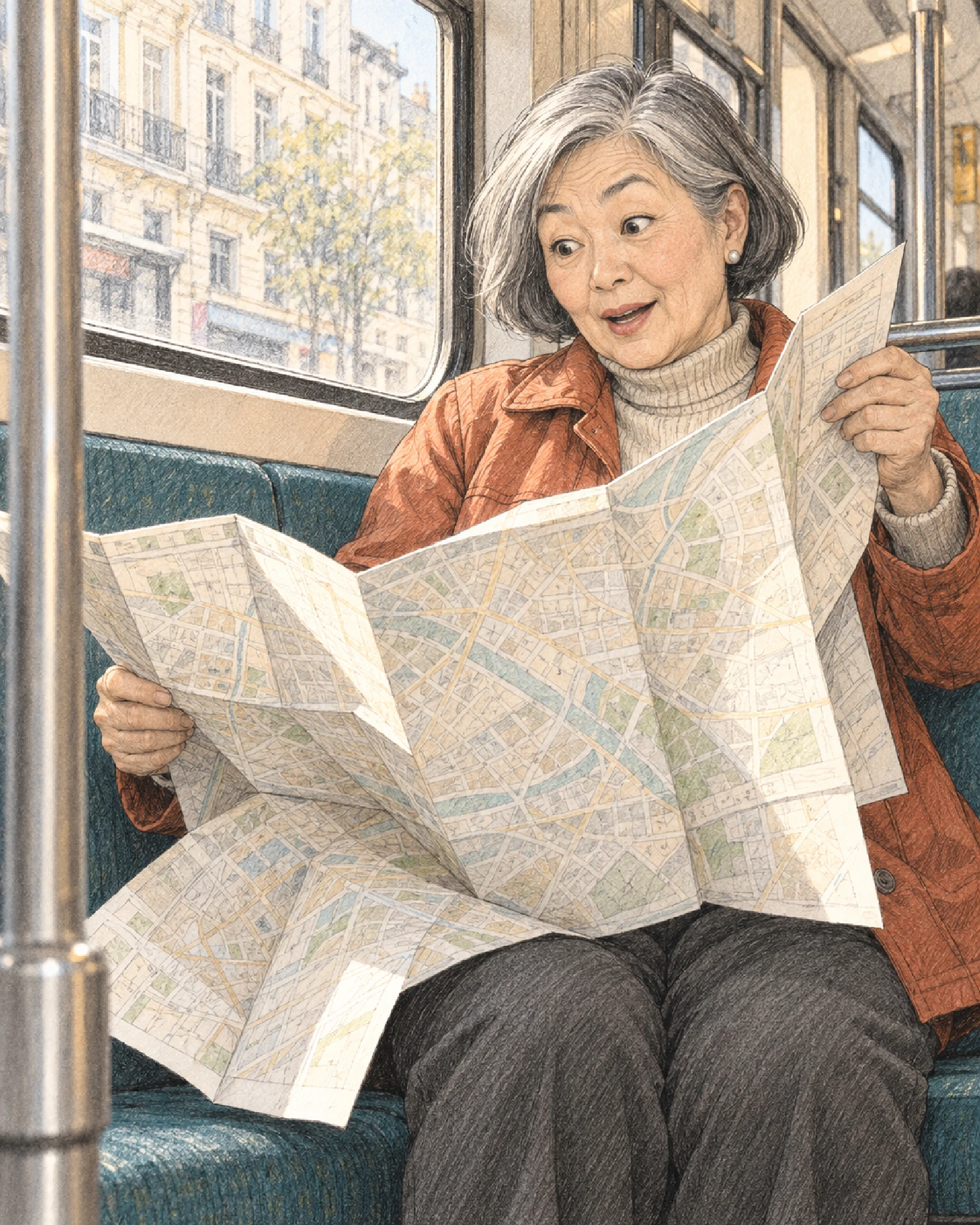
Woman Opening a Map on a Tram
A woman reacts with amused surprise as her map unfolds farther than expected across a tram seat. Overlapping paper planes and lively pencil work turn an ordinary journey into one expressive comic illustration.
Remix this referenceWoman Opening a Map on a Tram
- Form language
- Use economical slice-of-life manga simplification: broad readable masses with selective observational detail and naturally varied secondary shapes.
- Contour
- Let graphite contours alternate between firm pressure and broken, searching edges; retain occasional light revisions beneath decisive strokes.
- Mark-making
- Use quick, uneven pencil hatching that follows local surfaces; allow loose parallel strokes and a few blunt colored-pencil accents.
- Surface rendering
- Build soft midtones with rubbed graphite and translucent colored-pencil scumble, preserving paper tooth and crisp untouched highlights.
Priority
Rendering medium: Graphite-led slice-of-life manga illustration with restrained colored pencil.
What to avoid & what to check
Exact prompt for this example
MODULE OWNERSHIP
subject: Subject count, type, stable proportions and landmarks, resting face geometry, hair shape, physical materials, garment construction and permanent marks. No emotion, movement, color assignment or rendering recipe.
expression: Facial soft-tissue displacement and pupil direction, muscle coordination, regional intensity, asymmetry and onset/peak/release. No head/body pose, stable appearance, skin color or rendering.
gesture: Head/neck/body/limb orientation, joint movement, support, contact and pose-caused occlusion using existing anatomy. No eye/pupil movement, emotion, identity, props inventory or camera.
props: Prop count, type, construction, physical material and scale relative to the subject. Holding/contact belongs to gesture, position to composition, color to palette.
scene: Environment elements, terrain, backdrop/floor presence and structural detail. No canvas positions, camera, lighting, assigned colors or render texture.
camera: Projection, focal-length impression, camera elevation/yaw/roll, viewing distance and crop. No actor pose, world placement, lighting or canvas aspect ratio.
composition: Normalized 0-100% canvas positions, scale in frame, depth/overlap, focal hierarchy and margins. No joint pose, camera projection, rendering, subject/prop inventory or emotion.
palette: Color anchors, hue/saturation/value ranges, colors assigned to parts and approximate color coverage. No illumination direction, shading algorithm, physical material or layout.
lighting: Light-source direction/softness/intensity, ambient illumination, physical shadow direction/length and highlight position. Absence of directional illumination is allowed. No shading technique, palette or material changes.
style: Reusable form abstraction, contour weight/taper/edge quality, medium and mark scale/density/direction, surface rendering and tonal transition technique. No fixed subject proportions, anatomy, identity, expression, pose, palette, light-source direction, camera or layout.
output: Image count, aspect ratio, size, file/alpha requirements and global lettering/logo/watermark restrictions. No background scenery, crop, style, identity or pose.

SUBJECT
inventory: One original older adult woman, actor A.
geometry: She has a compact build, broad hands, a square jaw and a short bob with one side tucked behind an ear.
resting-face: Her resting face has straight brows, narrow almond eyes, a rounded nose tip and a broad, thin-lipped mouth.
appearance: A roomy cotton work jacket covers a ribbed turtleneck; plain trousers and small round stud earrings complete her appearance.

PRIORITY


AVOID


CHECK


EXPRESSION — ACTOR A
brows: Both brows rise, with the left lifting slightly earlier.
lids: Upper lids lift while lower lids retain a gentle curve.
cheeks: A small cheek lift begins on the left.
nose: The nose stays relaxed without nostril flare.
mouth: Lips part into a small opening, with the left corner beginning to curl upward.
jaw: The jaw releases slightly without a large drop.
gaze: Pupils track the map's newly opened outer flap.
coordination: Raised brows and parted lips carry surprise while the uneven cheek lift introduces amusement.
timing: Capture surprise at onset, just as a smile starts to form.

PRIORITY


AVOID


CHECK


GESTURE
head: A turns her head toward the opening flap, chin drawn slightly back.
torso: Seated on the bench, she recoils a little through her shoulders while keeping her hips supported.
limbs: Her elbows separate as one hand lifts and the other stays low; her knees remain loosely together.
contact: Her hands pinch opposite map edges; the lower folds rest across her thighs and conceal part of her jacket.

PRIORITY


AVOID


CHECK


PROPS
inventory: One folding paper street map, broad enough when open to exceed her shoulder width.
construction: Thin paper has alternating accordion creases, softened corners and an unlabelled network of streets and blocks.

PRIORITY


AVOID


CHECK


SCENE
inventory: A modest tram interior contains a continuous bench, a window, a vertical grab pole and a narrow aisle.
structure: Rounded window framing and simple wall panels establish the carriage; ordinary street facades appear outside.

PRIORITY


AVOID


CHECK


CAMERA
projection: Use natural perspective with a mildly wide focal-length impression.
viewpoint: Observe diagonally from the aisle at a seated passenger's eye level, with no camera roll.
crop: A medium-distance view includes her head, hands and lap, ending just above the knees.

PRIORITY


AVOID


CHECK


COMPOSITION
placement: Place her face in the upper-right third; let the map spread through the center toward the lower-left edge.
depth: A cropped foreground pole overlaps the map's far edge; paper planes overlap her torso, with the window receding behind.
spacing: The face and nearest map fold form the focal pair; leave breathing room above her hair and between the major paper planes.

PRIORITY
Use one continuous composition without panel divisions.

AVOID


CHECK


PALETTE
colors: Use warm ivory, graphite gray, dusty persimmon and muted teal, with mostly low saturation.
assignment: Ivory belongs to paper, persimmon to the jacket, teal to upholstery, silver gray to hair and warm beige to skin.
balance: Ivory and gray dominate; persimmon supplies the strongest chromatic accent and teal remains subdued.

PRIORITY


AVOID


CHECK


LIGHTING
sources: Broad, soft daylight enters from the upper left through the tram window, with gentle interior ambient light.
shadows: Short, soft shadows fall to the right beneath the paper folds, hands and chin.
highlights: Window-facing paper ridges and the upper-left cheek receive restrained highlights.

PRIORITY


AVOID


CHECK


STYLE GUIDE
form-language: Use economical slice-of-life manga simplification: broad readable masses with selective observational detail and naturally varied secondary shapes.
contour: Let graphite contours alternate between firm pressure and broken, searching edges; retain occasional light revisions beneath decisive strokes.
mark-making: Use quick, uneven pencil hatching that follows local surfaces; allow loose parallel strokes and a few blunt colored-pencil accents.
surface-rendering: Build soft midtones with rubbed graphite and translucent colored-pencil scumble, preserving paper tooth and crisp untouched highlights.

PRIORITY
Rendering medium: Graphite-led slice-of-life manga illustration with restrained colored pencil.

AVOID


CHECK


OUTPUT
format: Produce one portrait-format 4:5 image, 1600 × 2000 pixels, as an opaque PNG.
restrictions: Use a single illustration without lettering, speech balloons, logos or watermarks.

PRIORITY


AVOID


CHECK


FINAL INTEGRATION
expression + gesture + composition: Let facial acting and the unfolding action read together through clear overlap.
style + palette + lighting: Let pencil marks carry the image while color and illumination support their legibility.
Model information comes from image provenance. The same prompt may produce a different result.