Text to imageLandscapeStyle guide
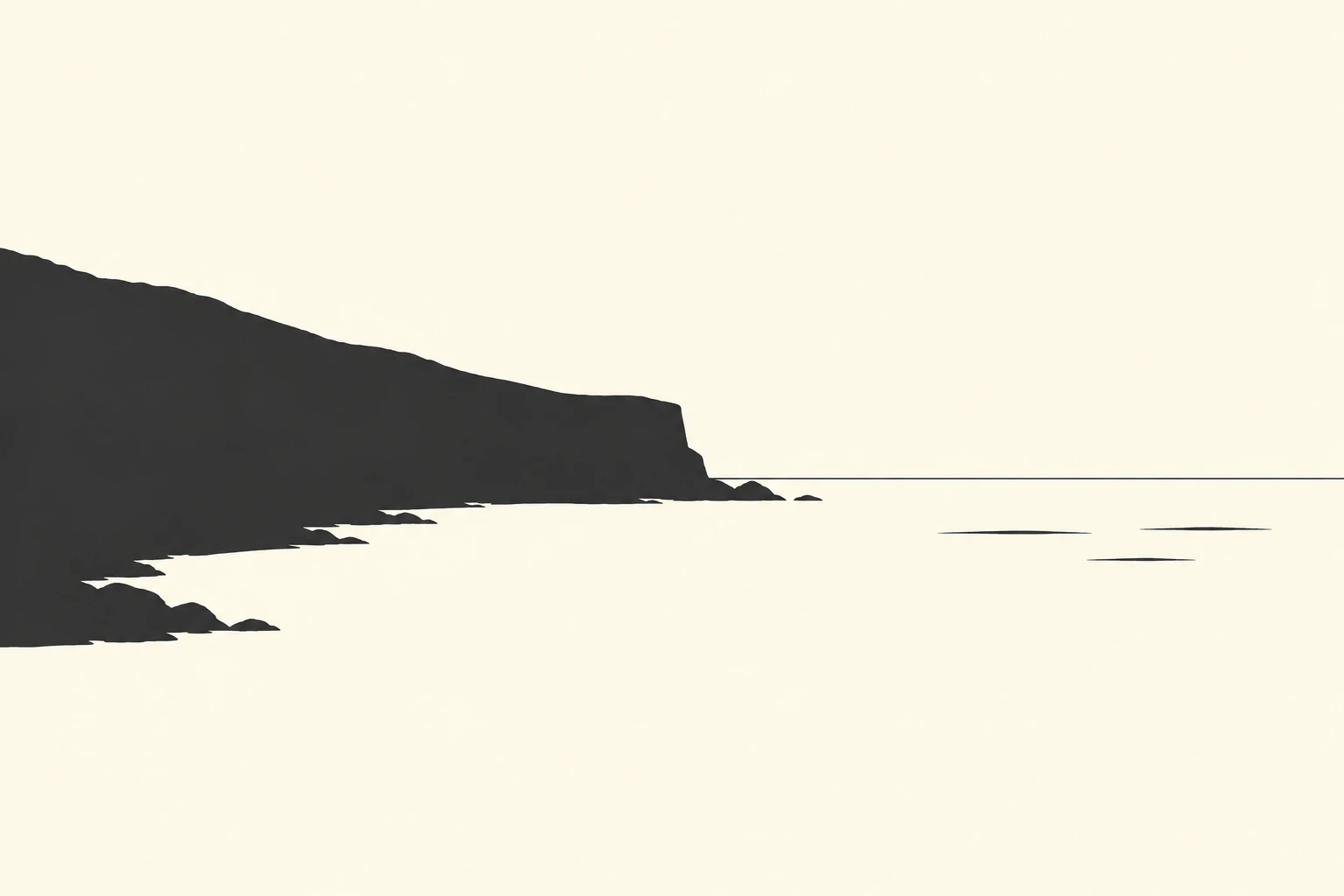
Small Coastal Headland · Two-Value Notan
Group a coastal headland and quiet bay into two values, building the landscape through interlocking light and dark shapes.
Small Coastal Headland · Two-Value Notan
- Shape & line
- Build the headland as one connected dark silhouette with a gently descending crest and a short, blunt cliff edge. Use broad, deliberate contours; simplify small rock breaks into a few readable changes of direction.
- Color & light
- Use only two flat values: warm ivory for sky and water, and deep charcoal for land and selected water marks. Merge all land shading into the charcoal mass, and let the ivory bay cut visibly into its lower-right edge without gradients or intermediate gray.
- Texture & material
- Give the image the opaque, even coverage of cut-paper shapes laid on smooth paper. Keep interior surfaces solid and edges crisp; describe calm water with two or three short charcoal horizontal strokes rather than grain, shine, or detailed ripples.
- Composition
- Balance the heavy dark mass on image-left with a broad uninterrupted ivory opening on image-right. Place the short water strokes below the horizon inside that right-hand opening, leaving generous light space around the cliff tip so the land–bay interlock remains the focal shape.
Priority
Prioritize a readable land–bay interlock using exactly two values.
What to avoid & what to check
Avoid gradients, extra gray tones, and detail that fragments the main silhouette.
Check that the headland stays connected and the ivory bay remains readable at thumbnail size.
Exact prompt for this example
SUBJECT
One low coastal headland projects from the image-left shore into one quiet bay. Its sloping upper edge ends in a blunt cliff near the center; open water continues to image-right beneath a clear sky.

COMPOSITION
Use a wide, eye-level view with the horizon slightly above center. The headland enters through the left edge and occupies the lower-left portion, while the bay opens toward the right. Keep the cliff endpoint clearly separated from the right frame.

STYLE GUIDE
1. Shape & line
Build the headland as one connected dark silhouette with a gently descending crest and a short, blunt cliff edge. Use broad, deliberate contours; simplify small rock breaks into a few readable changes of direction.

2. Color & light
Use only two flat values: warm ivory for sky and water, and deep charcoal for land and selected water marks. Merge all land shading into the charcoal mass, and let the ivory bay cut visibly into its lower-right edge without gradients or intermediate gray.

3. Texture & material
Give the image the opaque, even coverage of cut-paper shapes laid on smooth paper. Keep interior surfaces solid and edges crisp; describe calm water with two or three short charcoal horizontal strokes rather than grain, shine, or detailed ripples.

4. Composition
Balance the heavy dark mass on image-left with a broad uninterrupted ivory opening on image-right. Place the short water strokes below the horizon inside that right-hand opening, leaving generous light space around the cliff tip so the land–bay interlock remains the focal shape.

PRIORITY
Preserve the requested identity, count, action, composition and output settings. Apply the style rules within those constraints; a style reference must not replace the subject or layout. Within the style: Prioritize a readable land–bay interlock using exactly two values.

AVOID
Avoid gradients, extra gray tones, and detail that fragments the main silhouette.

OUTPUT
Create one landscape-format image in a 3:2 aspect ratio, with no lettering, captions, borders, or watermarks.

SELF-CHECK
Check that the headland stays connected and the ivory bay remains readable at thumbnail size.
Model information comes from image provenance. The same prompt may produce a different result.