Text to imageCharacterStyle guide
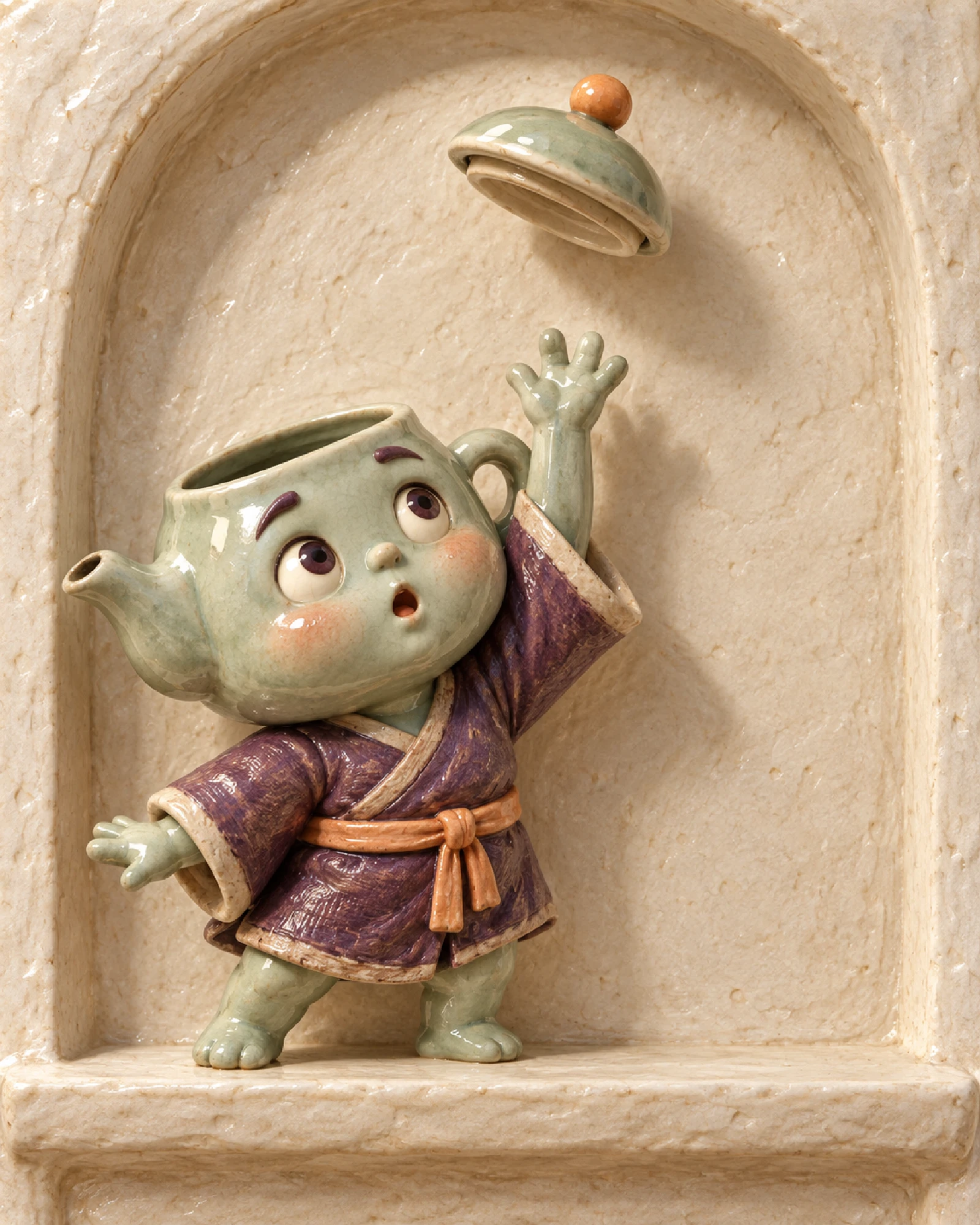
A Teapot Sprite Catching Its Lid
A little teapot sprite reaches to catch the lid of its own head in a glazed ceramic relief. An uneven look of surprise, an extended hand and a spacious wall field make the moment playful.
Remix this referenceA Teapot Sprite Catching Its Lid
- Form language
- Translate forms into shallow modeled relief with rounded masses and selective undercuts; allow small handmade irregularities.
- Contour
- Use rolled, slightly uneven relief edges and occasional incised separations instead of uniform drawn outlines.
- Mark-making
- Retain sparse thumb smoothing and short curved tool sweeps; let their spacing vary naturally across broad passages.
- Surface rendering
- Model glaze as translucent pooling in hollows and thinner washes over ridges, with softly mottled transitions and rounded reflective patches.
Priority
The image must read as a modeled, glazed ceramic relief illustration.
What to avoid & what to check
Exact prompt for this example
MODULE OWNERSHIP
subject: Subject count, type, stable proportions and landmarks, resting face geometry, hair shape, physical materials, garment construction and permanent marks. No emotion, movement, color assignment or rendering recipe.
expression: Facial soft-tissue displacement and pupil direction, muscle coordination, regional intensity, asymmetry and onset/peak/release. No head/body pose, stable appearance, skin color or rendering.
gesture: Head/neck/body/limb orientation, joint movement, support, contact and pose-caused occlusion using existing anatomy. No eye/pupil movement, emotion, identity, props inventory or camera.
props: Prop count, type, construction, physical material and scale relative to the subject. Holding/contact belongs to gesture, position to composition, color to palette.
scene: Environment elements, terrain, backdrop/floor presence and structural detail. No canvas positions, camera, lighting, assigned colors or render texture.
camera: Projection, focal-length impression, camera elevation/yaw/roll, viewing distance and crop. No actor pose, world placement, lighting or canvas aspect ratio.
composition: Normalized 0-100% canvas positions, scale in frame, depth/overlap, focal hierarchy and margins. No joint pose, camera projection, rendering, subject/prop inventory or emotion.
palette: Color anchors, hue/saturation/value ranges, colors assigned to parts and approximate color coverage. No illumination direction, shading algorithm, physical material or layout.
lighting: Light-source direction/softness/intensity, ambient illumination, physical shadow direction/length and highlight position. Absence of directional illumination is allowed. No shading technique, palette or material changes.
style: Reusable form abstraction, contour weight/taper/edge quality, medium and mark scale/density/direction, surface rendering and tonal transition technique. No fixed subject proportions, anatomy, identity, expression, pose, palette, light-source direction, camera or layout.
output: Image count, aspect ratio, size, file/alpha requirements and global lettering/logo/watermark restrictions. No background scenery, crop, style, identity or pose.

SUBJECT
inventory: One original teapot-headed sprite, actor A, with a small humanoid body.
geometry: A squat pot head has an open crown rim, a short side spout and an opposite loop handle; the body has stubby limbs.
resting-face: The front face has round eyes, separate short brows, full cheeks, a button nose and a small mouth above a rounded chin.
appearance: The head and exposed limbs are ceramic; a woven wrap tunic has broad sleeves and a simple tied belt. No hair.

PRIORITY


AVOID


CHECK


EXPRESSION — ACTOR A
brows: Both brows lift, with the brow nearer the lid distinctly higher.
lids: Upper lids open widely while lower lids remain softly supported.
cheeks: Cheeks gather slightly upward without a broad smile.
nose: Keep the nose relaxed, with no bridge wrinkle or nostril flare.
mouth: Lips form a small uneven oval, one corner slightly higher.
jaw: The jaw releases slightly, maintaining a compact mouth opening.
gaze: Both pupils look upward toward the lid.
coordination: Open lids and lifted brows lead; the smaller mouth response keeps the surprise playful.
timing: Hold the apex of surprise.

PRIORITY


AVOID


CHECK


GESTURE
head: A tips the head back slightly, extending the neck toward the raised hand.
torso: The torso bends sideways beneath the reaching arm, making a gentle continuous curve.
limbs: One arm reaches overhead with spread fingers; the other extends low for balance. Knees soften over planted feet.
contact: Both soles bear weight on the ledge; the raised fingertips remain just short of touching the lid.

PRIORITY


AVOID


CHECK


PROPS
inventory: One detachable teapot lid, sized to fit A's open crown rim.
construction: A shallow ceramic dome with a rounded knob and a visible inset lip beneath its edge.

PRIORITY


AVOID


CHECK


SCENE
inventory: A shallow architectural alcove with a narrow floor ledge and an otherwise uninterrupted wall.
structure: A broad curved recess meets the ledge through a simple rounded junction; no furnishings.

PRIORITY


AVOID


CHECK


CAMERA
projection: Near-orthographic projection with a long-lens impression and little depth convergence.
viewpoint: A nearly frontal view from slightly above face height reveals the crown opening and the lid's underside.
crop: Show the complete figure, complete lid and a modest section of the ledge.

PRIORITY


AVOID


CHECK


COMPOSITION
placement: A occupies the lower-left area, roughly two-thirds of the frame height; the lid sits above the raised hand near mid-width.
depth: The face and reaching hand share primary emphasis; the lid follows. Separate their silhouettes against the recessed wall.
spacing: Leave the right third spacious, preserve a narrow gap at the catch and give the handle breathing room.

PRIORITY


AVOID


CHECK


PALETTE
colors: Celadon, plum, warm chalk and a small apricot accent; use muted saturation with distinct values.
assignment: Celadon head, limbs and lid; plum tunic; chalk alcove; apricot belt and lid knob; deep plum facial details.
balance: The pale wall occupies most of the field; concentrated celadon and plum establish the figure, with apricot used sparingly.

PRIORITY


AVOID


CHECK


LIGHTING
sources: A broad studio light from the upper left grazes the relief, with soft frontal ambient fill.
shadows: Short, soft-edged shadows fall down-right beneath projecting forms and gather within the recesses.
highlights: Broad highlights follow upper-left bulges, with small bright accents on the knob and cheek peaks.

PRIORITY


AVOID


CHECK


STYLE GUIDE
form-language: Translate forms into shallow modeled relief with rounded masses and selective undercuts; allow small handmade irregularities.
contour: Use rolled, slightly uneven relief edges and occasional incised separations instead of uniform drawn outlines.
mark-making: Retain sparse thumb smoothing and short curved tool sweeps; let their spacing vary naturally across broad passages.
surface-rendering: Model glaze as translucent pooling in hollows and thinner washes over ridges, with softly mottled transitions and rounded reflective patches.

PRIORITY
The image must read as a modeled, glazed ceramic relief illustration.

AVOID


CHECK


OUTPUT
format: One finished image, portrait 4:5, 1600 × 2000 pixels, opaque PNG.
restrictions: No lettering, logos or watermarks.

PRIORITY


AVOID


CHECK


FINAL INTEGRATION
expression + gesture + composition: Coordinate facial attention, reaching action and the intervening gap so the impending catch reads immediately.
style + lighting: Let illumination reveal the modeled depth while surface transitions retain the character of fired glaze.
Model information comes from image provenance. The same prompt may produce a different result.