Text to imageArt stylesStyle guide
A Canyon Beneath the Kitchen Tiles
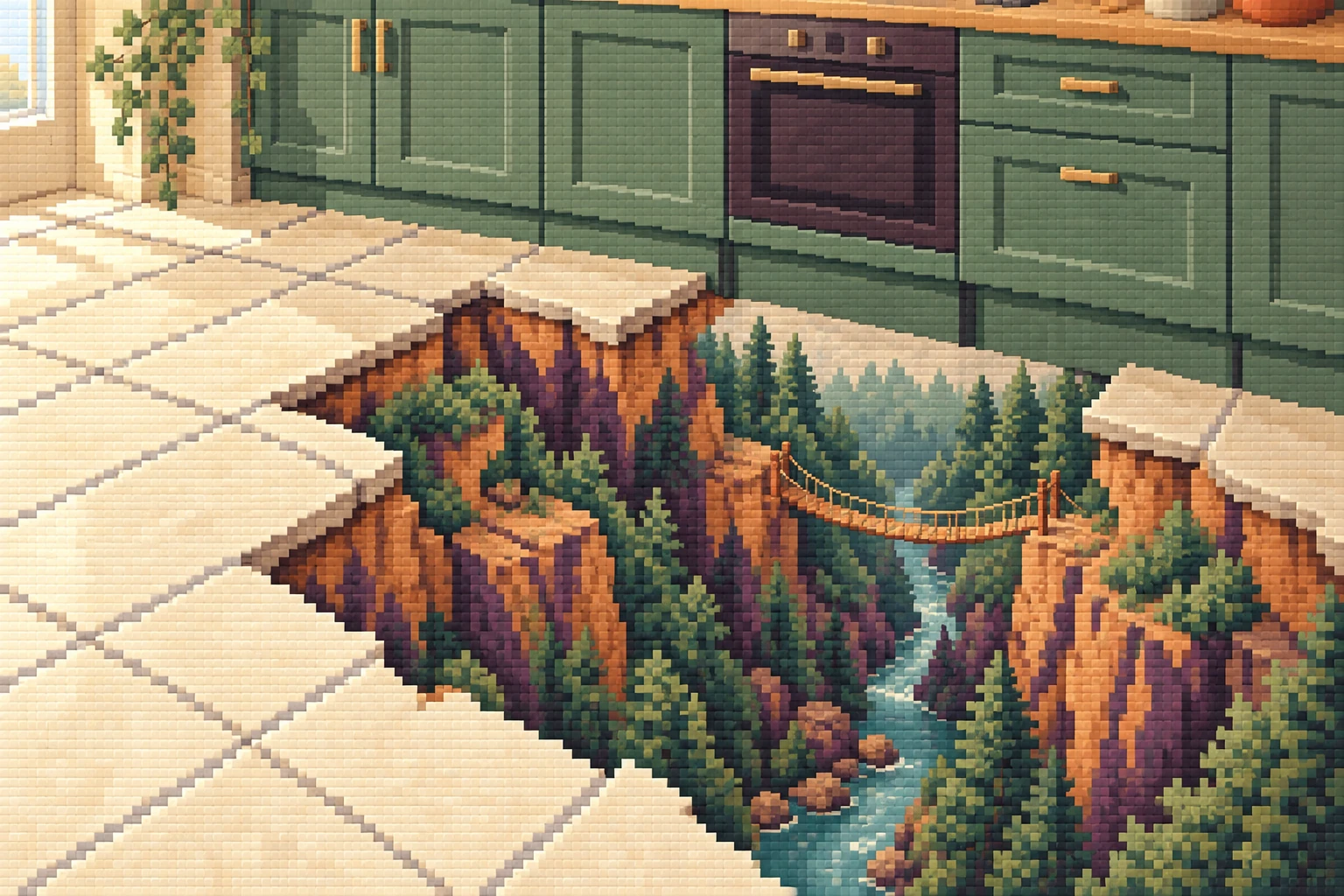
A miniature canyon and suspension bridge open beneath an ordinary kitchen floor. Deliberately stepped pixels and interwoven color clusters give the familiar interior an unexpected depth.
Remix this referenceA Canyon Beneath the Kitchen Tiles
- Form language
- Translate forms into interlocking pixel clusters, using broad block shapes and selective notches rather than tracing every small detail.
- Contour
- Keep deliberate low-resolution stair-step edges; vary the length of each step and use occasional broken outlines instead of uniform borders.
- Mark-making
- Cross short horizontal pixel runs with fewer vertical runs to suggest weaving; let run lengths and interruptions vary naturally.
- Surface rendering
- Interlace neighboring tones in loose over-under bands, alternating woven transitions with broad clustered fields rather than smooth airbrushed blending.
Priority
The woven pixel rhythm and deliberately stepped silhouettes must remain visible at normal viewing
What to avoid & what to check
Exact prompt for this example
MODULE OWNERSHIP
subject: Subject count, type, stable proportions and landmarks, resting face geometry, hair shape, physical materials, garment construction and permanent marks. No emotion, movement, color assignment or rendering recipe.
expression: Facial soft-tissue displacement and pupil direction, muscle coordination, regional intensity, asymmetry and onset/peak/release. No head/body pose, stable appearance, skin color or rendering.
gesture: Head/neck/body/limb orientation, joint movement, support, contact and pose-caused occlusion using existing anatomy. No eye/pupil movement, emotion, identity, props inventory or camera.
props: Prop count, type, construction, physical material and scale relative to the subject. Holding/contact belongs to gesture, position to composition, color to palette.
scene: Environment elements, terrain, backdrop/floor presence and structural detail. No canvas positions, camera, lighting, assigned colors or render texture.
camera: Projection, focal-length impression, camera elevation/yaw/roll, viewing distance and crop. No actor pose, world placement, lighting or canvas aspect ratio.
composition: Normalized 0-100% canvas positions, scale in frame, depth/overlap, focal hierarchy and margins. No joint pose, camera projection, rendering, subject/prop inventory or emotion.
palette: Color anchors, hue/saturation/value ranges, colors assigned to parts and approximate color coverage. No illumination direction, shading algorithm, physical material or layout.
lighting: Light-source direction/softness/intensity, ambient illumination, physical shadow direction/length and highlight position. Absence of directional illumination is allowed. No shading technique, palette or material changes.
style: Reusable form abstraction, contour weight/taper/edge quality, medium and mark scale/density/direction, surface rendering and tonal transition technique. No fixed subject proportions, anatomy, identity, expression, pose, palette, light-source direction, camera or layout.
output: Image count, aspect ratio, size, file/alpha requirements and global lettering/logo/watermark restrictions. No background scenery, crop, style, identity or pose.

SUBJECT
inventory: No human or animal subjects.
geometry: No character proportions or anatomical landmarks apply.
resting-face: No faces are present.
appearance: No character appearance or clothing applies.

PRIORITY


AVOID


CHECK


PROPS
inventory: No separate props.
construction: No prop construction applies.

PRIORITY


AVOID


CHECK


SCENE
inventory: A fitted kitchen with tiled flooring opens onto a miniature forested canyon containing a river and a tiny suspension footbridge.
structure: A missing strip of tiles exposes cliffs descending below the subfloor; intact tile lips overhang the gorge beside ordinary cabinet plinths.

PRIORITY


AVOID


CHECK


CAMERA
projection: Moderately wide rectilinear perspective with clear near-to-far recession.
viewpoint: Look obliquely downward from standing height, diagonally across the kitchen floor, with a level roll.
crop: Frame the floor opening and lower cabinet doors; let the nearest floor and upper cabinetry continue beyond the crop.

PRIORITY


AVOID


CHECK


COMPOSITION
placement: The canyon cuts diagonally across the lower frame; cabinets form a shallow upper band, with the bridge just right of center.
depth: The overhanging floor edge leads into the deep opening; the bridge is a secondary discovery above the river.
spacing: Leave a spacious patch of intact flooring beside the opening so the domestic scale remains legible.

PRIORITY


AVOID


CHECK


PALETTE
colors: Warm ivory, muted jade, deep aubergine, and restrained apricot form a compact, gently saturated palette.
assignment: Use ivory for tiles, jade for cabinets and forest, aubergine for the gorge depths, and apricot for exposed cliffs and bridge.
balance: Ivory and jade dominate; aubergine supplies the strongest value contrast, while apricot appears in smaller accents.

PRIORITY


AVOID


CHECK


LIGHTING
sources: Broad, soft daylight enters from the left, with gentle ambient illumination reaching into the canyon.
shadows: Soft shadows extend rightward from the tile lips; deeper recesses receive less light.
highlights: Keep highlights broad on left-facing tile edges, with a few small glints along the river.

PRIORITY


AVOID


CHECK


STYLE GUIDE
form-language: Translate forms into interlocking pixel clusters, using broad block shapes and selective notches rather than tracing every small detail.
contour: Keep deliberate low-resolution stair-step edges; vary the length of each step and use occasional broken outlines instead of uniform borders.
mark-making: Cross short horizontal pixel runs with fewer vertical runs to suggest weaving; let run lengths and interruptions vary naturally.
surface-rendering: Interlace neighboring tones in loose over-under bands, alternating woven transitions with broad clustered fields rather than smooth airbrushed blending.

PRIORITY
The woven pixel rhythm and deliberately stepped silhouettes must remain visible at normal viewing

AVOID


CHECK


OUTPUT
format: One finished image, landscape 3:2, 1536 × 1024 pixels, opaque PNG. No lettering, logos, or watermarks.
restrictions: One finished image, landscape 3:2, 1536 × 1024 pixels, opaque PNG. No lettering, logos, or watermarks.

PRIORITY


AVOID


CHECK


FINAL INTEGRATION
scene + composition + style: Let the woven abstraction preserve the relationship between the ordinary room and the miniature landscape so the scale reversal reads immediately.
Model information comes from image provenance. The same prompt may produce a different result.