Text to imagePortraitStyle guide
Adult with a Loose Bun · Far-Eye Occlusion
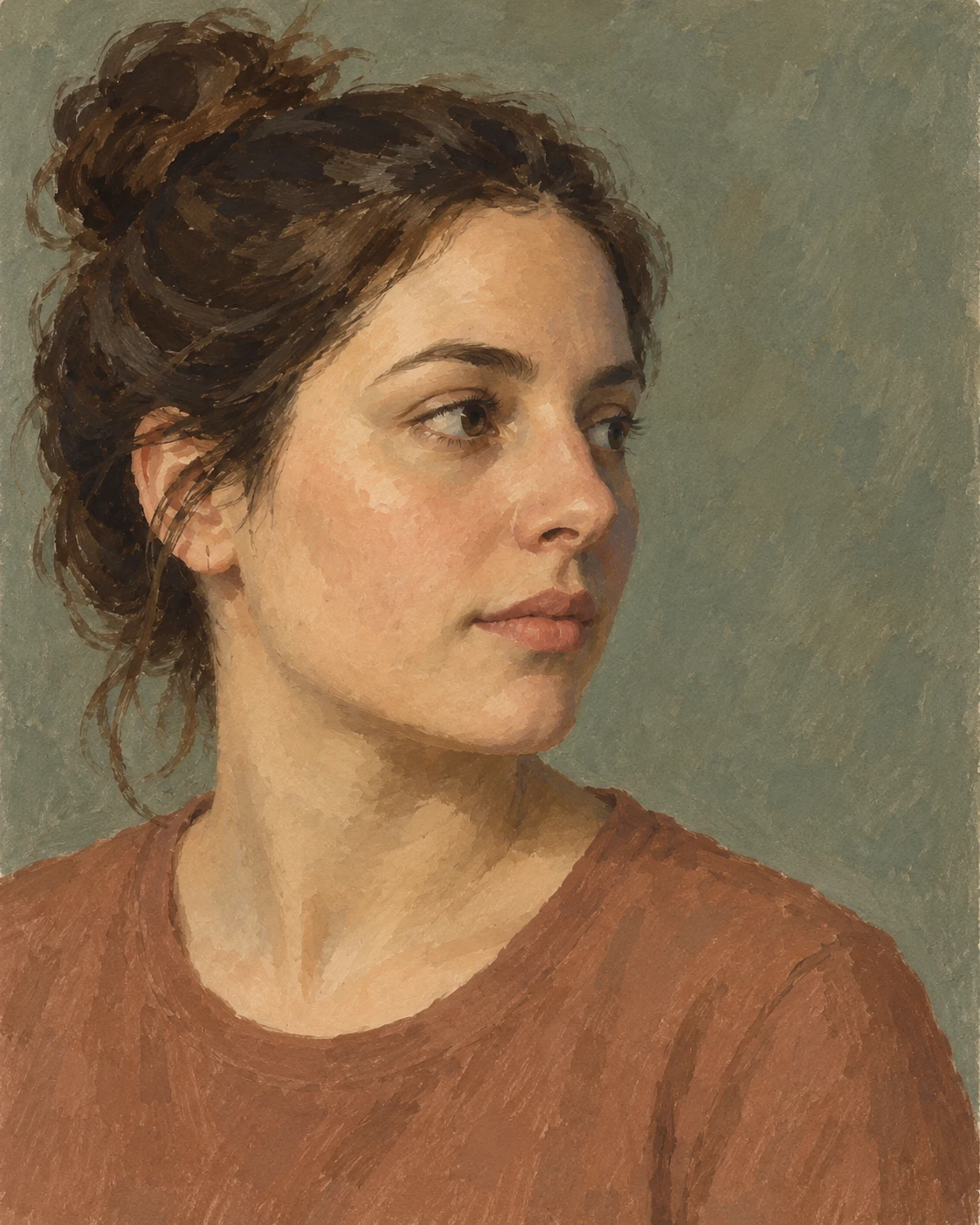
A portrait showing head rotation through the overlap of the nose and far eye as an adult turns toward image-right.
Adult with a Loose Bun · Far-Eye Occlusion
- Shape & line
- Build the turned face with a broad near cheek on image-left and a compressed far cheek on image-right. Let the nose bridge interrupt the inner contour of the far eye, leaving its outer corner and a narrow portion of the iris visible; draw the near eye as a complete lid-enclosed shape.
- Color & light
- Use soft light from upper image-left, placing warm pale tones on the forehead and near cheek and a muted cool shadow along the image-right side of the nose. Keep the visible far-eye fragment readable within that shadow without making it as bright as the near eye.
- Texture & material
- Apply matte gouache in broad, lightly broken strokes across the skin and shirt, allowing a little paper grain to show. Use smaller opaque strokes around the overlapping nose and far eyelid, and group the bun into a few dark masses with sparse curved strand marks.
- Composition
- Keep both eyes, the nose tip, and the full chin inside the crop, with the shoulders forming a quiet base. Set the face against an even gray-green background and leave more space in front of the nose on image-right so the turn and the eye overlap remain the focal relationship.
Priority
Prioritize the nose visibly occluding part of the far eye while preserving a readable eye fragment.
What to avoid & what to check
Avoid drawing two equally complete eyes or outlining the hidden eyelid through the nose.
Check that the image-left eye is fully visible and the image-right eye disappears naturally behind the nose bridge.
Exact prompt for this example
SUBJECT
One adult with a loose hair bun and a plain clay-colored shirt, turning their head toward image-right with a relaxed mouth and eyes looking in the direction of the turn. The nose bridge partially hides the far eye on image-right; the near eye on image-left remains fully visible.

COMPOSITION
A vertical head-and-shoulders portrait at eye level, with the head slightly left of center and open background space toward image-right. Use a pronounced three-quarter turn that preserves a small visible portion of the far eye.

STYLE GUIDE
1. Shape & line
Build the turned face with a broad near cheek on image-left and a compressed far cheek on image-right. Let the nose bridge interrupt the inner contour of the far eye, leaving its outer corner and a narrow portion of the iris visible; draw the near eye as a complete lid-enclosed shape.

2. Color & light
Use soft light from upper image-left, placing warm pale tones on the forehead and near cheek and a muted cool shadow along the image-right side of the nose. Keep the visible far-eye fragment readable within that shadow without making it as bright as the near eye.

3. Texture & material
Apply matte gouache in broad, lightly broken strokes across the skin and shirt, allowing a little paper grain to show. Use smaller opaque strokes around the overlapping nose and far eyelid, and group the bun into a few dark masses with sparse curved strand marks.

4. Composition
Keep both eyes, the nose tip, and the full chin inside the crop, with the shoulders forming a quiet base. Set the face against an even gray-green background and leave more space in front of the nose on image-right so the turn and the eye overlap remain the focal relationship.

PRIORITY
Preserve the requested identity, count, action, composition and output settings. Apply the style rules within those constraints; a style reference must not replace the subject or layout. Within the style: Prioritize the nose visibly occluding part of the far eye while preserving a readable eye fragment.

AVOID
Avoid drawing two equally complete eyes or outlining the hidden eyelid through the nose.

OUTPUT
One portrait illustration in a 4:5 aspect ratio, rendered in opaque gouache on lightly textured paper, with no lettering, captions, logos, or watermark.

SELF-CHECK
Check that the image-left eye is fully visible and the image-right eye disappears naturally behind the nose bridge.
Model information comes from image provenance. The same prompt may produce a different result.