Text to imageAnimationStyle guide
A Botanist Inside a Closing Flower
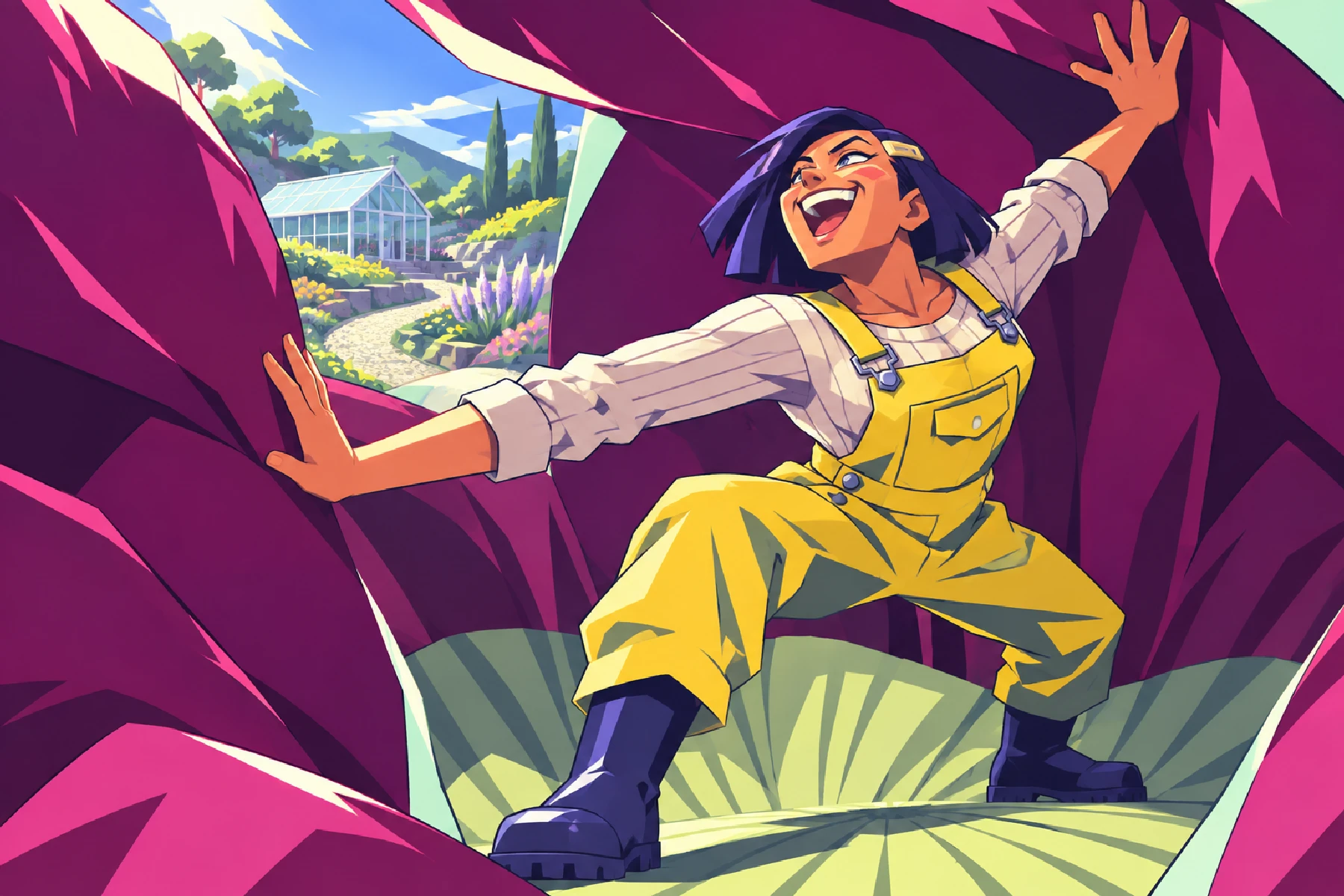
Inside an enormous flower, a botanist laughs while bracing its closing petals with both hands. Overlapping petals and a small greenhouse outside reveal the scale of her adventure.
Remix this referenceA Botanist Inside a Closing Flower
- Form language
- Abstract surfaces into wedges, triangles and angular facets; retain broad simple masses with selective sharp interruptions.
- Contour
- Contrast heavy exterior strokes with fine tapered passages; use short, sharp interior cuts instead of uniform outlining.
- Mark-making
- Use sparse angular chips and decisive pointed strokes; leave clean planes unmarked and allow natural variation in stroke length.
- Surface rendering
- Build volume from a few sharply separated tonal planes rather than gradients; vary facet shapes without making every surface equally busy.
Priority
Rendering medium: 2D angular Japanese anime graphic illustration; formal rendering reference: TRIGGER · 2010s · Promare (2019)
What to avoid & what to check
Exact prompt for this example
MODULE OWNERSHIP
subject: Subject count, type, stable proportions and landmarks, resting face geometry, hair shape, physical materials, garment construction and permanent marks. No emotion, movement, color assignment or rendering recipe.
expression: Facial soft-tissue displacement and pupil direction, muscle coordination, regional intensity, asymmetry and onset/peak/release. No head/body pose, stable appearance, skin color or rendering.
gesture: Head/neck/body/limb orientation, joint movement, support, contact and pose-caused occlusion using existing anatomy. No eye/pupil movement, emotion, identity, props inventory or camera.
props: Prop count, type, construction, physical material and scale relative to the subject. Holding/contact belongs to gesture, position to composition, color to palette.
scene: Environment elements, terrain, backdrop/floor presence and structural detail. No canvas positions, camera, lighting, assigned colors or render texture.
camera: Projection, focal-length impression, camera elevation/yaw/roll, viewing distance and crop. No actor pose, world placement, lighting or canvas aspect ratio.
composition: Normalized 0-100% canvas positions, scale in frame, depth/overlap, focal hierarchy and margins. No joint pose, camera projection, rendering, subject/prop inventory or emotion.
palette: Color anchors, hue/saturation/value ranges, colors assigned to parts and approximate color coverage. No illumination direction, shading algorithm, physical material or layout.
lighting: Light-source direction/softness/intensity, ambient illumination, physical shadow direction/length and highlight position. Absence of directional illumination is allowed. No shading technique, palette or material changes.
style: Reusable form abstraction, contour weight/taper/edge quality, medium and mark scale/density/direction, surface rendering and tonal transition technique. No fixed subject proportions, anatomy, identity, expression, pose, palette, light-source direction, camera or layout.
output: Image count, aspect ratio, size, file/alpha requirements and global lettering/logo/watermark restrictions. No background scenery, crop, style, identity or pose.

SUBJECT
inventory: A is one original adult human botanist; no other people are present.
geometry: A has a compact athletic build, broad hands and a rounded face with a prominent chin.
resting-face: Her resting features have low straight brows, almond-shaped eyes, a broad nose tip and a wide mouth.
appearance: Her hair forms a blunt bob with one clipped temple; canvas overalls cover a ribbed shirt and rubber ankle boots.

PRIORITY


AVOID


CHECK


EXPRESSION — ACTOR A
brows: Both brows lift, with the left slightly higher.
lids: Raised lower lids narrow the eyes without closing them.
cheeks: Both cheeks bunch upward, more strongly on the left.
nose: The nostrils widen slightly without wrinkling the bridge.
mouth: The mouth opens in a broad laugh, with the left corner pulled higher.
jaw: The jaw drops freely rather than clenching.
gaze: Both pupils point toward the opening between the petals.
coordination: Cheek lift, narrowed lids and the open mouth form one unguarded laugh.
timing: Capture the laugh at its peak, before the mouth starts to close.

PRIORITY


AVOID


CHECK


GESTURE
head: A lifts her chin toward the petal opening, with her neck clear of her shoulders.
torso: Her torso twists between opposing reaches, with her weight lowered into a broad stance.
limbs: One arm reaches high and the other sideways; both knees bend, with one foot farther forward.
contact: Her palms press opposing petals apart; both boot soles bear against the flower's broad inner base.

PRIORITY


AVOID


CHECK


PROPS
inventory: No separate props.
construction: No prop construction applies.

PRIORITY


AVOID


CHECK


SCENE
inventory: An enormous cup-shaped flower grows in a hillside botanical garden with a small greenhouse and gravel paths.
structure: Thick overlapping petals enclose a broad ribbed base; the greenhouse has a modest pitched roof.

PRIORITY


AVOID


CHECK


CAMERA
projection: Use a moderately wide perspective with a clear near-to-far size change.
viewpoint: Look slightly upward at a three-quarter yaw with a level horizon.
crop: Keep A's full figure visible while allowing the nearest petals to extend beyond the frame.

PRIORITY


AVOID


CHECK


COMPOSITION
placement: A occupies the right third; the petal opening crosses the upper-left area, framing the greenhouse roof beyond it.
depth: Foreground petals overlap A's outer silhouette while leaving her face and palms legible; the greenhouse stays small and distant.
spacing: Make the face and opposing hands the primary read, followed by the opening; preserve a generous gap around the face.

PRIORITY


AVOID


CHECK


PALETTE
colors: Anchor the image in saturated aubergine, acid yellow, pale mint and deep indigo, with warm ochre skin.
assignment: Give the petals aubergine faces and pale mint reverses, A yellow overalls, and her hair and boots indigo.
balance: Let aubergine dominate; keep yellow concentrated on A and use the pale garden hues as a quiet counterweight.

PRIORITY


AVOID


CHECK


LIGHTING
sources: Broad sunlight enters from upper left through the opening; soft ambient light reaches the flower's interior.
shadows: Overlapping petals cast broad shadows downward and right; contact shadows stay close beneath palms and boots.
highlights: Highlights gather on upper-left petal rims, the lifted cheek and the upper surfaces of the hands.

PRIORITY


AVOID


CHECK


STYLE GUIDE
form-language: Abstract surfaces into wedges, triangles and angular facets; retain broad simple masses with selective sharp interruptions.
contour: Contrast heavy exterior strokes with fine tapered passages; use short, sharp interior cuts instead of uniform outlining.
mark-making: Use sparse angular chips and decisive pointed strokes; leave clean planes unmarked and allow natural variation in stroke length.
surface-rendering: Build volume from a few sharply separated tonal planes rather than gradients; vary facet shapes without making every surface equally busy.

PRIORITY
Rendering medium: 2D angular Japanese anime graphic illustration; formal rendering reference: TRIGGER · 2010s · Promare (2019)

AVOID


CHECK


OUTPUT
format: Produce one opaque image at 1800 × 1200 pixels, landscape 3:2.
restrictions: Include no lettering, logos or watermarks.

PRIORITY


AVOID


CHECK


FINAL INTEGRATION
gesture + expression + composition: Let the performance and overlaps explain the predicament immediately while preserving readable facial acting.
lighting + style: Translate the physical illumination into the style's limited tonal divisions without losing the distinction between adjacent surfaces.
scene + camera + composition: Place the viewpoint inside the flower, coordinating camera orientation and layered composition into a coherent interior-to-garden sightline.
Art direction
트리거 / TRIGGER · 2010s · 프로메어(2019) / Promare (2019) ↗- Abstract form surfaces into wedges, triangles and angular facets
- Strong exterior weight contrast with short sharp interior cuts
- Small angular facets and sharp marks, with no marks in clean planes
- A small set of sharply separated tonal planes in place of gradients
Model information comes from image provenance. The same prompt may produce a different result.